


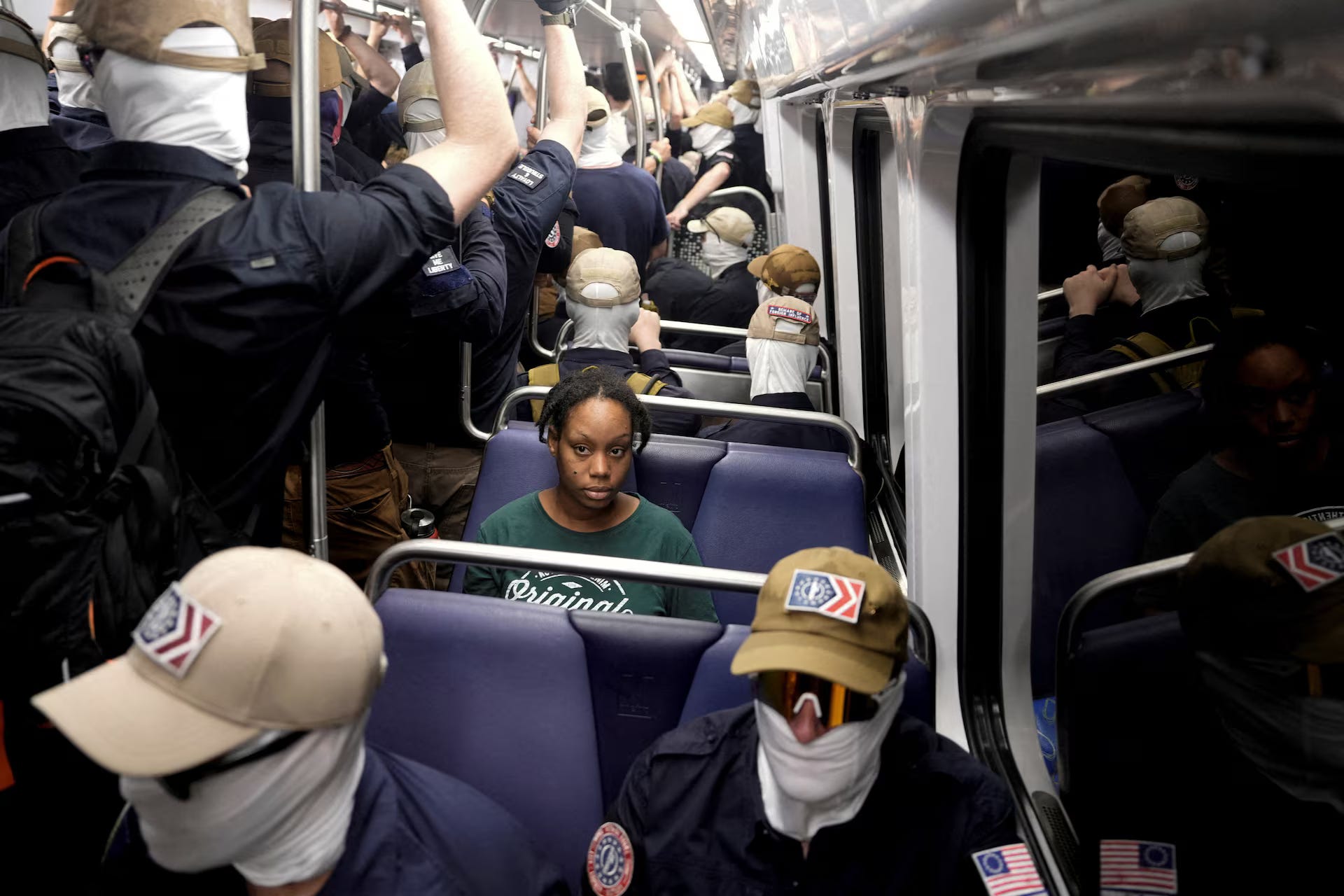
Is America great again yet? This image will be the defining image of this moment for future generations, just as the picture of Rosa Parks was a defining image of the Civil Rights Movement. Neither woman sought to define the society in which they lived; they were simply going about their day when history froze a moment in time as an indictment of the division our politics has created.
Is this now the face of America?
As an outside observer, I find myself asking how America can come back from this, but I dare say I would have been asking myself the same question in the era of the Civil Rights Movement, and yet right did prevail over wrong. Overcoming adversity is never easy, and overcoming the tyranny of Trump is no exception. As we draw ever closer to what should be a day of reckoning in November, we face what, for me, should be a simple choice. Not between right and left, but between right and wrong.
For decades, Republicans have excelled in creating an environment of perpetual fear in order to instil a constant state of anxiety. In some ways, one can’t help but admire how they have managed to create a parallel universe in which they are the party of fiscal responsibility and ‘small government’. It’s no mean achievement that they claim the former, even as one man is responsible for nearly 25% of the current national debt over just two presidential terms.
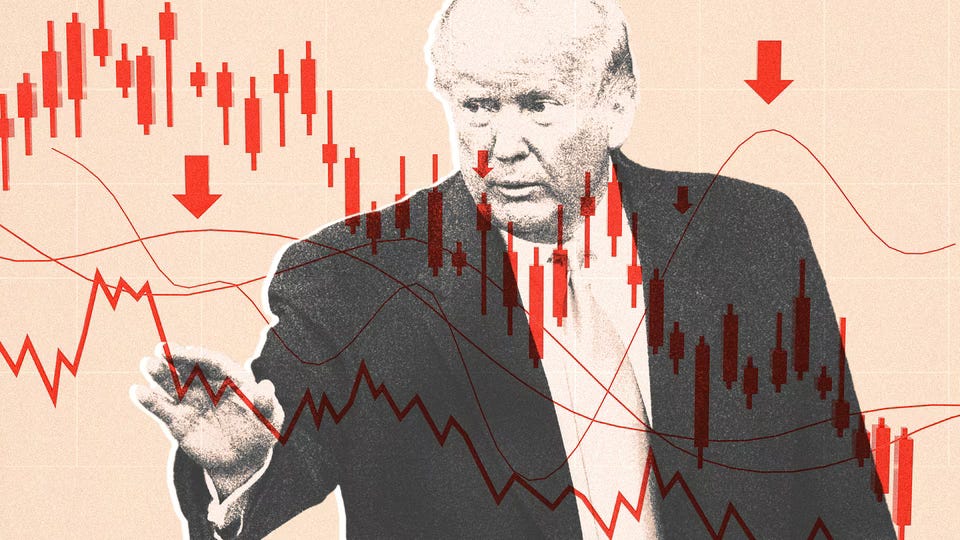
This is a party that spends like drunken sailors to provide tax cuts for the rich while in power, and at the same time accuses the Democrats of profligate spending when they are in opposition. This, my friends, is why NOBODY TRUSTS politicians. In recent weeks, I find I’m asking myself what it takes to break through the wall of the same old sensationalist headlines that tell Americans what they already know as if to reaffirm that they are ‘well informed’. I’m not going to lie: I find it immensely frustrating to watch not just a collapse of critical thinking and awareness, but a bizarre willingness to accept that a win in November from Democrats will make everything right again.
I don’t doubt that if Democrats take back the House in November and they seize the power of the subpoena, Trump will become a lame duck buried in corruption investigations as he should. What it won’t do is stop the never-ending deluge of executive action that will perpetuate the carefully crafted Heritage Foundation policy agenda that has effectively become a shadow legislative agenda. We have seen that while the courts do eventually catch up and strike down many of his executive actions, by the time they do, the damage has all too often already been done.
The big question is the makeup of the next Democratic caucus, because that will be the true litmus test for change. If all America gets for its votes is Republican lite, then what? For sure, there will be no sign of the transformative change required, and I fear it will just be more of the same politics that led 90 million Americans not to vote in 2024, which will certainly not bode well for 2028.
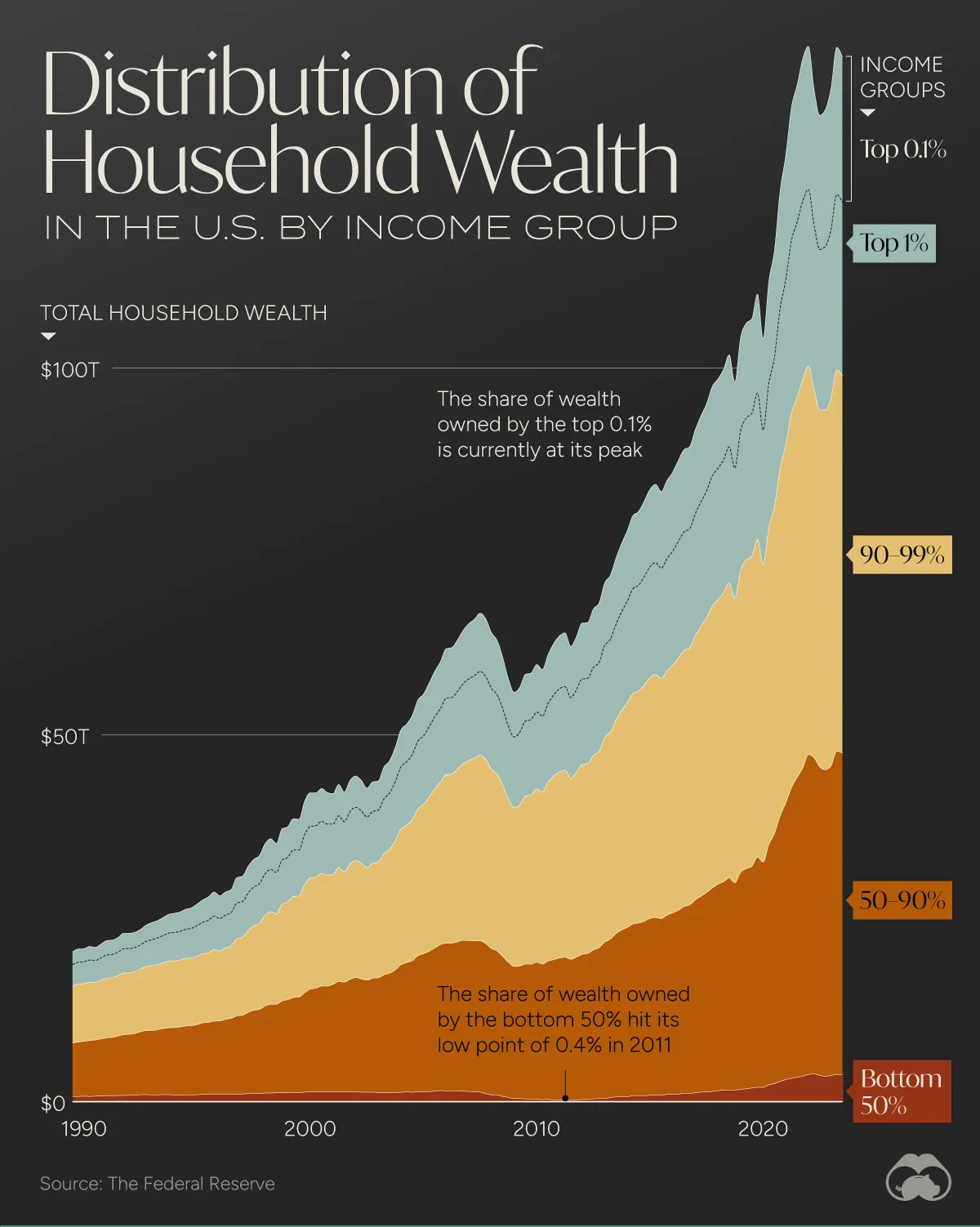
In this recent series of posts, I have spent a great deal of time examining the key impediment to true progress in America, the wealth gap. The prognosis is very simple: without narrowing the gap, the only people to benefit from growth and productivity will be the 30 million Americans who make up the top 10%, and that’s not hyperbole; it’s just a fact.
There has been much talk of a two-tier justice system, but that pales in comparison to America’s two-tier economy. Forget the upper-class, middle-class, and working-class; we now just have the have-nots and the have-yachts. The asset class and the underclass. Americans need to be clear-eyed about their place in Trump’s reimagined America. In a consumption-dominated economy, the top 10% account for 50% of consumption, financed by disposable income generated by an overinflated stock market. What happens if that market collapses?
The whole stock market is currently being propped up by a handful of tech giants that are cooking their books to maintain the same illusion that banks presented in 2007, before the housing market crashed. The same illusion that tech companies sold in 2000 before the dot-com bubble burst. It seems promises of untold wealth render us ignorant of the basic laws of economics. The distortion of the AI bubble is further complicated by the fact that AI is not just about the technology; it’s also about the infrastructure required to deliver it to the end user.
It’s this infrastructure that is muddying the waters when it comes to assessing the economy's performance beyond technology. It generates short term growth from the construction of data centres and the expansion of the power grid. If you combine the tech and the infrastructure construction, then you exclude their contribution to the US GDP, Professor Jason Furman said in 2025, "Investment in information processing equipment & software was 4% of GDP. But it was responsible for 92% of GDP growth in the first half of this year”. GDP, excluding these categories, grew at a 0.1% annual rate.
The bottom line is that almost the entire economy now rests on the shoulders of AI and the infrastructure required to deliver it. There is a whole separate issue with the social and environmental costs of supporting a technology the US has bet the house on. The assumption that the US will win the AI race has become a very contentious subject because the definition of what winning looks like is similar to what winning the Iran war looked like. The winner is not the one who drops the most bombs; it’s the one that has the winning strategy.

The US has always been about ‘the biggest and the best’. Nobody doubts that the US AI frontier models have the edge, just like the US has the biggest bombs. However, this doesn’t guarantee success. The Trump administration is working on the flawed assumption that it can use access to these frontier models as leverage. This was on full display when the administration prevented foreign nationals from accessing the latest Anthropic model. It was proof to allies and partners that the US could not be relied upon to provide access in the event of any dispute between them and the US. Europe is already on the path to removing reliance on US tech, as it removes browsers and the MS Office Suite from the European Parliament networks, a path also being followed by European governments, just as trade is being rewired around the world.
At the moment, there is a lag that is not yet showing up, as this gradual withdrawal of reliance is being implemented. The same is happening in the defence sector as procurement shifts from the US Military Industrial Complex to European arms manufacturers. These transitions don’t happen overnight, but they are occurring with increasing intensity as NATO and European allies adjust to the geopolitical shifts at the heart of which is the US. There is little doubt that the US is burning bridges on the flawed assumption that it is the centre of the universe, when it is simply a nation in decline.
Gone are the days when the US said “jump” and everyone asked, “How high?” It is difficult to articulate the level of reputational damage the US has suffered as a result of the Iran War and Trump’s catastrophic foreign policy agenda. He has once again made the stupid mistake of thinking that he’s outplayed Iran by opening the Strait of Hormuz long enough to get enough oil out to take the pressure off the global economy. It’s just another example of short-termism that will end in tears. He believes he can now start hitting targets in Iran with little to no consequences. Once again, he has learned absolutely nothing.
Returning to the economy, I have to tell you that anyone in the bottom 90% who believes that it will all turn out OK in the end needs to seek medical advice. I cannot begin to explain how fearful I am that the US is hurtling down the track to the most significant market correction in modern history. This is not me indulging in scare tactics or conspiracy theories; it’s an honest concern based on the fact that with almost $40 trillion of debt, this regime has gone all in on a technology that simply can’t deliver the level of profit required to rescue the economy in time, because the race is already lost.
I would urge you to watch the video below from Andrei Jikh. Andrew is one of the few investment advisors who has taken the time to look at the big picture regarding AI and the different approaches taken to AI between the US and China. To produce growth through improved productivity is about ‘horses for courses’. China has approached the deployment of AI in a totally different way from the US. They are focusing on societal integration, while the US is focused on profit through labour replacement.
While this clip does not focus on the integration element, which we will discuss in the next episode, it does focus on the fundamental differences in approach that make China the winner of this race: the cost of adoption. I’m pretty sure that Americans are soon going to see Chinese AI models banned in the US because that's the game the US always plays when it looks like it might get its ass kicked. It’s exactly the reason why Americans can’t buy BYD cars.
China is, as ever, playing the long game, making its AI models as cheap as chips to adopt and fully open-source. The US frontier models simply can’t compete. They might be better and faster, but they are not ten times better, as the cost reflects. OpenAI is now offering the US government a 5% stake in its business, not because it’s feeling benevolent, but because, without government intervention, it will run out of money. This means, of course, that YOU will be on the hook for what is a bailout in all but name.
Given that the EU is walking away from US tech, that’s one hell of a market that is opening up for the Chinese when it comes to AI. The level of strategic incompetence at play here is truly breathtaking. I just can’t see a way for a self-correction opportunity; arrogance is preventing that. Every aspect of the US AI strategy is built on a fantasy, and now the reality is starting to hit home. Buckle up, people, because the consequences of the administration’s incompetence are going to be catastrophic for the bottom 90%. As for the vulnerable and the working poor, I shudder to think what the consequences will be for them.
For those who want to support my work but can’t commit to a paid subscription, you can make a one-off donation by clicking on the image below. Help keep this independent reporting free for all.

I have not noticed any strategic vision in our leadership, and can only see hard times ahead.
If I was the little girl, I'd be terrified. Why face cover???!!!
Very very intimidating and terrifying.