


As we approach the end of another week of firsts, Trump has succeeded in keeping our minds off the fundamental issue of the decline in US economic and geopolitical power. As a European, I am witnessing it first-hand. America is now seen as an enemy of democracy and the progress made over the decades to bring stability to global trade. Trump is viewed not as a hard man, as he keeps insisting, but rather as the puppet of those who want to see the destruction of the global economic system.
No more does his stupidity shine brighter than in his birthday military parade planned for tomorrow. He’s a man obsessed with optics, enduring a crisis of confidence that requires him to show the world that he has numerous military toys and soldiers, signalling ‘Don’t mess with me.’ The truth is that in the modern world, a conventional army is overvalued, yet he’s throwing another $300 billion at an inefficient military dinosaur which can’t pass an audit
In reporting from Econofact, they state:
In November 2024, the Pentagon failed to pass its annual audit, meaning that it wasn’t able to fully account for how its $824 billion budget was used. This was the 7th failed audit in a row, since the Department of Defense became required to undergo yearly-audits in 2018.
If there is ever a candidate for fraud, waste, and abuse, the DOD is the poster child; yet, it has just received a further $300 billion despite having failed seven consecutive audits. It seems removing healthcare from up to 14 million Americans and nutritional assistance for the vulnerable takes priority. America has declared war on the poor and the vulnerable while spending like a drunken sailor on a military with no fiscal accountability.
If it’s one thing the Ukraine war has taught us, it’s that large conventional military forces are unable to do what they did in World War 2. You would have thought the US would have learned their lesson in Vietnam, Afghanistan and Iraq. If you are facing an insurgent enemy, it’s all but impossible to win using conventional forces. We are now living in an era where the tank is all but obsolete, and inexpensive drones are the new frontier.
Is America militarily weak? Absolutely not. It remains the best-equipped army in the world with phenomenal capabilities, but by its own admission, its focus has been slow to shift to technology-first capabilities. This is where the darling of the stock market, Palantir, comes in and where AI jumps the gap to make killing more efficient. The reason the US is laser-focused on AI is driven by necessity, as it is at the heart of future of warfare. In normal circumstances, US dominance would be a given, but this is no longer the case given China’s advances in the AI tech stack.
China has long had the measure of the US. Unlike their adversary, who are dominated by short-term thinking, China thinks decades ahead, so everything that’s happening on the economic landscape will have been gamed out by the Chinese. Are tariffs hurting China? You bet they are, but a state-controlled economy is much better placed to ride the storm. The Chinese trade deal is merely a revision back to the position before the chaos. As reported by CNN yesterday:
‘In reality, the trade truce – if that’s really what was accomplished this time around – is mostly just a return to the already-tense state of affairs from before April 2. Tariff rates from both countries remain historically high, and significant export restrictions remain in place. The United States has not opened its doors to China’s autos, nor is it going to sell its high-end AI chips anytime soon. And, in Trump’s parlance, China isn’t treating America much more “fairly” after this agreement than it did before.’
The result is that, despite all the turbulence and damage inflicted on consumers and small businesses, the US has made little progress. Meanwhile, China has been working behind the scenes to fill the soft power gap and promote itself on the global stage as a stable and reliable trading partner amongst America’s existing partners, who feel abused by the constant stream of threats from Trump.
No president in history has inflicted so much harm on both the US economy and its reputation around the world. This damage may take decades to recover from. The ‘ninety deals in ninety days’ was and remains a fantasy. When repeatedly challenged, Scott Bessent squirms and then throws out an unconvincing lie to demonstrate loyalty to his great leader. I spend most of my time listening to Bessent with my head in my hands, staring through my fingers as he twists himself like a pretzel to defend the indefensible with the nonsense claim that his whole economic plan is based on GDP, using the same 2017 assumptions that growth follows massive tax cuts for the rich. IT NEVER HAPPENS.
In a piece by Mike Maharrey of Money Metals Exchange, he states the age-old theory
Tax cuts “pay for themselves” and will ultimately lower deficits due to the fact that they incentivize work and investment, thus boosting productivity. While tax rates are lower, they are applied to higher levels of income, keeping total tax revenues steady and even increasing them over time. This theory was popularized in the 1980s by the Laffer Curve.
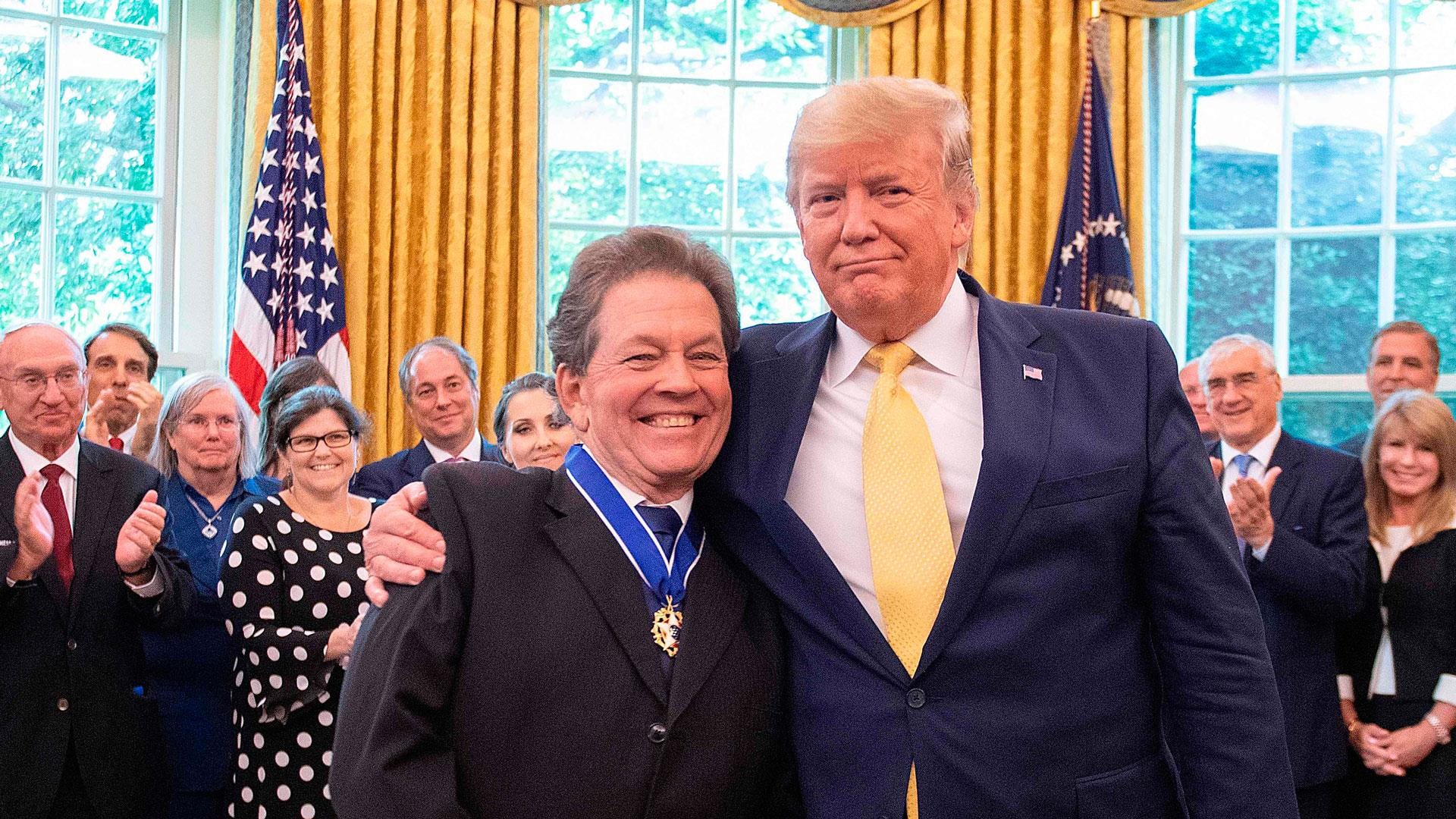
This is the Laffer Curve, which I believe should be called the ‘laughter curve’ because it’s a joke. As an aside, Arthur Laffer, who introduced it to Ronald Reagan on the back of a napkin, is currently under consideration to replace Jerome Powell as head of the Fed, Lord help us. Oh, did I mention Trump awarded Art the Congressional Medal of Honour in his last term? Anyway, I digress. Here’s the theory
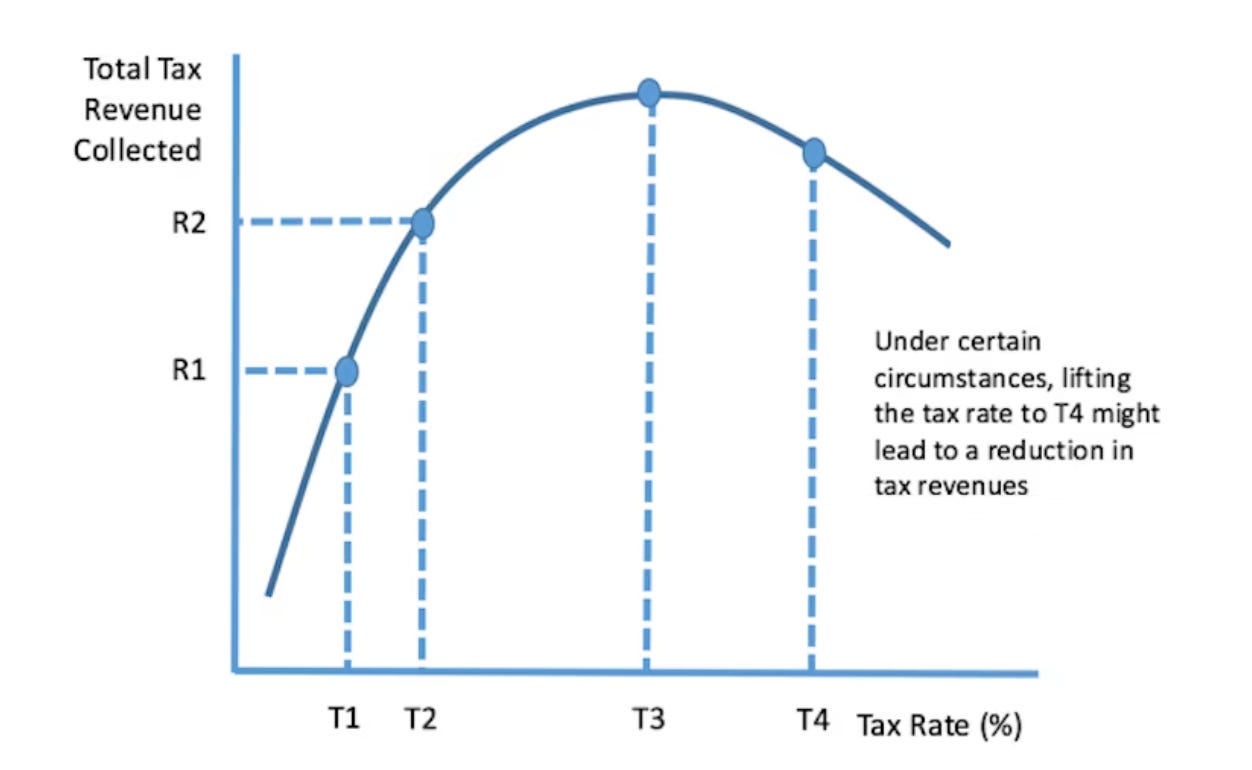
It suggests that there is an optimal tax rate, between 0% and 100%, that maximises tax revenue. Below that rate, tax revenue increases as tax rates increase, but above that rate, tax revenue decreases as tax rates increase
There have been three significant tax cuts since the 1980s
Reagan tax cuts in 1981 and 1986
Bush Tax cuts in 2001 and 2002
Trump tax cuts in 2016
Without exception, federal revenue as a percentage of GDP declined, and the tax cuts ultimately contributed to higher deficits. All big tax cuts for the rich achieve is that they make the rich richer and the poor poorer. It is a simple, proven fact, but we keep swallowing the snake oil.
The London School of Economics published a definitive debunking of this age-old example of voodoo economics. The paper is called The Economic Consequences of Major Tax Cuts for the Rich I have linked it so you can read the full paper, but the bottom line is this:
We find that major tax cuts for the rich push up income inequality, as measured by the top 1% share of pre-tax national income. The size of the effect is substantial: on average, each major tax cut results in a rise of 0.8 percentage points in top 1% share of pre-tax national income. The effect holds in both the short and medium term. Turning our attention to economic performance, we find no significant effects of major tax cuts for the rich. More specifically, the trajectories of real GDP per capita and the unemployment rate are unaffected by significant reductions in taxes on the rich in both the short and medium term.
I just thought it important to dispel the lie that Bessent and others are peddling about GDP growth. It is a fantasy. Even more so in the current economic climate, when nobody trusts America. Yesterday, Trump was at it again, trying to force Powell to reduce interest rates. I wouldn’t have Jerome Powell’s job for a gold pig, as we say here in the UK. The pressure is only going to increase as the refinancing of nearly $9 trillion of US debt looms ever closer.
CNBC reported yesterday that after describing Powell as a “numbskull”:
Trump claimed that lowering rates by two percentage points would save the U.S. $600 billion per year, “but we can’t get this guy to do it.”
“We’re going to spend $600 billion a year, $600 billion because of one numbskull that sits here [and says] ‘I don’t see enough reason to cut the rates now,’” Trump said.
The problem the whole world faces right now is that the lunatics are running the asylum, and nobody knows what the lunatics will do next. In the UK, when lunatic Truss(she of rotting lettuce fame) got the keys to the bank, the systems of checks and balances kicked in and her minsters jumped in to stop the madness, but not until after she caused the UK economy to lose £30 billion overnight and force the Bank of England to step in. Liz Truss did exactly what is proposed in Trump’s ‘Big Beautiful Bill’: dishing out significant, unfunded tax cuts to the rich on the assumption that growth will cover the cost. It didn’t, it doesn’t, and it never will. We are still living with the consequences today. Just so we are clear, she was receiving advice on policy from the likes of Steve Bannon at the time; she was, and remains, a Trump fangirl. One other point I would make is that Art Laffer of ‘Laffer Curve’ infamy praised what Truss did, as the economy went up in flames, and mortgages skyrocketed.
My friends, I try hard to break things down in an attempt to make the complicated easy to understand. Still, it becomes increasingly difficult as I begin to unravel a nest of vipers who would sell their grandchildren for a profit. Recently, Jerome Powell has been purchasing treasuries in the dead of night to mask the cracks of a serious threat to the US economy. At the same time, Trump is spending $43 million on a military parade that will do nothing to enhance the US's global reputation.
Take a listen to this important piece by Professor Richard Murphy, Emeritus Professor at the Sheffield University Management School, co-founder of the Tax Justice Network, the Fair Tax Mark, and Finance for the Future. I appreciate Richard’s clear and concise clips on taxation and global economics. I hope you find this as useful as I did. A default on US debt is not beyond the realms of possibility right now, and the fallout from such an event would be cataclysmic. It’s like we are in a slow-motion car crash, and we have no control over the outcome.
THE TRUE THREAT
What I’ve been attempting to do with my recent posts is to try and look beyond the red meat Trump throws out, not just to fire up his base, but to elicit outrage from liberal voices, to focus on what is being revealed to be a truly dystopian vision. Those pulling the strings of Trump are making plans not just for America, but for the world, which is why technology is at the very heart of their mission for global dominance. I firmly believe that in a weird twist of irony, China has unwittingly become what stands between us and their vision.
They can’t control China, and they are uncertain about just how powerful the Chinese military is. As a result, global plans are currently in a holding pattern as Trump probes for weaknesses in the worldwide trading system. Their primary focus right now is on total domestic control while further assessing the Chinese threat. Everything Trump has done in the first 140 days has been about stress-testing the the system and disrupting federal agencies that stand in the way of his ambition for absolute power. If he manages to nullify the judiciary, the game is over, I’m afraid, because those driving the bus have much bigger plans than we have seen to date.
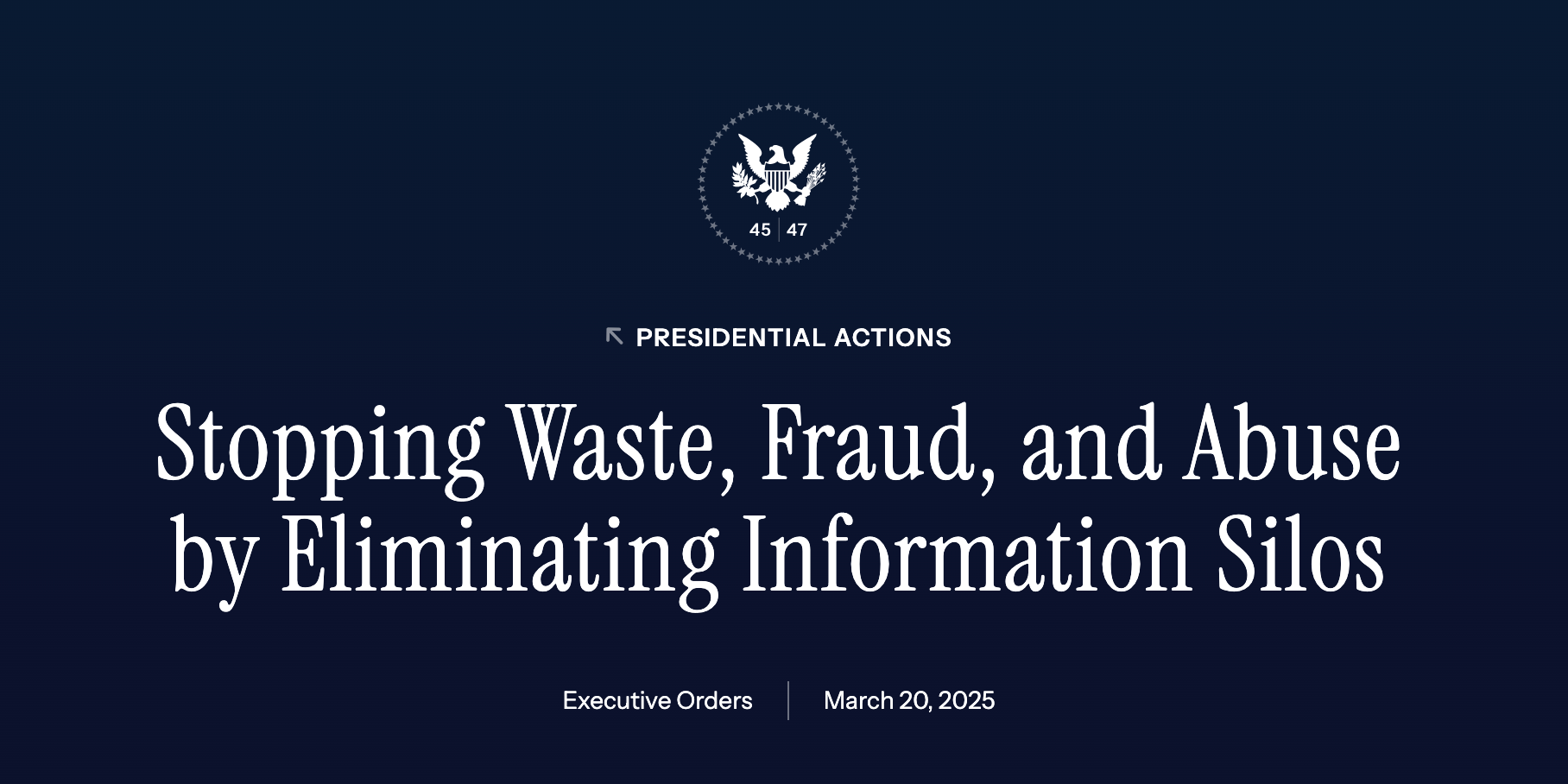
What can seems like frivolous executive orders hide within them Trojan horses that can be called upon downstream, and key among them is "Stopping Waste, Fraud, and Abuse by Eliminating Information Silos," signed on March 20th. I’m fairly certain that this will prove to be the most consequential orders Trump has signed to date.
It is painted as an innocent attempt to integrate datasets held across government to facilitate better management of information. As a data analyst myself, I see that if used correctly, it could unquestionably improve data sharing across the government. On the face of it, that’s a positive move, but it presents a significant ethical challenge when it comes to how that data is aggregated for use. Given the high level of mistrust in the current administration, I, for one, can see significant opportunities for abuse when it comes to using a centralised data set for political purposes, especially for elections.

The fact that new contracts have been awarded to Palantir raises a massive red flag, and every American should be deeply concerned about the potential of Palantir’s involvement in analysing this data. To be clear, Palantir is the world leader in its field of data analysis; this is evident from the contracts it holds with governments and intelligence agencies worldwide. Forbes reports that Palantir's software was used to analyse intelligence reports, surveillance data, and courier network information, ultimately helping to pinpoint bin Laden's location in Abbottabad. Its clients include the CIA, FBI and NSA, and Homeland Security has also used the software for the detection and removal of undocumented immigrants.
We are living through a technology revolution in which ultimate power lies in big data, and there is absolutely no doubt that Palantir is on the cutting edge of what I believe could be a dystopian political revolution many will never see coming.
In tomorrow’s post, I’ll be taking a deep dive into the source of my concerns and how the same names appear time and again, illustrating how, for decades, the alliance between the hard right and the techno oligarchs has evolved to meet this moment. I have also created a short film to walk you through my assessment visually. I think you know me well enough to know I’m not a conspiracy theorist. I’m a pragmatist who knows and understands data and what is possible in this new technology age.
I don’t believe Trump was joking when he said, “In four years, you don’t have to vote again. We’ll have it fixed so good, you’re not gonna have to vote.” and neither should you. It’s time for people to be fully aware of the threat America is facing.
I really really appreciate your commentary and information.(I just wish I could believe it’s not true.)
It’s becoming painfully clear - or at least worth looking at-that the effort to tear down the post WWII alliances, norms and foundations has been in the works for a really long time. I’m recalling various parts of Bill Bryson’s “A Short History of Nearly Everything”, and the chapters on the post-war private sector policy shift to promoting consumerism in everything- land, water, natural resources etc., all in the name of profit over everything. That has infiltrated every aspect in ways many haven’t understood or thought about. We have a long road ahead to a very different future.
Our voices will most likely barely put a dent in it unless we are as single minded as they are and as unafraid as they are, and as united as they are, but can we be?