


As we end another week, and you think things can’t get any worse, they do. As I’ve said on many occasions, it’s difficult to keep pace with all the moving parts, and we face a number of converging threats that, I have to admit, are keeping me awake at night. I’m mindful that in order to navigate through challenging events, we need something to focus on that provides hope that all the pain and persistent anxiety we are being forced to endure is not for nothing. I have to concede, it’s becoming increasingly difficult to locate light in the darkness, even though it’s not yet extinguished.
I have always been, and remain, a glass-half-full sort of guy, but what makes things more difficult now is that Trump’s madness has escaped the lab; the cancer that has consumed the US has well and truly metastasised onto the global stage and poses an existential threat to geopolitical stability. At a cost to the entire world economy, Trump is being forced to come to terms with the truth that military power has its limitations and that military air power is just one small part of imposing one's will on an enemy.
I hope this final piece in this three-part series serves as a splash of cold water, waking people up to the truth about what we face. Trump is out of his depth, and despite having the most powerful military on the planet at his disposal, he’s being forced to face the realisation that he has grossly miscalculated his chances of achieving a quick victory. He entered into an unnecessary war of choice that is now not only threatening his presidency and the future of the Republican Party, but has also delivered dangerous regional instability that has the potential to spread much further.
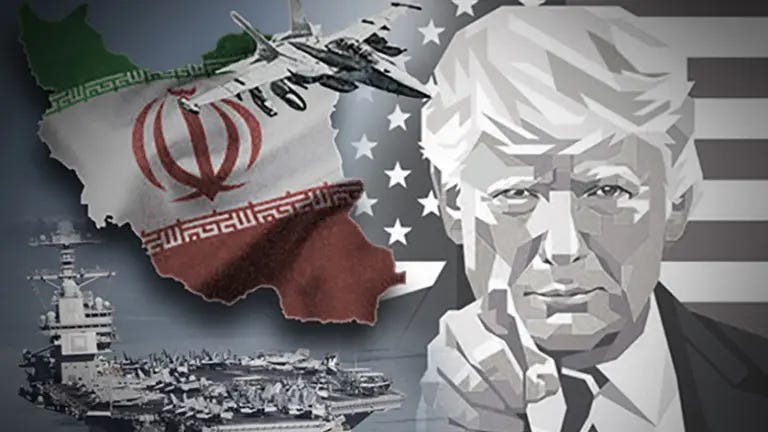
No military has EVER been able to win a war from the air. Add that the US has not won a single major conflict it has instigated in the last 75 years, and you have to wonder: are they paying attention? Time and again, it has entered wars on the arrogant assumption that power and money always win, only to find the opposite to be true. $2 tillion and the lessons of over half a century of failed military excursions have proved that repeating the same mistakes over and over, expecting a different outcome, is indeed the definition of insanity. Having said that, it has made arms manufacturers great again.
This failed war is no exception when it comes to meeting a meaningful objective; it will just result in another ‘Failed’ plaque being awarded on the side wall at the entrance to the Pentagon. If the US military were a 3-star Michelin restaurant after WW II, it’s now become the best-equipped, overpriced burger joint in the world, where food waste is its speciality, all while 37 million of the population live in poverty. Fear not, though, Trump proposes to spend another $200 billion on the joint, because there’s nothing better than a makeover to paper over the failings of his imbecilic foreign policy agenda.
At some point, there has to be an awakening to the reality of just what Trump has done. While we all focus on the war and gas prices, the US economy is slowly crumbling, held together by 7 companies and the consumer spending of the top 10%. The latest economic numbers show that the annualised GDP growth figure for the last quarter of 2025 was revised down to 0.7%. Consumer spending dropped by 2% as spending on both goods and services slowed. Meanwhile, exports declined at a faster pace of 3.3% from 0.9%, marking the largest drop since the third quarter of 2023.
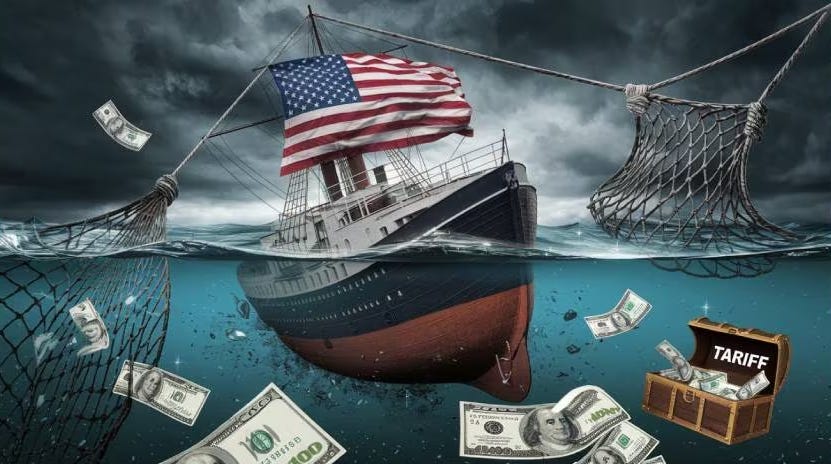
Before the Iran conflict, the global economy was already fragile due to Trump’s tariff policy. We are now moving into uncharted territory. The economic models are not built to predict the perfect economic storm; they aren’t designed to alert to the threat of multiple simultaneous structural failure points. In September 2022, as a result of UK Prime Minister Liz Truss’ mini-budget, which attempted to adopt a similar economic policy agenda to Trump's, with unfunded tax cuts and banking deregulation, etc., the UK gilt market came within hours of collapse. This was not because of any specific economic catastrophe, but rather because UK pension funds had built leveraged derivative positions through liability-driven investment strategies that nobody outside the industry understood.
It would take a whole other post to explain how this came to pass, which I’m happy to do if it would help. For those who understand leveraged positions and liability-driven investments, you can look at the breakdown by Ketan B. Patel and Santiago I. Sordo Palacios in the Federal Reserve Bank of Chicago's Chicago Fed Letter No. 480 (June 2023), which provides a detailed analysis of the factors that led to the crisis.
For those who take a look at the report and don’t understand a word of it, in short, financial instruments that few understood, just as in 2008 with credit default swaps, were created to bet on markets with nonexistent money, using debt for market speculation, in search of higher returns. This was done to try to cover a shortfall in underfunded pension liabilities. The problem with this strategy is that it becomes very vulnerable to dramatic shifts in the cost of selling sovereign debt. As a result of Truss’s budget, the gilt yields exploded overnight, and the Bank of England had no choice but to step in to buy £19.3 billion of UK debt to prevent the collapse of pension schemes.
In 2023, the failures of Silicon Valley Bank led to a deposit run that spread to regional banks across America. What happened was that as these deposits fled banks, they found a home in money market funds, which then invested in reverse repo facilities at the Federal Reserve. To understand reverse repo, take a read of this explanation in Investopedia. In short, fiscal crises always lead to money searching for a new profit vehicle. The key takeaway is that this was an example of liquidity shifting in a way that regulators had not modelled and could not control in real time. The important thing to understand is that these were not outlier events. They were symptoms of a much bigger problem that has remained unsolved and lurking in the shadows.
Global leverage in the non-bank sector has continued to grow, as has unregulated private credit. In some instances, at a 50:1 leverage ratio, the current estimated value of that leverage exceeds $1.2 trillion. We are living in a Monopoly money fantasy that is, in effect, a global economic IED. If a volatility shock of serious magnitude causes these leveraged positions to unwind simultaneously, the pressure on the Fed would be off the charts, with catastrophic consequences, and there is no regulatory early warning system in place. You have to remember that the maturity of US debt has shortened as the government scrambles to sell more and more of it in a climate where the US is being forced to refinance trillions of dollars in debt every quarter. This, at the same time, as foreign buyers of US debt are retreating and indeed ditching US bonds.
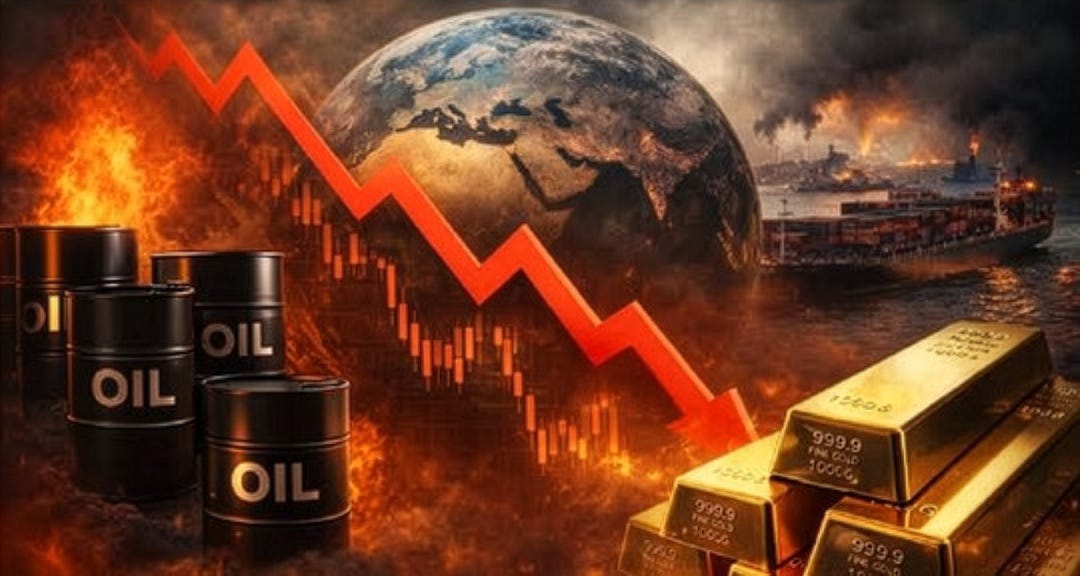
The point I’m trying to make here is that the Iran War provides the perfect permissive environment for a violent economic shock that could cause the dominoes to fall. This is where the sovereign debt trap meets the shadow liquidity crisis in the US Treasury market, the alleged safest, most liquid market on the planet. This speaks to currency bifurcation as the traditional economic shock absorber, global dollar demand, is slowly being eroded from the outside. If you combine the sovereign debt trap with the shadow liquidity crisis and shrinking demand for the dollar, we move into economic extinction-event territory.
What you have to remember here is that Trump has chosen a path of economic predatory behaviour. He is using extortion and racketeering linked to military might to further a strategy to achieve global economic dominance. Given the amount of US debt the US is chained to, this is an audacious play which, in my opinion, sees him grossly overplaying his hand. As a result of this very high-risk strategy, he has now painted the US into a corner, making it a pariah state on the world stage. He is no longer feared by allies; he’s tolerated, as they scramble to insulate themselves from what they see as his geopolitical lunacy.
The constant threats, lack of moral integrity, and obsession with self-enrichment have led to him being regarded as a global threat. His inability to recognise mistakes and instigate a course correction is seen as an existential security threat. While Trump is playing ‘Bobby Big Bollocks’ surrounded by sycophants, behind the scenes, middle-power nations and the EU are quietly modelling a new world order, led by Mark Carney and other competent leaders, in which dependence on the US will no longer be part of the equation.
Trump is in many ways causing the US to commit geopolitical suicide. His arrogant assumption that he needs nobody has proved glaringly false as a result of his illegal war in Iran. He began the weekend saying he’s won the war, while Iran continues to rain down missiles and drones on Israel, US bases and Gulf State energy infrastructure. His bizarre assertion that the war is won, and it’s up to the rest of the world to deal with the Straight of Hormuz, is a clear demonstration, if ever it were needed, that he’s completely lost his mind.
His latest proclamation is that if Iran does not open the Straight of Hormuz to shipping, he will destroy Iran's power infrastructure. It’s almost as if he has Putin as his new Secretary of War. Aside from this being a war crime, which will have a dramatic impact on the civilian population, what does he hope to achieve except global condemnation? He now finds himself oscillating from one failed strategic move to another, as each day, stocks of interceptor missiles are depleted, all while the Iranian leadership remain able to attack targets at will.
Any American legislator or surrogate supporting Trump’s actions in Iran needs to take a long, hard look in the mirror, because they are potentially looking at becoming complicit not just in war crimes, but in the potential obliteration of the US economy. I can’t, in all good conscience, sit here and tell anyone it’s going to be OK because this type of self-harm will, in my view, take at least a generation to recover from. There is no sugar coating this pill, I’m afraid.
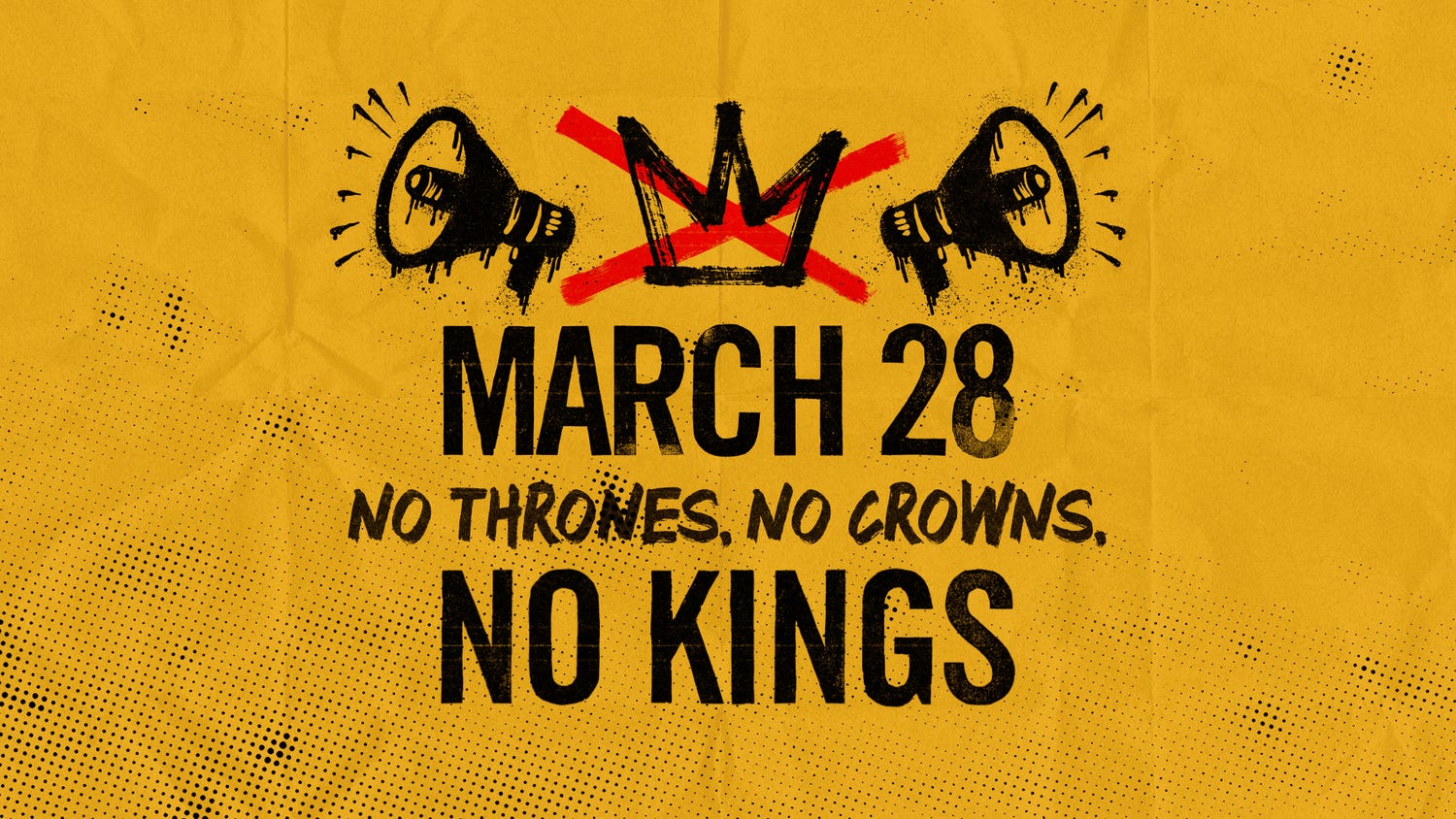
Next week, on March 28th, millions of Americans will take to the streets for the next No Kings Day event. It will certainly be interesting to see how many people attend the event across the country. Do I support it? Absolutely, I do. I think it’s essential for like-minded Americans to gather together and have their voices heard. There’s nothing like feeling part of a solidarity movement up close and personal. It will help the broader population see the strength of dissent and, from a psychological perspective, prove to be a vital motivator as we approach the midterm elections.
It will, unfortunately, have little impact on the regime, which will simply paint it as a bunch of paid radical left activists who are traitors to their country. This is irrelevant in big picture terms because the aim of the event should simply be to deliver a LOUD apolitical message that the event is about ‘We the people’ against a tyrannical regime supported by the wealthy elite. It MUST focus on reaching the 90 million Americans who did not vote in 2024, engaging them and encouraging them to join this fight against theocratic autocracy. While I accept it will be political at heart, given the organisers, it should encourage participation across the political spectrum.
I’ll conclude today by reiterating that America faces the dangerous trinity of the sovereign debt trap, a shadow liquidity crisis, and shrinking demand for the dollar. This is a ticking bomb hiding inside the US economy. If it blows, a catastrophic global recession will follow, and that should terrify us all. To be clear, I am NOT saying this is imminent, no more than was the nuclear threat to the US from Iran, but I have to admit to being deeply concerned by the risk.
Once again I see the phrase "the most powerful military on the planet." I beg to differ. Martin is correct in saying that despite the sacrifice of line officers, men, and women, the U. S. has not won a war since 1945. Complicated, hugely expensive machines are no match for dedicated guerrilla armies, suicide bombers, and assymetric arms like drones. The AF can flatten great swaths of land (see Gaza), but the humans who survive emerge, mostly, radicalized at best. One can argue that the only thing war begets is more war, not to mention misery and generational animosity. History proves that humans never learn the lessons of armed conflict.
His Royal Heinous, Donald the Barbarian, King of the Rednecks, the Hateful, the Ignorant, the Greedy, the Oblivious.