


As is no secret, the written word is something I am passionate about. As well as writing here, I am an avid consumer of the writing of others. I am blessed to have a relatively large reader base, and I want to start a journey to give back by helping promote the work of other writers whose work has spoken to me and the values I hold dear.
To be very clear, there is no intention to profit from this exercise. If the writers I feature resonate with you, too, and you want to support their work, the pieces are linked at the top of the essay, and I am sure they will be grateful for your support. I am more than aware that people’s inboxes are often filled with regular content that can be difficult to filter and curate even on a good day, so there is no intention to fill people’s inboxes with endless emails, as I know how irritating that would be. My simple aim is, on a couple of occasions each month, bring a piece that has stood out or spoken to me to my own audience.
I am very interested in receiving your feedback on the idea, which marks the beginning of a further expansion of my footprint across the social media landscape in what promises to be the most consequential year in American history.
Today, I feature the voice of Annalinda Stewart in a piece called Narrative of an American Girl.(This is the link in case you want to subscribe to her work)
The writer was born and raised in Los Angeles County and is the child of first-generation immigrants. She holds degrees in Government and Political Science from American University and Johns Hopkins. She has lived and worked in four countries, enjoyed a career on Capitol Hill and formerly served in positions with the U.S. Departments of State, Justice, and Homeland Security. She also had the privilege of being a stay-at-home mom for many years to two young girls. She and her husband have almost fifty years of combined federal service.
The First
I didn’t know my father’s parents. They died long before I was born. Grandpa was a shipwright for Harland and Wolff. Grandma was a housewife who sometimes took shifts in a tobacco factory. Some nights, he didn’t get home from the Yard to Spamount Street. It was just safer to sleep there. Same for her. Street riots would keep her at the factory. For their son, William, the end of his day meant looking out the window at school. Plumes of smoke would tell him which way not to walk home. When a stray bullet came through that window and hit his best friend, he watched him bleed out on the floor and die. William walked home for the first time that afternoon alone. He was eight.
The next day Grandma said, ‘we’re leaving.’ I don’t think Grandpa argued. He went first. He entered Canada legally - the United States, we don’t know. He took a chance on Ohio and sent for his family. Grandma, tiny woman that she was, got on a ship with William, her two-year-old daughter, and her infant son, my dad. Without her husband by her side, she bore the brunt – the looks, slurs, the ‘just go home’ - but she made it, and she stayed. My dad became a son of Cleveland. House on Easton Avenue. Third baseman, East Tech High. Alum Jesse Owens was often there to cheer him on at track.
He didn’t naturalize until Pearl Harbor. He went down to the U.S. District Court, took his citizenship oath, and at eighteen became an American and a soldier. By twenty he was a combat veteran, at twenty-six a Case Western physicist, at thirty a patent holding scientist recruited by the burgeoning Xerox Corp. in Los Angeles, and at forty-eight, finally, a father. I was born there, in California. He took me home from Glendale Adventist on Wilson and walked the floor with me many a long, long night. He said I was the best thing he ever invented.
He took me hiking and camping, to baseball games and ballet. Every year on his birthday we’d go get the family Christmas tree, just the two of us. Then he’d teach me how to string the lights while we watched the Browns game on TV. He’d explain to me what pass interference was and what it wasn’t. He’d explain the current in the lights. He’d hum verses of Verdi and I’d hum along, just wanting to be near him. He was a brilliant man, and I loved him very much.
He and my mom were polar opposites. He was deeply conservative. She was a Los Angeles County social worker who’d taken a Freedom Ride in 1962. Arcadia High School. Waitress on the weekends. So unbelievably pretty she could giggle at her classmates vying for a place on the Rose Queen float. She wanted a place as a trainer at Santa Anita Racetrack. But girls couldn’t do that back then. She went to college instead.
Summers she would take my brother and me on road trips. By the time I was fifteen, I had been to all the lower forty-eight. On purpose. In every single one she showed us something particular. We didn’t go to much you’d ever heard of. We went to county fairs and ate in diners and took long walks through neighborhoods. She’d send my brother into African American barber shops for a haircut. She’d have me check out at the grocery store so I had to talk to the clerk. When the car broke down in Big Spring, Texas I sat on the shop counter, swinging my little legs, chatting with the elderly mechanic. He shared his soda with me, I asked him where the big spring was, he pointed to the California plates and asked me if I knew any movie stars. We made each other laugh.
I was very enamored of Florida. I hadn’t known the ocean could be warm. When we camped in Michigan I got confused because everything was damp – my sleeping bag, my Hello Kitty doll, the car doors, the toilet paper. ‘It’s called humidity,’ Mom said. In Natchez, Mississippi we listened to a very nice lady in an antebellum dress, in an old historic house, tell us about life pre-civil war. The door to the garden was open and I could smell magnolias. In White Sands, New Mexico, we didn’t bother putting up the tent to sleep in. Growing up in Los Angeles I had never really seen stars. Not like that. In Montana, I washed dishes alone at a camp faucet and watched the sun set over Bighorn Canyon. Core memory. Still my favorite state, hands down.
I could say something about all of them though. My mother thought it important that I know all of them. That I at least try to understand every corner. Meet people from every corner. Listen to people from every corner. It’s the greatest gift she gave me. ‘I want you to know them,’ she would say. ‘Help them. If you don’t ever do anything else, contribute to their Pursuit of Happiness.’
By sixteen, I was working on political campaigns. Mom would drop me off in Watts with an armful of sample ballots, and I’d go door to door, blonde teenager from the Valley. Did I feel unsafe? Not once. Dad was thrilled though. I skipped prom because it was the Saturday before the primary and there were things to do. I told the guy who kept asking me to go with him to please understand. I don’t think he did.
I thought I was a perfectly normal teenager, and I was in many ways. I went to our school football games. I had a terrible crush on the senior DB, but my brother wouldn’t let him near me. I followed the Angels religiously. I waited in line for tickets to see Depeche Mode at the Rose Bowl. I hated math. I served beer to golfers at a country club - not super legal but tips were shared so of course the bartender would send me. Running through all those ordinary days though were two constants. My father’s immigrant example and my mother’s sense of purpose. Their sum was a child of odd but exceptional focus, with a singular ambition – contribute.
I left Los Angeles for college and have since worn that contributive path deep. I married a contributor too. Between the two of us we’ve given decades of our lives in service to our country. I won’t say specifically what we do, but he’s long focused on protecting the ‘Life.’ I’ve shored up the ‘Liberty and Pursuit of Happiness’ that my mother always invoked. We’ve moved our young family to serve abroad, and back. We’ve lost millions in earning potential. Tiny house. In-laws weighing in on our fields of expertise while we smile and nod. ‘We respect you so much for what you do,’ they say, then vote not accordingly. It’s frustrating yes, but worth it for the chance to serve. There’s nothing like it. I listen to them and interpose the face of the mechanic who shared his soda with me, or the lady in the antebellum dress, and I remember why I do it.
But there’s this one thing that happened. I became a mom.
The Second
My choices, my limitless drive to serve, to move us toward that ever More Perfect Union, are all still there, but sobered by my daughter. I’ll call her Anna. IQ off the charts, 5’8”, 112 pounds, beautiful wavy hair, gentle blue eyes. I watch her flit across the stage at school and I see my mom, and myself. I’m sure she’ll have as many business cards thrust at her as I did. Stopped once by a well-dressed woman in Union Station, asking me what I did for a living, I tried to explain the Byrd Rule in budget reconciliation as she pulled modeling agency materials from her bag. She blinked at me for a moment, then turned and got on her train. It wasn’t the first time this had happened, and it wasn’t the last.
Anna and I are a lot alike, but there are some things subtly different. She’s quieter than I was. She can be tentative, as if she has not near the confidence in the world around her that I did. And I’ve long tried to piece together what’s different about her experience than mine. So I asked her one day, what is it, and this was her answer. “As much as you want it to be 1990, Mom, it’s not. Men are not the same.”
Not at all what I expected to hear. She’s fearful of boys and it’s as simple as that. I’m justifiably concerned, left wondering where this came from, and me being the diehard fan of men that I am, I reminded her of all the good men in her life. Her own father, for one. Then she says, “I don’t go to school with Dad. I don’t mean your men, Mom. I mean mine.”
Anna hears the R word - as in rape - at school all the time, out loud. Her study hall period happens to be predominantly male, and now I know she often spends it in the library, to give her at least some time during her day where she doesn’t have to hear it. Our school district is coincidentally dotted with the imitative Gaetz and Hegseth, Trump and Kennedy. There can be no effective counter to the ‘your body, my choice’ refrain when it comes from the very top.
To try to understand how I missed this about Anna’s experience, I’ve spent a lot of time reminiscing, wondering what’s changed in such a short span of time. I’m not a sociologist, but I do see one thing for certain. At her age, I could easily project what I saw in my own father outward. I grew up under George H.W. Bush. War hero fighter pilot. I wasn’t exposed to a lot of weak, negative masculine examples, not at school, not in the workplace as I got older, and certainly not in leadership. And if I did see one, he almost certainly suffered consequences. Think Hastert, Packwood, Rostenkowski or poor Gary Hart. Jail for some, career ending for all. And perhaps that’s it. If you grew up when I did, a young girl could separate men really into two kinds, Everetts and Romes.
When that particular confrontation happened, my father thought it was hysterical. I watched it with him, but I didn’t think it was funny. I felt reassured. I felt safe. Everything was right with the world. The consummate whiner, the hostile rat poking the stronger bear, always with something negative to say, always laying blame, always expounding on that which he could never do himself, always seeking a performative spotlight, was put in his place by the man in the room – someone who takes responsibility, someone who instinctively reaches down to lift, not push, someone who shoulders more of the burden than perhaps is fair but does it anyway, so others won’t have to.
For a young woman in 1994 this is what made a man, and in a girl’s eyes I don’t think that perception has changed. What has is that there are so many more Romes now than Everetts, as my own daughter’s sad face conveys. They’re at school. They’re in church. They’re at work. Social media is rife. Congress is infested. And we’ve put one in the Oval Office, idolized by all the younger versions of himself because, despite all his inadequacies as a man, he’s ridden their shoulders to the pinnacle of power. They can be comfortable in their success, even relaxed. There’s no man in the room - no man at their table to turn it and set things right.
They are precisely the sort my father used to chuckle at, and he could laugh because they were largely outnumbered. He knew they couldn’t hurt my mom and he knew they couldn’t hurt me. ‘If they could get wives or girlfriends a fellow wanted to spend more than a good ten minutes with,’ he used to say, ‘they wouldn’t be so angry. And the ten-minute women just perpetuate the farce. Don’t ever be the farce.’
At that age obviously I wasn’t quite sure what he meant. Now though, when I watch the Habbas and the Halligans - the Leavitts, the Lunas, the Lahrens, it’s clear. Not close enough to anyone’s ideal to have gotten those business cards, not expert enough at anything to secure a job with a boss of real strength, intellect or ethics. Strong hires strong, after all. Mediocre feels comfortable with, well, mediocre. These ladies languish in that decision limbo of procuring the attention they so desire or holding on to something of the integrity slipping through their fingers. And there’s no way to tell how they got there - some bad experience perhaps that you’d normally have great empathy for but just can’t muster when the example they set for your own daughter is so bizarre. Is my generation of women really the only one that will have known the happy medium, the just medium, between a Mrs. Cleaver and a Mrs. Trump? The former was no woman of intellect or substance, but at least she had her dignity and was loved. The latter is absent all. In answer to my question, Anna tells me, “yes, Mom, apparently so.”
As a consequence, we don’t quiz Anna on world capitals at the dinner table anymore or ask her what she thinks about To Kill a Mockingbird. Now we discuss safety and ethics, strength versus weakness. And our talks about where she should go to college aren’t like the ones I had with my parents. For Anna they focus on dorm security, avoiding Greek schools, maybe choosing a campus where men don’t outnumber women. The President and his surrogates tell us we’re supposed to fear migrants, or trans kids, but keeping my husband and me up at night are the images of hordes of boys in red hats. They outnumber migrants a thousand to one, commit violent crime at a rate even more statistically disproportionate, and are frustrated with young women – confused when a girl chooses a degree over a pregnancy, angry because the consensual sex goes to the calmer more confident men. They’re eager to shift the blame, always shift the blame for why a girl might not want them, to whichever scapegoat – teachers, doctors, scientists, journalists, liberals, gays, feminists, migrants, anything to explain away, and deflect from, their own shortcomings. They are Romes, not Everetts.
Anna is a waif of a girl, and she’s scared. I have this recurring dream where Officer Goodman and Governor Moore, or Officer Dunn and Jason Kelce roam the halls of her high school, watching, waiting, keeping her safe – girl dads, men in the room, so to speak. Outside of putting those fellows on my payroll, I’ve struggled with what to do. Strong, ethical men are not in charge, and until they are again I’m not sure where Anna belongs. I just know it’s not here. Her high school is not mine. Her college life won’t be like mine. Her American future is not the one I stepped into. Her young American men, as she says, are not my American men. But must they be the limit of her life’s experience? Certainly not.
The grandparents I started this with, the immigrants who gave me a gift I’ve spent the first several decades of my life never thinking about - never believing I’d have to use – resurface. Because of them I’m a citizen of the United Kingdom. I’m a citizen of Ireland, and therefore a citizen of the European Union. And I can emigrate. I don’t want to. No one in my family wants to. But is it the right thing to do? Is it better for Anna to spend her formative years in a safer place where she won’t have to face the newer, uglier, American normal?
After all my years of service, honoring the immigrant legacy of my father and his parents, am I really having to ask myself not what I can contribute to the Union, but what I can do to keep my young daughter safe from it? How can it possibly be that the Union is in fact far less Perfect than it was when I was born, when my dad brought me home, when my mom made the states my classroom, when I was Anna’s age and I left California to find my way.
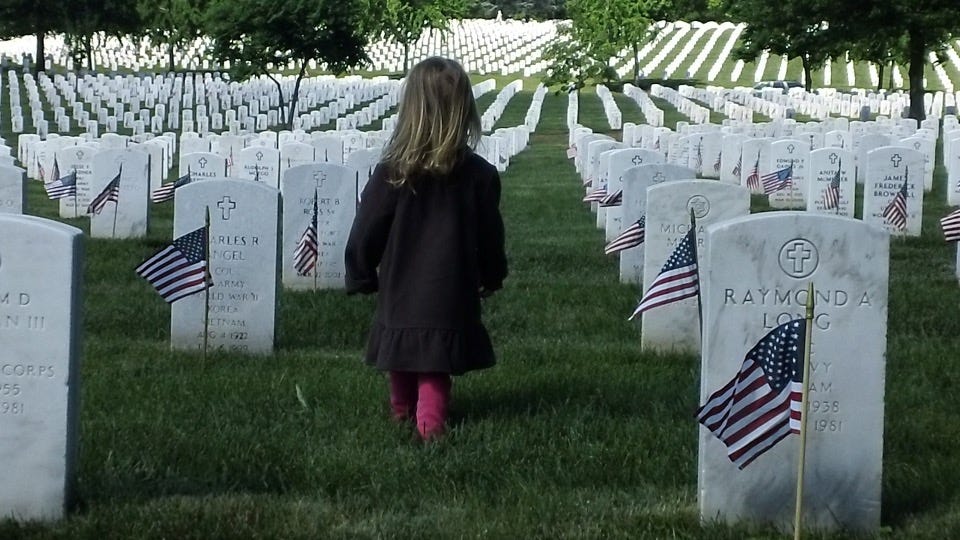
I’m an American girl. Above all. But just as America gave my grandparents a safe haven, their home can now give the same to me. I can seek refuge in, yes, Belfast. Belfast, of all places. Would my grandparents be surprised? Maybe. Would Dad be surprised? For sure. Usually when I visit his grave at Arlington I ask him, ‘am I doing enough?’ Last time I asked it in the past tense and burst into tears. ‘Have I done enough,’ I asked. ‘Have I repaid the debt your parents owed this place for taking them in? I’ve worked so hard at it, for so long.’ I know he’d say yes. I’ve paid it, my husband has paid it, and Dad paid it, in spades. ‘There’s nothing left for you to do,’ he’d say, ‘and you have to take care of Anna. Get her on a plane.’
The first time I went to Ireland I stayed in a house with a view of the sea. I fell asleep watching a tiny ferry boat cross the channel back and forth, back and forth, to Rathlin Island. My dreams were about my grandparents, and my dad as a baby. When I get to that house again though, I’m sure they’ll drift around the stars at White Sands, the sunset at Bighorn, the garden in Natchez, and my girlhood home in a California canyon – where I dreamed of all the difference I would make. It was in fact a dream, turns out, for I don’t appear to have made a difference at all. Not for Anna.
What a compelling story. Simple, mysterious, leaves us all wanting more. Clearly a family that I would love to know who I envy for having done so much for the world. I hope she will continue the story and that her daughter finds peace and happiness in this deteriorating world!
Anna’s story just broke me. Thank you for sharing it, though.