


Before I begin, I wanted to thank those who gave up their time to provide some thoughtful feedback on my post yesterday, about getting the balance of my literary output right. Having thought long and hard about it, I think I may have been having a crisis of confidence. I’m genuinely finding it hard to come to terms with the fact that so many people are interested in what I have to say. |It absolutely blows my mind that I’m sitting at No 64 in the US Political Substack list today. I admit I’m in and out of the list like a Trump tariff, but I’ll take it. I’ve come to the conclusion, much as Leo McGarry did in the West Wing to ‘Let Martin be Martin’, I’ll just write when I feel the need to say something and if that’s every day, so be it. That’s what the unsubscribe button is for if I annoy anyone.
So what’s on my mind today?
Unless you are in the top five percent of earners, it must be difficult to wake up and face another day of watching your 401k drop still further, cope with the dark clouds of job insecurity, all while witnessing the dismantling of your rights and the freedom to voice dissent. This is a heavy cross to bear for far too many Americans today.
If you happen to have lost your job, or are taking care of a disabled or vulnerable loved one, then worry turns to despair, as the programs you rely on are cruelly snatched away. This is an administration hellbent on driving low income workers into poverty and slave labor, then blaming them for the ills of the middle class. This is a full on structural assault on American society by an ideology designed to divide and conquer. In Trump’s new feudal society around 53 million Americans are now serfs to a mad king and those numbers only look set to grow. There truly is no economic Viagra to improve performance given the cliff Trump has decided to drive the US economy off. The administration knows these reckless actions will likely have a devastating impact on their midterm election prospects, hence the Save Act and I’m sure, lots of other voter suppression measures which I’m sure will follow in an attempt to render Democrats impotent in 2026
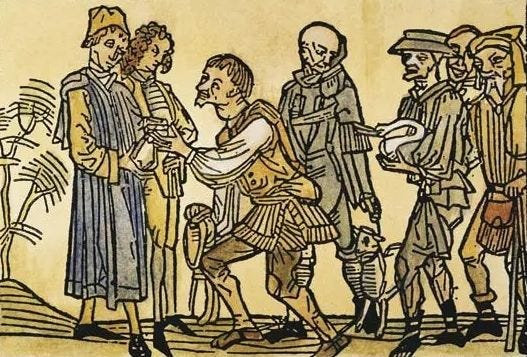
The trade war with China might appear to be a lose lose for everyone. For China however, it’s much more than that. For Xi, it’s culturally unthinkable to cower to a US President who he sees as an existential threat to China’s plans for future economic expansion. To better understand the psychology, you have to compare what China has achieved in the last 4 decades.
Rather than waste pages on a review, I thought you might find this clip useful to bring you up to speed.
The key to understanding it’s rise to becoming the second largest economy on the planet, is it’s investment in infrastructure. Since 1980 it’s been pouring 30% of its GDP into large infrastructure projects. In stark contrast, the US has averaged between 2 and 2.5% of GDP. It’s also worthy of note that US infrastructure investment is half of what Europe invests. I can’t seem to find the numbers, but I suspect China’s investment in overseas partner projects in Africa and Latin America dwarfs that of combined European and US investment. You don’t have to be a rocket scientist to understand why China is leading the way.
The huge difference in investment is down to the systems of government and a differing cultural approach to economics. There is much debate as to whether China is a communist country given it’s pseudo capitalist open markets. Deng Xiaoping was a controversial revolutionary, and a political theorist who led China from 1978 to 1989. He was a pragmatist who understood the benefits and drawbacks of capitalism. He was a man ahead of his time really, with all of the flaws that come with being a radical visionary. He was a man focused on a plan and nothing was allowed to get in the way including human rights. This was evidenced with the military crackdown in 1989 with the Tiananmen Square protests, that’s before we get started on his one-child policy. He knew education and science were the key to delivering prosperity and he wasn’t wrong. He helped establish China's nine-year compulsory education, and oversaw the launch of the 863 Program to promote science and technology. He was the architect of shifting China from a command economy to an economy open to foreign investment. He knew he had ownership of western capitalist’s drug of choice, cheap labor. He knew the West would be powerless to resist when presented with such a cheap fix to feed their greed trip.
The result is a weird combination of ‘state capitalism’ which sort of became a hybrid market capitalist economy. Most of the Chinese companies that have seen success in export markets are not private companies as we know them, they have close links to local government. Pre Xi, local government was blighted with rampant corruption. While it no doubt still exists, the central government took big steps to get it under control.
The large companies are government controlled. The nearest you will get to private companies is Huawei, Lenovo and Ali Baba, but these too have close links to the Chinese government. We can talk all day about the differences between Chinese and western society, but for the first time in history China has fully opened its doors to foreign travel. If you are transiting through China today, you can travel around the country visa free for 10 days, so you can feel free to check it out for yourself. I’m not here to advocate for the Chinese government, but I am an advocate for the truth and the economic reality the West faces.
I’m sure there are authors on human rights, who will describe my assessment as ignorant to the downside of life in China, especially in rural areas which do not enjoy the same prosperity as the populations in the big cities. However, by all measures, the work that the government has done on poverty reduction is by any global measure extraordinary.
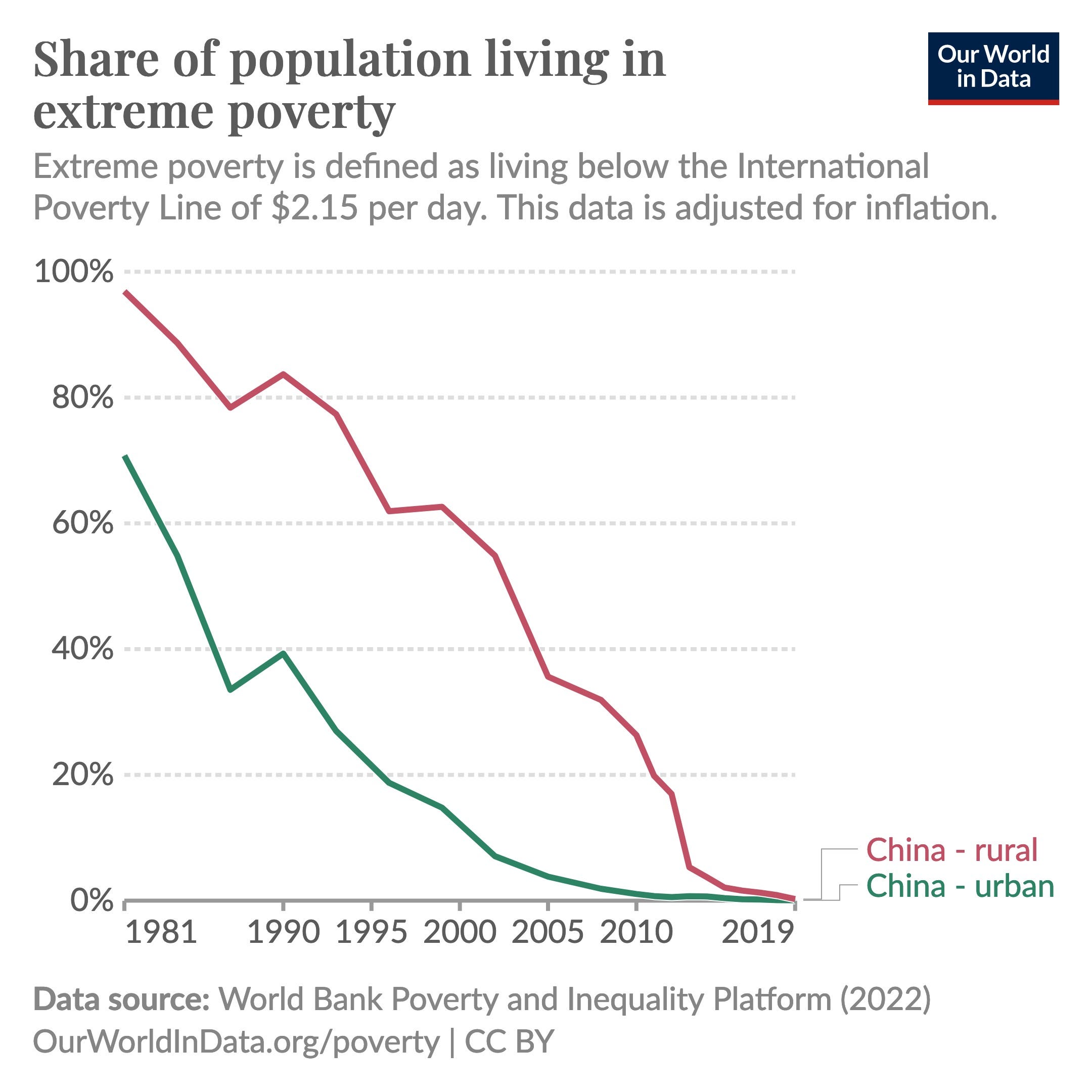
Given the demographic makeup of Chinese society in 1981, this is a level of success that no western economy could have achieved in the same space of time. The real irony is, this was achieved through western investment in Chinese cheap labour. In a little over one generation, China has used that investment to all but eradicate poverty, construct world leading infrastructure, build a safe society with a 97% literacy rate and the most highly educated students in the world. It embraced the vision of Deng Xiaoping of investing in education and technology to leap ahead of its largest economic rivals.
If we fast forward to the China of Xi Jinping we are seeing the next phase of Chinese economic advancement. It’s his vision now that takes center stage in China’s global ambitions. In November 2023 at the third Belt and Road forum he stated, “Changes of the world, of our times, and of historical significance are unfolding like never before,”. He went on to say China will “..make relentless efforts to achieve modernization for all countries” and work to build a “shared future for mankind.”
Unlike western governments, China plans way ahead and that is one of their great strengths. In short, it no longer feels the need to adapt to western economic dominance, China wants to reshape global trade and economic development. Their new dominance in auto manufacturing is just one example of what Xi sees as that leadership. Take the unveiling of the new 5 minute charge capability BYD is showcasing for it’s upcoming electric vehicles. I use this purely as an in the moment example of the level of innovation China is able to achieve, in spite of the US block on sharing technology and chip supply. I’ve included this clip simply because there is a lot more to fast charging an EV battery than the glossy ads would have you believe and I want to provide the big picture to include the challenges too. Nevertheless, this is just one example of how fast Chinese tech is advancing. We could go on to talk about Deepseek which I have tested personally and can attest to its ability to almost match ChatGPT. OpenAI’s laughable response, was to cry and claim that Deepseek stole their training data. The same data OpenAI had stolen from every author and journalist around the world.
The history of Chinese economic development is absolutely fascinating and I have been immersed in it now for over a week.
Does China have problems? Absolutely it does, not least of which is it’s housing crisis, largely due to overbuilding and debt. It’s a problem then compounded by a regulatory crackdown on developer debt. Unlike western capitalist economies, the Chinese government does have some tools at its disposal to mitigate some of the economic damage. It has reduced mortgage rates and is looking also to lower property taxes. In addition, it’s exploring buying up unsold inventory for social housing. This option would not be on the cards in a western capitalist economy. The problem is nowhere near resolved and may still have implications for global markets. However, one thing the crisis HAS highlighted, is the need for a more sustainable economic model and this is where Xi’s focus is. He is desperate to develop domestic consumption to provide an economic fire break against external shocks. In the last decade, China has made significant progress on reducing reliance on US imports, a fact Trump seems to forget when drawing up his failing battle plans. You have to understand, Xi does NOT spend every waking hour worrying about the US threat. He has better things to do and I suspect he likes living in Trump’s head rent free.
There are those who have criticised my recent China centric output, but for me, it’s an absolutely fundamental to understanding the problems America faces today. Ironically, it may actually be China that proves to be the chink in Trump’s armour that sinks his ambition to be King. I needed to create some context today to prepare the journey into tomorrow’s chapter on why China is the whole ball game. We’ll take a look in more detail at the nuts and bolts of Trump’s tariff fiasco, to look not only at the economic impact but the crossover with judicial oversight and the permissive environment Mad King Don has created for unchecked corruption.
Superbly written. Valuable information. I am impressed and better informed. Well done!
While I feel like many other writers rightly focus on the threat du jour, I am grateful you step outside and provide background and historical context. Well done