



In my last piece, we looked at the intersection of the war and the economy, and I think it is worth examining things in a little more detail to understand just how misguided Trump’s actions are on so many levels.
Outside of the US, the world looks on in horror as Trump stumbles from one deadly unforced error to another. He’s attempting to convince the gullible that a man with an approval rating so far underwater that he needs a hypobaric chamber is winning. The problem, of course, is that he is drowning in sycophancy, which is exactly as he likes it. His malignant narcissism leads him to believe that the deluge of lies that fall from his mouth represents the truth when the world simply sees him as the Emperor with no clothes.
While the world is quietly amused by his inarticulate nonsense, they know that much of his behaviour is dangerous and represents a threat; leaders smile politely and comply in an attempt to get the petulant child not to shoot the loaded gun. They have learned that the more you concede, the more he extorts and abuses. As a result, we are starting to see a silent resistance, with growing confidence to say no to him, as we have seen over the last week on the issue of the Straight of Hormuz.
What you have to remember is that the current world order, shaped by the US following World War 2 has become the norm over the past 80 years. Nobody likes change, especially when economic and defence strategy has been baked into what has become that accepted norm. Now that Trump has come along and torn up the geopolitical order in favour of American exceptionalism and isolation, it has come as a severe shock to US partners and allies. For decades, it’s fair to say that NATO members did take advantage of the US in terms of security in peacetime and their willingness to foot a disproportionate share of European security costs. This was wrong, and Trump was right to draw a line in the sand, forcing NATO members to step up and meet their agreed commitments.
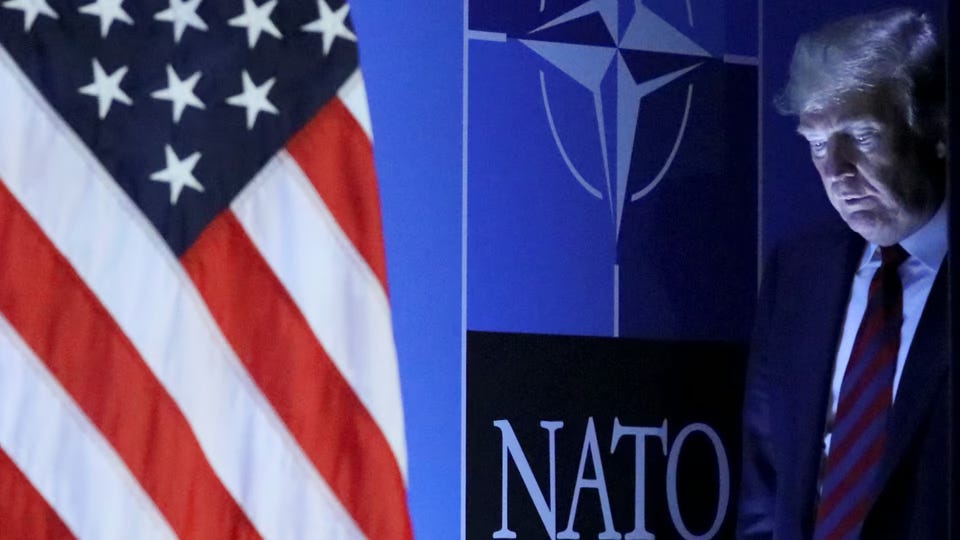
I can think of no other issue on which Trump and I are aligned. However, on NATO partners paying their fair share, we are as one on his insistence that members do so. Having said that, it is really difficult to separate fact from myth when it comes to respective contributions to the NATO alliance. It’s also important to understand the broader dynamics among alliance countries regarding their defence spending and ties to US arms manufacturers. The US has received huge economic benefits from NATO allies’ spending. Let’s begin first, though, with the bottom line numbers when it comes to the US contribution to the NATO budget.
The important consideration is that the US has long spent more on defence than the next 10 countries combined. It accounts for 40% of global military spending and represents around 3.2 of US GDP. Prior to Trump taking a stand on member state contributions to NATO, the agreement had long been that 2% of GDP was the target. For many years, far too many members failed to deliver on this commitment. This is why Trump was correct to light a fire under those shirking their responsibilities. As you can see from the chart below, every member of the alliance met their 2% commitment in 2025.
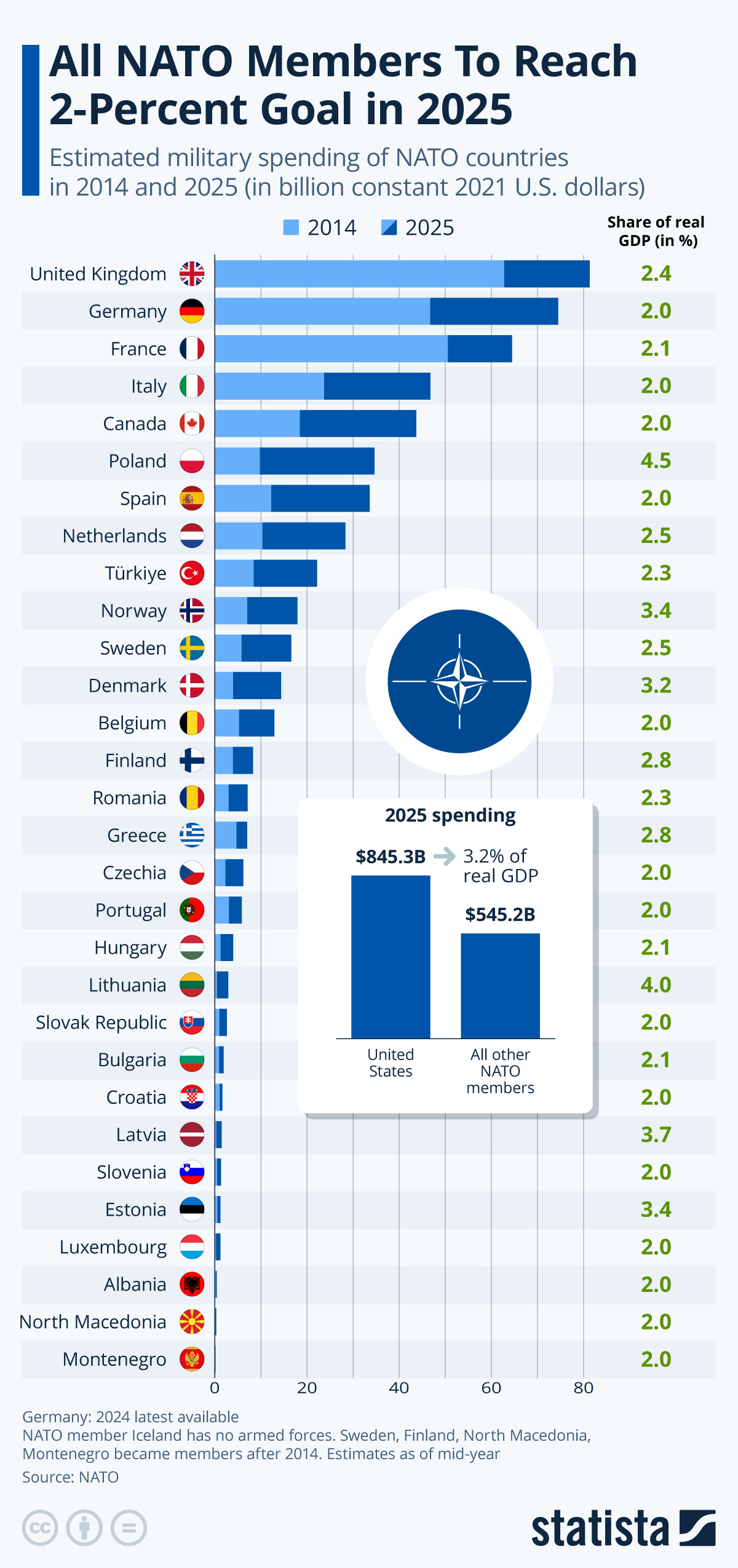
You will note that a number of countries exceed 2% of GDP, mainly those in closer proximity to Russia. Trump, of course, has applied more pressure, suggesting that members should now be spending 5% of GDP, which is totally unrealistic, but Trump always has to have the last word.
To be clear, it’s the US's choice to spend almost a trillion dollars each year on defence, and one thing we do know is that American taxpayers have never seen value for money when it comes to spending their hard-earned tax dollars on the Industrial-Military Complex. The War Department, as Trump now prefers to call it, has never passed an audit since audits began in 2018. It consistently demonstrates an inability to account for all assets, a lack of auditable business systems, and incomplete transaction records. Now, call me old-fashioned, but it screams to me of ‘Corruption Central’. The very definition of fraud, waste, and abuse, yet the DOD totally escaped the DOGE purge when it came to spending on weapons.
Defence spending appears to have, for years, provided a slush fund for executives in the elite club of US arms manufacturers, contractors and their shareholders, many of whom have been or are legislators. It would certainly be an interesting exercise to have a gold-standard forensic auditing firm conduct a forensic audit with a view to jailing those found guilty of defrauding the US taxpayer. Maybe they could use one of the new detention warehouses to house the guilty? I think not, the regime would rather help click fund Nick Shirley, amplifying the lies of a pretend journalist, suggesting that all fraud is perpetrated by immigrants and Democratic operatives?
It’s more than worthy of note that Trump, far from being a fraudbuster, appears to be a president addicted to issuing pardons for fraudsters, while halting funding to states as alleged punishment for ‘out of control’ fraudulent spending. In a piece in the Guardian by Adam Gabbatt on January 26th 2026, he quoted a statement from Jamie Raskin, the ranking member of the House Judiciary Committee, who is quoted as saying:
“Our analysis shows that Trump’s criminal pardon spree is, in addition to everything else, an astonishing giveaway to lawbreakers to keep the money they stole from their employees, their investors, and all the American taxpayers. Whoever said crime doesn’t pay has certainly not studied the Trump administration.”
I’m afraid corruption appears to have long been rife in the US arms supply chain. There’s a good reason Trump wants to add a further half a trillion dollars to this rich man’s slush fund. It’s just another refuge for non-accountability.
We often listen to US right-wing talking heads bemoaning the US's disproportionate contributions to NATO, when the reality is very different from the narrative. I thought it might be worth spending a moment on it, as the relationship will come into sharp focus in the coming months. Below is a chart of the common funding contributions
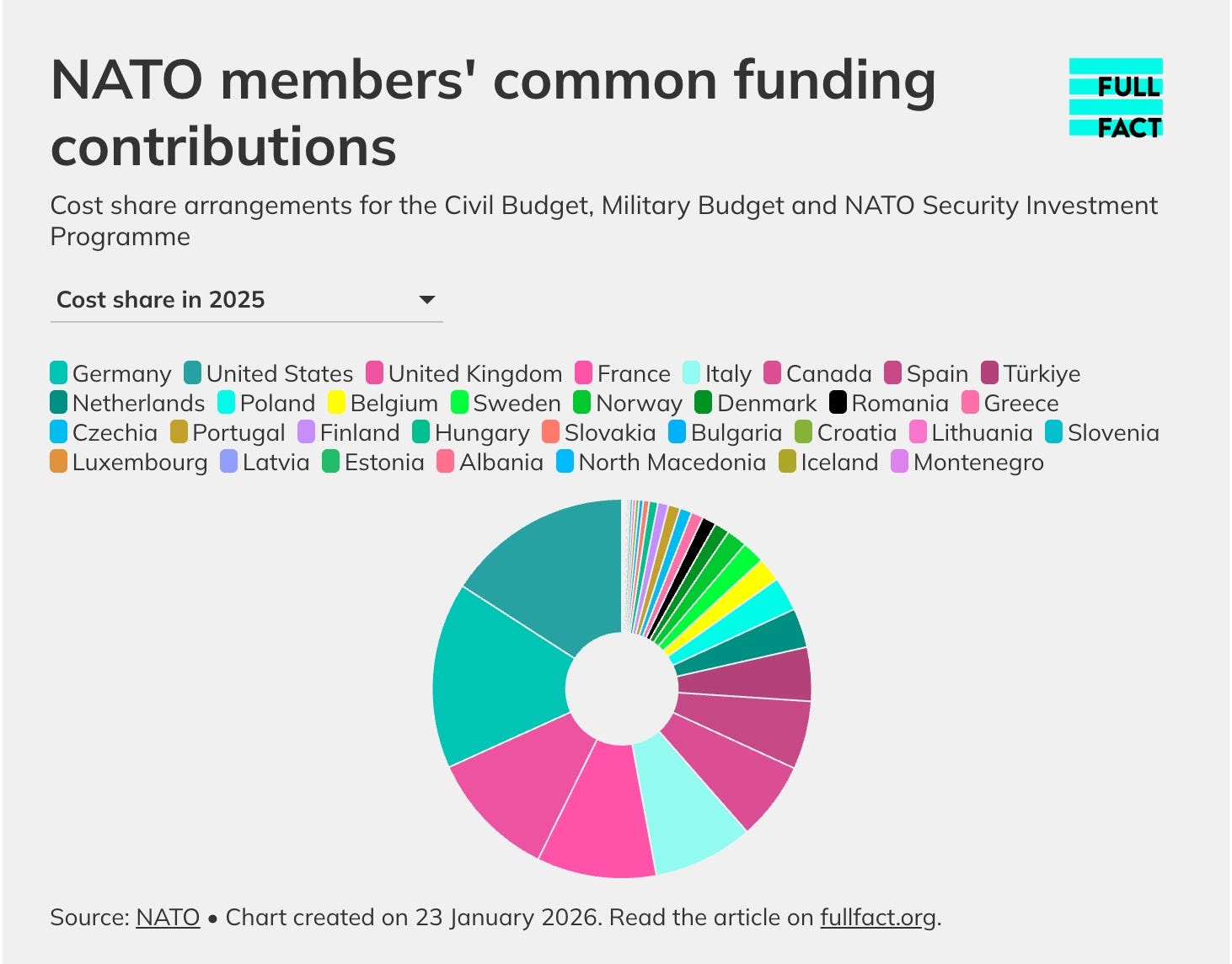
The US contributed 15.88% in 2025. Trump often misrepresents total US defence spending as money being spent on NATO, which is, of course, nonsense. Nobody is suggesting that the US is not the largest single contributor to NATO, but focusing on general defence spending is disingenuous given the respective sizes of the member states' economies. A much better measure of commitment would be the percentage of GDP, in which case Poland is at the top of the tree at 4.5%, followed by Lithuania, Latvia, Estonia, Norway and Denmark.
It’s easy for Trump and his acolytes to manipulate the numbers to fit his narrative; it’s what they do all the time, but the truth is that NATO members are now meeting their commitments, and there is a clear roadmap to increase spending to 5% by 2035, which in my view will be a contribution difficult to achieve in the current economic climate that Trump himself has created.
What he often does, is look at the US presence in NATO countries as part of the US funding model, which is, once again, a misrepresentation of the facts. European and NATO airbases clearly host US military assets in the European theatre, but this is as much for US force projection as it is part of NATO capability and protection. The US would certainly find it very difficult to manage its interests in the Middle East and elsewhere in the world. without access to these bases. For example, in the UK, US bases are operated rent-free by the US, only contributing a percentage of the operating costs.

In many cases, the US has longstanding rent-free agreements in which it shares infrastructure costs, and these are part of security guarantee arrangements. There is never any mention of these hidden economic benefits that the US receives as part of these arrangements. Trump merely asserts that the US is being taken advantage of, which plays very well with his base and far-right talking heads. Maybe allies could shift to a new funding model based on annual rent increases? There are 40 major US bases in Europe, which serve as hubs for the US military. These are the foundations of US force projection and mobility in the region. If the US chooses to leave NATO, then this force projection collapses. This is not an à la carte benefit arrangement.
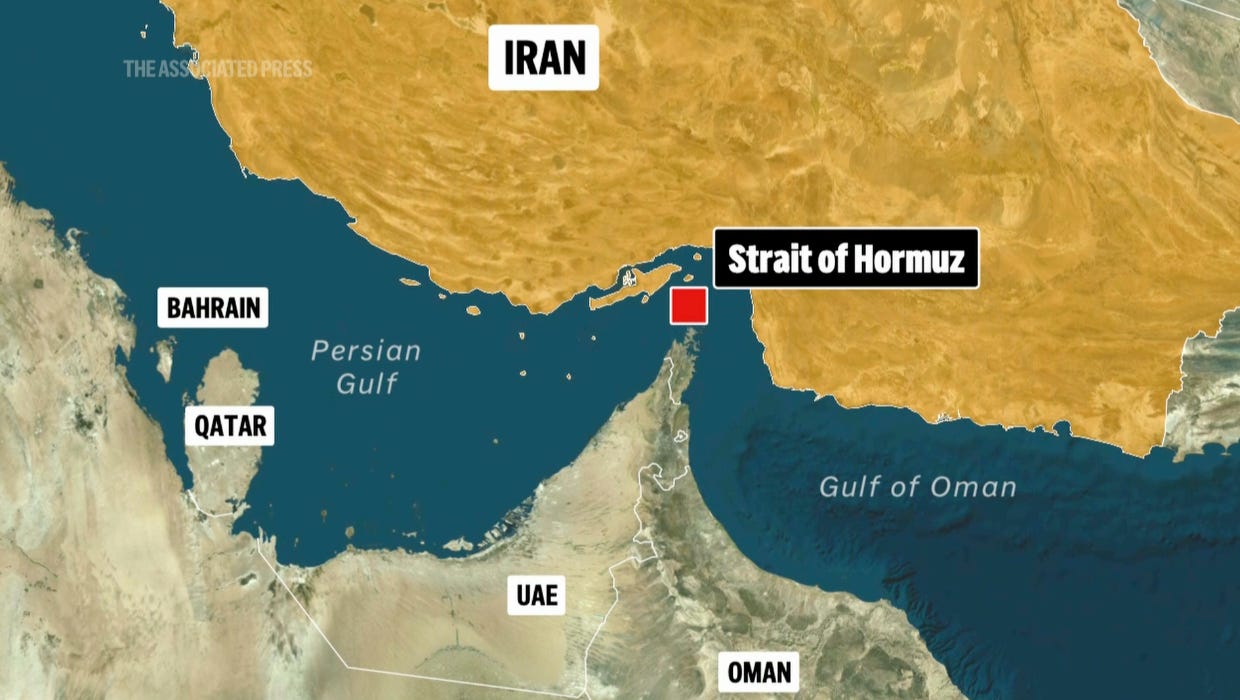
We have seen how vital these bases have been for operations against Iran, and the US is fortunate, certainly, that the UK relented and is now allowing their use, but without UK commitment to offensive operations in America’s failing war. All too often, Trump is used to countries capitulating when he demands something. What we have seen from NATO members is the correct approach under International Law. Their commitment to assist in aiding with the passage of shipping through the Straight of Hormuz is noted by GLOBSEC as a response based on:
..maritime law and humanitarian concern — not a declaration of solidarity with the US-Israeli military campaign itself. That distinction matters enormously. European governments are drawing a deliberate and careful line: they support freedom of navigation as a foundational principle of international order; they do not endorse a war they were never consulted on. Kaja Kallas, the EU’s foreign policy chief, put it plainly — Europe is an ally of America, but nobody in Brussels genuinely understands what Washington’s strategic objectives are, or how victory is defined. They were not at the table when the decision was made to strike Iran, and they are now being asked to carry a share of both the military risk and the economic fallout.
In other words, this is not a case where US allies are coming to the aid of the US. In any event, NATO is a defensive alliance. While the US shows blatant disregard for International law and the rules of war, NATO allies have been drawn into US-instigated conflicts before, only to be told by Trump that they never really made a contribution and sat out of danger behind the lines. Pretty rich coming from a five-time draft dodger. There’s only so many times you let a friend punch you in the face before you say ‘Enough is enough’. There is no upside to US allies joining offensive strikes where war crimes are being committed, not to mention threats to commit more being made on camera to the global media by a US President.
Trump is in a deep, deep hole and is panicking regardless of what his acolytes and his state-sponsored media outlet are spewing. Is the US hurting Iran? Absolutely, it is, and they are hurting badly, but he’s dealing with a nation of 93 million people in a theocratic autocracy, working on the assumption that the people will rise up and be the cannon fodder rather than using US military personnel. He now knows that there will definitely be no NATO ally boots on the ground.
If it’s one thing the Iranians are good at, it’s stringing people along, and they are exceptional with propaganda, too.
Despite all the bombing and destruction, they are just like the Viet Cong, an enemy fighting for survival in a country many will defend to the death. Iran is a formidable, resilient adversary and an expert practitioner of asymmetric warfare. They don’t care how many civilians the US kill; the more they kill, the more insurgents Trump creates. Time and time again, the US exhibits a deficiency in assessing the culture it is waging war on. This, despite getting their ass kicked time and again in recent decades.
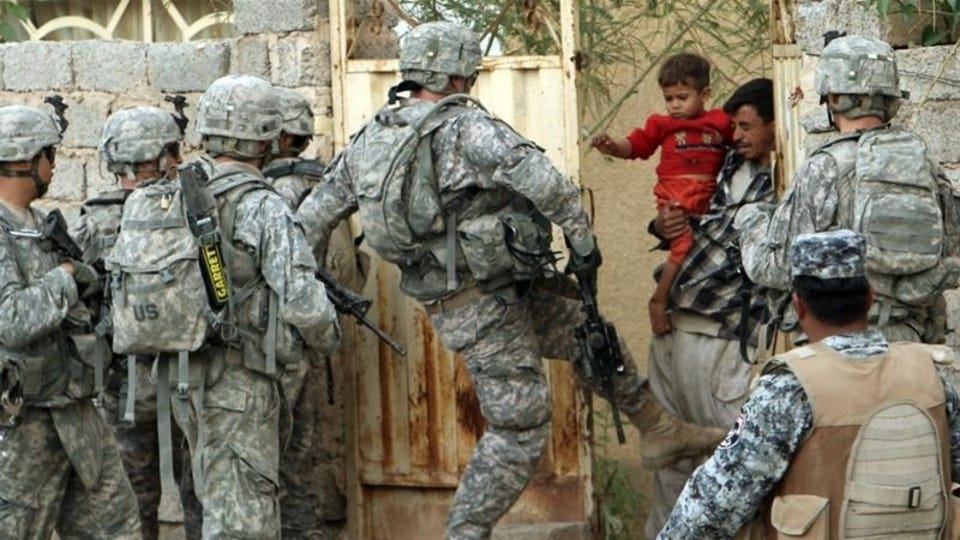
When they were in Iraq, they had absolutely no understanding of the tactics that were required against an insurgent threat. They were forced to rely on UK military planners for help, based on their experience fighting the IRA. They didn’t lose because they were woke; they lost because they underestimated the enemy, as they have done now, and I fear that’s why they will lose yet again.
Trump now has to make a decision. If he goes ahead with military strikes on energy infrastructure, he will be committing an advertised war crime, which will alienate allies still further and garner yet more international condemnation, as well as further condemnation from the UN. Of course, none of that matters to Trump, but ultimately, I believe it will have downstream consequences. He’s signalling an escalation that could trigger a catastrophic, long-lasting economic downturn and a global recession.
What you have to remember is that the US has been strangling Iran with crippling sanctions for years, but now, in a bizarre twist, sanctions have been lifted on its oil, providing revenue. The Iranians smell blood in the water. Warfare has changed since Trump and Hegseth last watched a war movie together. We now live in a bizarre world where a mighty power has to spend millions of dollars shooting down $50,000 drones. Ukraine could have told him that had he bothered to ask. Maybe he was fearful Zelensky would inform him that Iran appears to hold all the cards this time around?
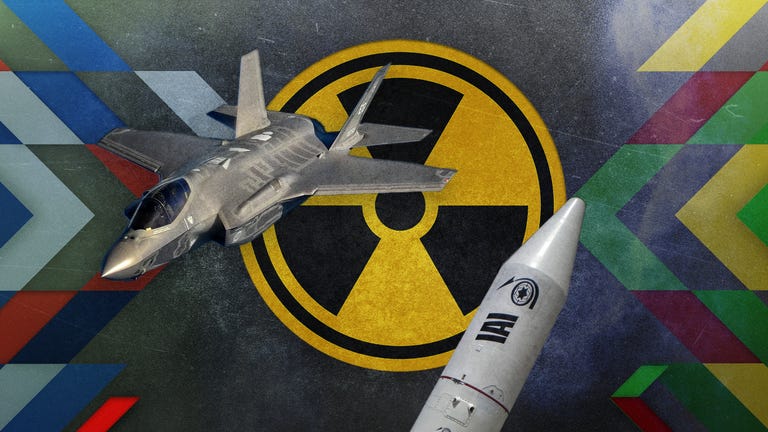
My biggest fear here is that the US will deploy ground troops who will likely suffer heavy losses. If those losses are catastrophic, we are into new territory, where Trump might conclude that the only option open to him is ‘broken arrow,’ and he goes nuclear, or gets Israel to do it. Am I saying this is the likely outcome? No, but I’m afraid that you can rule anything out when it comes to Trump. It would be my hope that if it comes to him becoming totally unhinged, he will be stopped by the military, because if not, we are all economically cooked well into the future.
There is a lot up in the air at the moment, and everything is speculation, but the deadline he has set for tomorrow is fast approaching, and then who knows where this will go. Trump is the child in the room with a loaded gun without adult supervision.
The key to defeating Trump? Mass non-cooperation | Mark Engler and Paul Engler
The key to defeating Trump? Mass non-cooperation | Mark Engler and Paul Engler
The following are excerpts from this article.
“The extraordinary level of grassroots solidarity and creative resistance in anti-ICE protests in Minnesota has given people a new appreciation for the power that mass non-cooperation can have in resisting the Trump administration’s drive toward authoritarianism. And it has created an awareness of why such action is clearly needed.”
Early in Trump’s second term, an array of mainstream critics expressed skepticism about the value of continued protests in the streets. They invested their faith in institutions such as Congress and the courts. But as these institutions – along with law firms, universities and the business community – have each caved in to the administration’s demands and proven themselves unwilling to catalyze an ardent defense of democracy, it has been left to the people themselves to do this essential work.
Mainstream political thinking in the US sees power as “monolithic,” resting in the hands of senators, generals, billionaires, presidents and CEOs. From that vantage point, the options for opposing a rogue administration seem desperately thin: wait for elections, file a lawsuit, hope for some unforeseen maneuver by elites. This worldview breeds despair. One prominent Democratic party consultant even advised that the best course for progressives is simply to “roll over and play dead”.
Those immersed in social movements look at the process of change in a different way than political insiders do. Instead of subscribing to the monolithic view of power, they hold a social view of power, which understands that those in positions of authority are dependent upon the cooperation and support of the governed.
Now, as then, the list of methods is best seen as an invitation to creativity, reminding organizers they have many tools in their collective toolbox – each with distinctive properties and powers. The potential of civil resistance is not just in holding large demonstrations. It is in drawing from a vast array of strikes, boycotts, noncooperation tactics and artistic protest. And it is in coming up with innovative forms of creative resistance that may never have been seen before.”
I agree that the US under different presidents have not understood the culture of those they invade. They hear “communist”or religious zealot and think it has to be put down by American thinking and values ( as they were back then). Trump plays a power game and thinks every thought he has is a win in his deranged mind.
He has no diplomatic skills and poor communication skills and runs on gaining headlines.