



Trump has become so efficient at manipulating the US economy that it becomes ever more difficult to nail down what’s actually going on under the hood. The latest growth figures show that the economy grew by 2% in the first quarter of 2026. There is no arguing that if this number is accurate, it represents a pretty solid performance off the back of a poor Q4 in 2025. The key is to focus on where this growth is coming from, and most of it is coming from consumer spending, which is celebrated as holding up well until you drill into which segment is fueling the majority of that spending.
The top 10% account for close to 50% of it, which means that those driving half of current consumer spending are limited to just 15 million earners. If ever you wanted proof that the US is a two-tier society, here it is. The top 10% is the very reason Trump is obsessed with the stock market: these consumers represent his economic golden goose and are the largest beneficiaries of stock-derived income. Together, they own close to 70% of the nation’s wealth and are currently spending like drunken sailors at the expense of the bottom 90%. In stark contrast, the bottom 50% are left to fight among themselves for just 2.5% of the wealth pot, the scraps from the banquet table they are never invited to sit at. With far less disposable income, their spending is driven more by necessity and volume than by spare cash.

Herein lies the very real economic danger that America faces from having all its consumer spending eggs in one fickle basket. If there is a market correction at the level seen during the 2007-2009 financial crisis, when 50% of the stock market's value was wiped out, the economic fallout would be devastating and rapidly cascade through the economy. I hate to say it, but you should not rule out this scenario, especially given the potential for current converging crises. Some economists are, as we speak, quietly but seriously concerned because they’ve identified that we are at the convergence of four similar, damaging historical economic events.
It’s not unusual to face economic headwinds or threats; they're all part of the rich tapestry of life as we know it. However, before we discuss these threats, let’s examine them against the current economic backdrop. It’s important because threats are best countered by resilience, and I would hardly count current consumer spending as resilient when combined with an anaemic jobs market under siege from AI. In an economy powered by 170 million workers, relying on just 15 million of them to prop up 50% of consumer spending amid record-low consumer confidence, should not inspire confidence. This is not dissimilar to relying on seven big tech companies to prop up a market that appears to be feeding only the top 10%.
Back to the converging historic economic events,
Protectionist policies in the form of Tariffs
This is nothing new in the US. Following the Great Depression, we saw the introduction of the Smoot-Hawley Tariff Act of 1930, which increased import duties in the US, in some cases as high as 60%. It is widely accepted that these tariffs had a significant detrimental effect on both the US economy and global trade, which collapsed to the point that US unemployment reached 25% in 1933.
Fast forward to 2025, and Trump’s tariffs, while not having the same catastrophic impact as in the 1930’s, have nevertheless had a significant detrimental effect on the contemporary global trade environment, especially given that $160 billion of the tariffs levied have since been ruled illegal by the US Supreme Court. Regardless, even the current average 10% tariffs have led to rising prices, contributing to the current affordability crisis. These are what we call small supply shocks, which produce slow-burning harm to the economy.

Oil crisis and the potential for stagflation
There is no doubt that there are clear indications of emerging stagflation, as seen in the 1970s, when the world experienced oil supply shortages following the 1973 Arab-Israeli war. Arab states instigated an oil embargo in retaliation for the West’s support for Israel. At the time, it had a more devastating effect on the US because it was largely reliant on oil from the Middle East.
Fast forward to 2026. The energy dynamics of the Iran War, while somewhat different given that the US has been the number one oil producer in the world since 2018, does not change the fact that oil is priced in a global market. As a result, despite Trump’s false claims that the US is not reliant on the Strait of Hormuz, it remains vulnerable to oil supply shocks, just the same as the rest of the world. Aside from this, the US relies on the Strait for much more than oil, given the volume of other vital commodities it requires, such as fertiliser and helium, to name but two.
The dotcom bubble vs the AI bubble
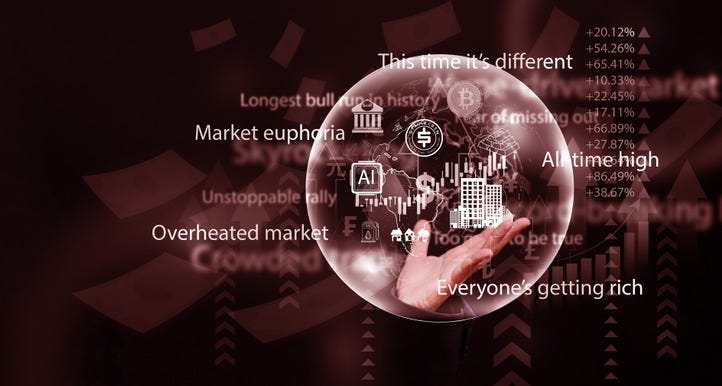
Those who suffered at the hands of the dotcom crash will remember it well. Between 1885 and 2000. The Nasdaq rose by 600%, only to fall 78%. Just as with AI giants now, frontier tech businesses were created on the back of emerging mainstream Internet technologies. The economy experienced unprecedented growth based on the dream of what the Internet would deliver. Internet companies had massive valuations based on nominal revenues and the dreams of hitherto unrealised revenue. Was it a revolution? Absolutely, but as with all technology-driven promises, it takes time, and that’s not the capitalist way.
Fast forward to 2026, and it’s like looking in a mirror. The same hype, the same gross overvaluations built on the hype peddled by a handful of obscenely rich CEOs promising a world in which the workforce is the latest form of acceptable collateral damage. It’s worth noting that at this point, it took FIFTEEN YEARS for the US economy to recover from the dotcom bubble. I would also add that the AI revolution is highly dependent on energy supply, and given that the US is walking away from renewable energy, the oil crisis plays directly into the risk analysis.
The 2008 financial crisis vs the crisis Trump is working hard to hide
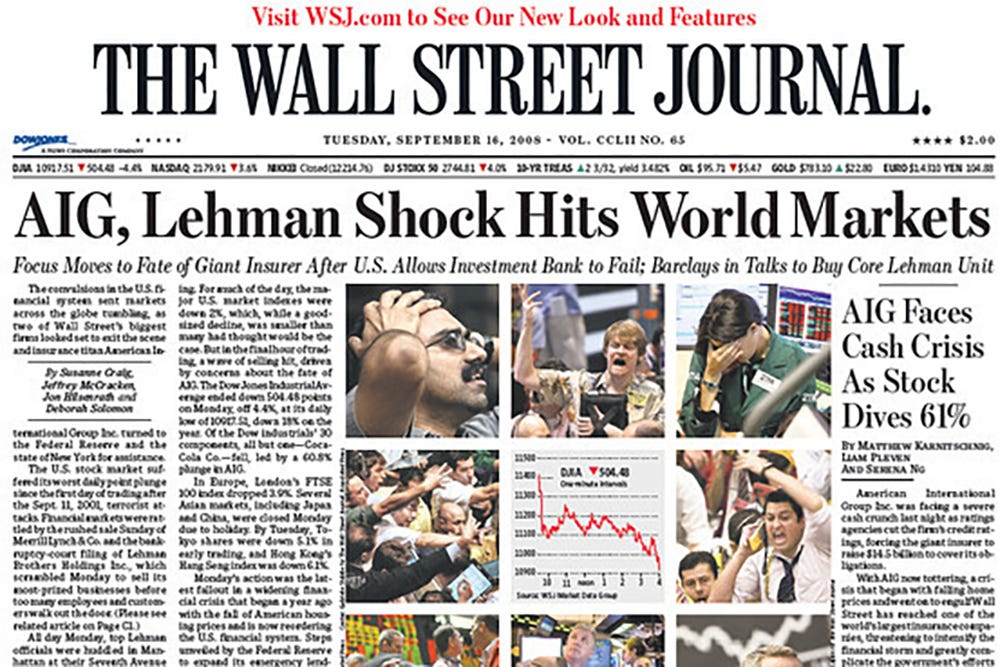
In 2006, home mortgage debt in the US rose from 61% of GDP in 1998 to 97% by 2006. By 2008, U.S. home mortgage debt reached $10.5 trillion. This was about a massive expansion of private rather than government debt. The key here is not the source of the debt, but rather the lack of oversight that allowed that private debt to spiral out of control. It was the false golden age of Mortgage Backed Securities (MBS). In short, banks did not hold the tsunami of subprime home loans on their books; instead, they sold them on to Wall Street. By 2005, subprime mortgages represented nearly a third of the total mortgage market.
When housing prices began to fall following the artificial juicing of the housing market with toxic, high-risk debt, borrowers inevitably defaulted on their home loans, which they could never afford from the outset. The rest is history. The key is that in many cases, Wall Street bundled up this debt, while complicit ratings agencies labelled the toxic debt as triple-A, and it was then sold around the world. The endgame was simply a matter of who was holding the fiscal IED when the music stopped. It was a corporate criminal enterprise for which nobody was held responsible. The result? The S&P 500 lost roughly 56%–57% from its Oct 9, 2007, peak to its March 9, 2009, trough.
In short, the banks and Wall Street hid the truth from everyone until it came knocking at the door, and the bottom 99% paid the price again for the reckless criminal behaviour of the top 1%.
Fast forward to 2026, take another glance in the mirror, and what do you see? With the same fiscal deregulation, this time we’re seeing big tech colluding to hide the truth about economic expectations for AI technology. Meanwhile, student loan and car finance debt are at record levels. When viewed against a backdrop of wider public debt from credit card spending, and total public debt yesterday exceeding US GDP for the first time since World War I. It’s déjà vu, the same old story, just told by a different storyteller.
I believe the US once again stands on the precipice of economic collapse, except this time it’s facing four converging risks we have seen before and learned nothing from. The top 1% keep doing it because they face no consequences and simply pass the pain down the social ladder.
History is never far away when it comes to identifying warning signs, but there is simply no appetite to warn of the risks, and in my eyes, that’s a criminal act of deceit. The American people were told that the country was broke because of fraud, waste, and abuse in government. It was a lie then, and it remains a lie today. It has been a constant false narrative attempting to blame the poor and the vulnerable for an economy serially raped by the wealthy elite, evading tax while gorging themselves on government tax giveaways funded by those struggling to survive.
There’s no question in my mind that the day of reckoning is nigh; the question is no longer if the economic situation will decline, but when. At the moment, there are already parts of the world that have no oil as a result of this war of choice. The US, despite rising costs worsening the affordability crisis, is still benefiting from global oil reserves that provide a cushion against the full impact. Trump’s assertion that, as soon as the conflict is over, costs will reduce to below what they were before the war began, is a deliberate, bare-faced lie. There’s no other way to describe it.
When the market correction occurs, much as it did during the COVID crisis and earlier crises, rest assured that the first people in the bailout queue will be corporate America, arms stretched out with their oversized begging bowls, while those in the middle and at the bottom pay the real price once again through austerity and welfare cuts. Same as it ever was. How many times are the American people happy to watch this rinse-and-repeat exercise before they call time?
Tomorrow, we’ll examine the geopolitical impact of Trump’s delusional, shortsighted foreign policy fantasy. It’s important that the American people understand that there is only one winner in this made-for-TV failing pursuit of empire, and that’s China.
It would also be nice if China and Iran would release the full Trump epstien files for the world to see along with trumps tax filings..om goodness...those two things alone will push him over the edge....
Expropriate all the money and assets of the Epstein class whose financial crimes, greed and corruption have brought America to this position. Use their wealth to benefit the entire nation, there's plenty to go round. F*** them all.