


Big picture commentary in a chaotic media environment, where the government is hellbent on controlling the political narrative, is always challenging and never more so than in this moment, where the foundations of a decades-old world order, for all its faults and failings, has largely delivered peace in the West.
I find myself somewhat uncomfortable making this more-than-slightly selfish assessment. As someone who lives in a Western democracy in a developed, top-ten economy, I am blessed to have reaped the rewards of a more-than-imperfect order, which has allowed me to raise a family and help provide my children with opportunities that, in today’s world, are far more difficult to achieve. It’s as if the music never stopped while the world played pass the parcel. allowing them to begin their own journey to build a future for themselves. However, even with this good fortune, though, I suspect the years ahead will likely prove more challenging than they were for me.
Don’t misunderstand: like all people who have worked for themselves all their working lives, there were dark times, but the economic environment always provided opportunities to bring light back to those challenging moments. To even think about trying to do this in the world we now inhabit, I’m honestly not sure if I could do the same again now. There’s a part of me that always believes the glass is half full, but for many young people now facing the world of work, I shudder at the thought of what they face in a world changing so quickly. It’s difficult to see abundant opportunities for the fiscal security required to build a foundation for the next generation. That is, of course, unless you are breathing the rarified air of the top 10%.

Since the 1970s, when the wealth gap began to accelerate, the average worker has fallen victim to the ‘boiling-frog-effect’. The imperative to survive diverts our attention from the fact that those at the top of the socioeconomic food chain embarked on a slow yet deliberate operation to extract ever more wealth from the output of the workforce that made them the apex economic predators they have become.
I’ve written on many occasions that slavery never went away. Over the decades, it has simply pulled on a new suit and employed a PR team in the form of bought-and-paid-for federal legislators who act as paid PR agents for Corporate Interests. The same Corporate Interests that have always viewed the cost of a workforce as an impediment to unregulated wealth.
When US manufacturing made America the world's economic powerhouse, laying the foundations on which modern America was born, they could have simply built on the outstanding achievement of a highly productive labour force. There would have been no such concept as making America great again. Tragically, in a country where those at the top of the food chain grew ever hungrier for larger profits, fair wealth distribution became the enemy of the newly minted wealthy elite, marking the beginning of a search for cheaper labour, branding US workers as acceptable collateral damage in pursuit of a better bottom line.

In the 1920s, before the Great Depression, wealth inequality in the US was considered a chasm. The top 1% owned around 24% of pretax income by 1928. Before the stock market crash of 1929, we saw the all-too-familiar tax cuts for the rich, as are on display today. This, then as now, led to a massive concentration of wealth at the top, with the top 0.1% holding almost 25% of household wealth. While they grew ever more wealthy, 60% of Americans lived below the poverty line. Sound familiar? It seems just as fashion is cyclical, so is obscene wealth.
The top 1% have done a remarkable PR job of convincing the bottom 99% that their survival depends on them. Beyond the threat that they will take their wealth and find another home for it, they have built an alternative reality that, in many ways, defies evolutionary logic. Human nature normally dictates that those at the top are vulnerable to the collective disquiet of the masses below, and history has seen it manifest itself as revolution and civil unrest. In a quite remarkable achievement, the rich have somehow managed to convince the middle class that the socioeconomic group below them in the food chain is responsible for stalling their prosperity.
The narrative from the top 1% is that the middle class are being overwhelmed by a system that taxes the productive to pay for the "non-productive," creating an expensive social welfare trap funded by the fruits of their labour. They are made to believe that they are paying for public services and welfare benefits that support lower-income groups. Meanwhile, those on low incomes, often working multiple jobs, find themselves still falling behind. So, who do they blame?
You guessed it, they "look down" at immigrants, younger generations, or other subgroups. It should be noted that in this conflict created by those at the top, neither the middle class nor the working class is placing the blame on the rich, who are the true source of this manufactured economic inequality; they are too busy at war with each other, and that’s exactly what the oligarchs require in order to hold any chance of holding revolution at bay. It truly is a masterclass in narrative control.

Income inequality in the US was at its lowest following the Second World War, as the New Deal paved the way for growing union membership and workers’ rights. Those returning from war effectively demanded a better deal. The last thing the wealthy elite wanted was a revolution led by fighting-age men who were battle-hardened from fighting Nazis and the Japanese, so there were no overt attempts at theft and racketeering directed at them for almost 40 years.
To rebuild wealth in a way that didn’t stoke civil unrest, they had to adopt the ‘boiling-frog-effect’. slowly but surely eroding the workers’ share of rewards from their labour, while gradually undermining workers’ rights. What we have seen historically is a rinse-and-repeat operation. The rich squeeze the bottom 90% until they push their luck too far, and then there’s a reset. The 1929 market crash, followed by World War II, saw the top 1%’s wealth drop from around 25% to just 10%. These two economic shocks resulted in the largest-ever narrowing of the wealth gap.
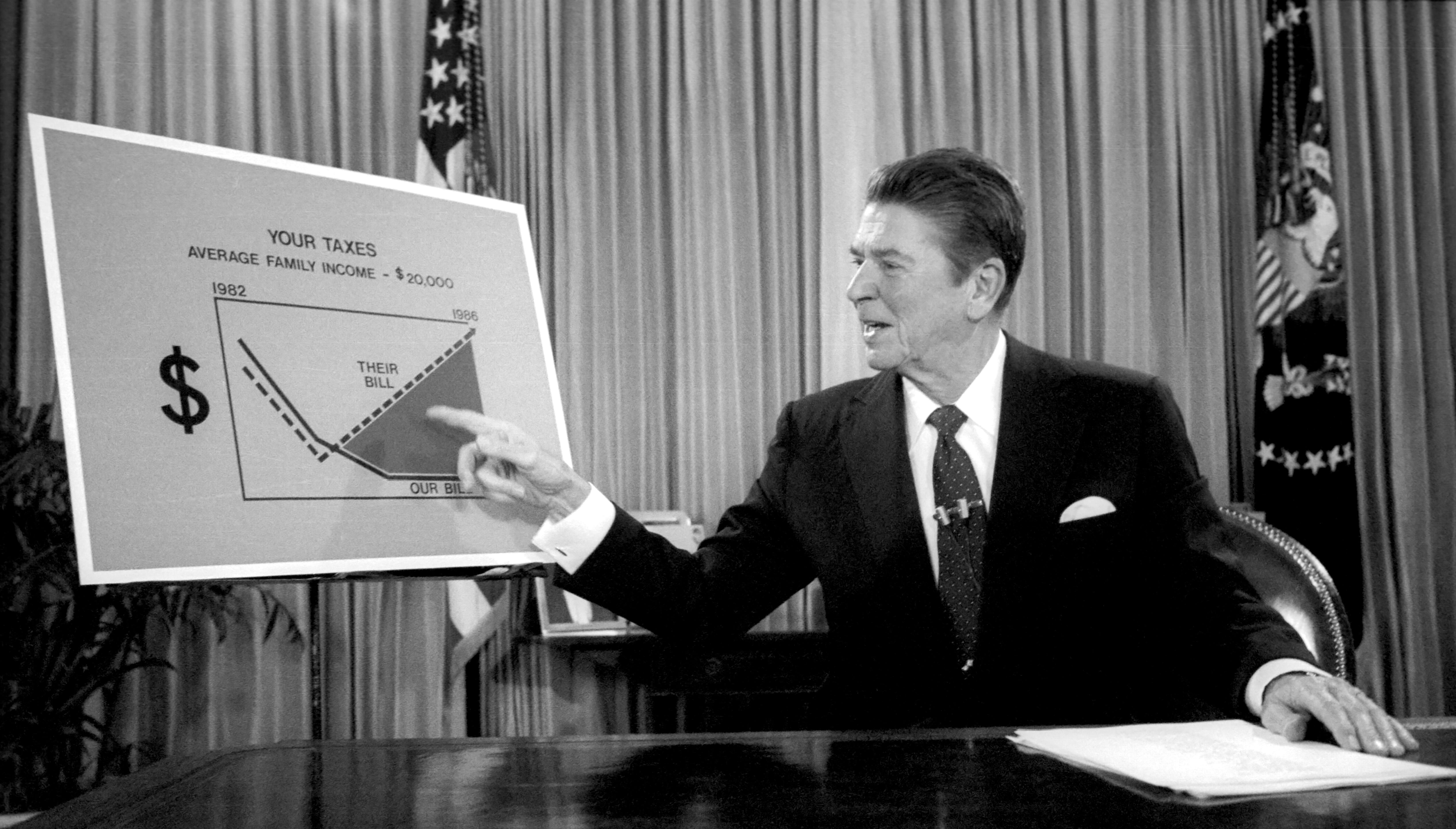
From the late 1940s to 1979, that gap remained pretty static. Then came Reagan, and this marked the march of the elite back to a wealth gap beyond that of the heady roaring 20s. The important point here is that oligarchy really is nothing new; it’s baked into the DNA of the US. economic model. The major difference, though, is that, unlike in the past, where the ‘boiling-frog-effect’ took place quietly in the dark, Trump, America’s new Sheriff of Nottingham, dispensed with it altogether and simply ordered the bottom 90% be thrown into an economic boiling vat of oil, on the assumption that only the strong will survive. In any event, he couldn’t give a damn. He feels his only obligation is to serve the top 10%, 9% of whom he does so begrudgingly, because he’s only really interested in serving the top 1%.
So what on earth does this have to do with the Iran war, I hear you ask. The simple answer is GREED. Since being elected this time around, Trump has utilised everything he learned about exploiting presidential power in his first term. He’s established absolute immunity for his corrupt and illegal behaviour in this second term from the highest court in the land.
The war against Iran is part of a strategy to deploy US military might for personal gain. We know this because central to all alleged diplomatic negotiations are Steve Witkoff and Jared Kushner, neither of whom was elected nor has been confirmed by the US Senate. Neither has any diplomatic expertise, NONE. Their only qualification is that they are members of Trump’s transnational extortion gang run from the Oval Office. They merely act as Trump’s advance team for his self-enrichment skimming operation.
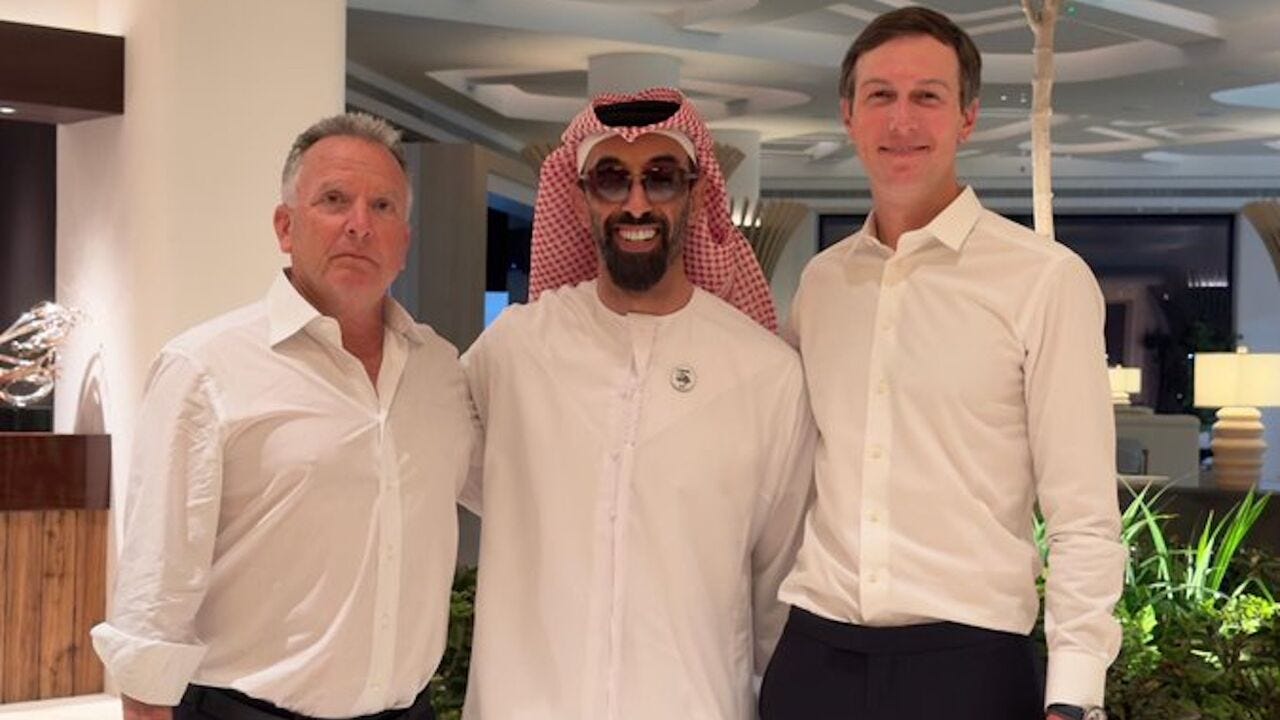
In the case of Middle East peace negotiations, Kushner is at the same time pitching for investment in his investment firm, Affinity Partners. In a report on March 13th 2026, by finance reporters Rob Copeland and Maureen Farrell at the New York Times, they noted:
Mr. Kushner, President Trump’s son-in-law, has spoken with potential investors in recent weeks about raising $5 billion or more for Affinity Partners, his investment firm, according to five people with knowledge of the talks who were not permitted to speak publicly about the discussions.
As part of the fund-raising effort, Affinity’s representatives have already met with Saudi Arabia’s Public Investment Fund, which invests the proceeds of the kingdom’s vast oil reserves, two of the people briefed on the discussions said. PIF is led by Crown Prince Mohammed bin Salman, who has formed close ties with Mr. Kushner and the Trump administration.
The key takeaway here is that NONE, and I really do mean NONE, of Trump’s geopolitical moves are about anything but the potential for adding to his own personal wealth. For him, this is a time-sensitive window in which he must maximise opportunity. People should dispel the thought that any of his actions are about the welfare of the people of the nations he’s targeting. He’s just a maniac kleptomaniac on a march to secure an empire. I’m British, I live in a country that once lived his wet dream.
The one thing history tells us is that empires rise and fall as sure as night follows day. Trump is merely attempting to use the same model on his conquests as the British used in India, a totally one-sided profit-sharing model, but without the protectorate element. While this may have worked in Venezuela and may do the same in Cuba and the other Latin American countries he has his eye on, there is ZERO chance it will work in Iran, a reality he is beginning to understand to his cost.
Once again, arrogance and hubris have replaced strategic thinking and common sense. I’m pretty sure that if there is ever an after-action autopsy of his adventures, it will show that his imbecilic actions ran counter to all military advice. Hegseth’s dangerous religious crusade rhetoric and attempts to dominate the media narrative will be judged for what they are: religious zealotry. History teaches us that religious crusades never end well.
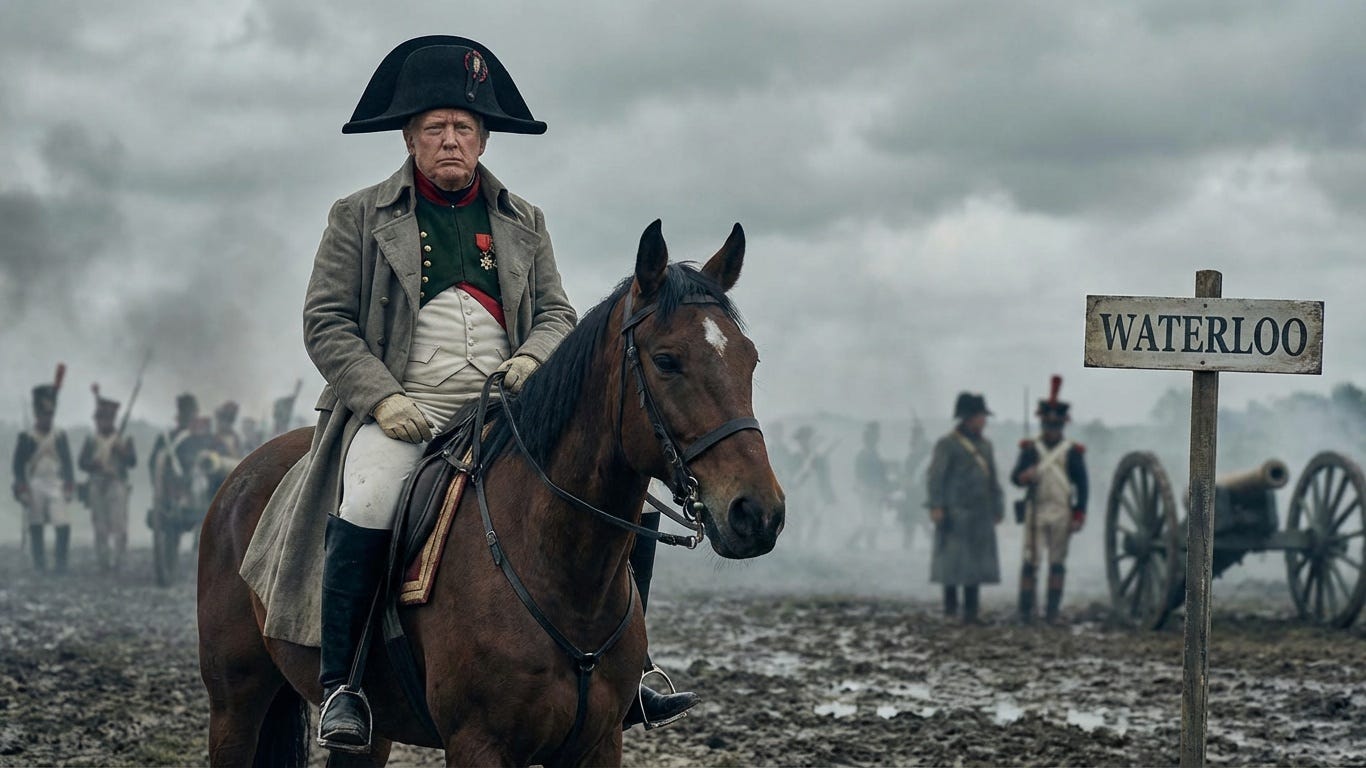
It’s my belief that Trump is facing his Waterloo moment, the definitive loss of Napoleon Bonaparte at the Battle of Waterloo on June 18, 1815, ended his reign as French Emperor. The thing about loss in war is that it’s a timeless byproduct of narcissistic arrogance, and this ‘excursion’ into Iran will be recorded as just another failure by a man who wrongly believed he was invincible.
In the final part of this three-part series, I’ll hopefully bring the threads together to link the power dynamic to its economic and political impact. Trump is about to faceplant and destroy the Republican Party. It’s just another imbecilic unforced error among many. It’s not about whether Trump will fail; it’s about when.
He’s a fading light. I’m far more concerned about the upcoming opportunity for change, which I fear will tragically lead to the same tired corporate Democrats delivering a Republican lite agenda. An administration with little appetite for the transformational change so desperately required if the US is not to face the same tyranny again when Democrats fail, as they will, unless they are prepared to be bold, progressive and socially ambitious.
As a veteran, this is exactly what we’ve seen over and over wars sold for greed while real people pay the price. Generals, politicians, and investors play their games, and veterans and ordinary families are left to suffer. It’s sickening to watch history repeat like this.
Greed … yes . If Iran was to turn over their gas , oil and rare earth minerals to Trump … the war on the regime would be over in 60 seconds . He doesn’t care about the cruelty of the cleric ayatollah regime , or the deaths of the protestors . It’s self enrichment that is his motivation - Jared is paving the way … as all Israeli interests coincide with a land grab and “ new Vegas “ plan and Trump loves rare earth minerals in his pocket. The corruption is out in the open . This is an opportunistic war . But a little bribery could end it …