


Apologies for the delay in posting this; I have had the most awful of days ever. Every part of it went tits up. I couldn't post this early this morning as planned, and then I got delayed on the way home, which made me very late. As they say, though, ‘better late than never,’ and I hope you think it's worth waiting for.
After setting the stage in PART ONE of this two-part post, I want to use this potential conclusion (depending on whether you want me to provide more detail) to walk you through the true power of collective economic disengagement, which has been so underestimated in these times of extreme peril for so many in the US. Just as the exploitation of the poorest Americans is a choice, I have to tell you that taking action to stop it is a very viable choice too. Pain can be a two-way street; it’s NOT about the top 10% being the only winners by any stretch.
Trump has created a K-shaped economy in which the top 10% of households account for 50% of current consumer spending in a heavily indebted economy that depends disproportionately on consumer spending. Trump and those pulling his strings assume that if they can keep the shareholder class happy, then the rest of America is irrelevant. On paper, that might sound fine, especially as the top 10% are currently spending like drunken sailors at the expense of the bottom 90%. In much the same way, the puppet masters also depend on the AI giants and the infrastructure being invested in to support them. Strip out these companies and their supporting industries from the economy, and you're left with growth of just 0.1%. This represents the delusional world Trump inhabits.
In their world, a small segment of corporate America and stock-market beneficiaries is the illusion on which they’ve built a false narrative of economic success. Trump’s delusions are never more evident than when he posts endless AI images in an attempt to embellish the ludicrous reality nobody outside his cult and America takes seriously. Underneath the bluster and the tales of untold wealth that nobody but he and his friends are experiencing, Trump knows that the walls are closing in. He understands the danger posed by the bond markets and the inflation problems his economic agenda continues to create, to the point where he’s desperate to strong-arm his new Fed Chair into cutting interest rates by threatening to cut off trade with trading partners the US runs a trade deficit with. It’s economic madness personified, but it has a purpose.
Trump knows that $40 trillion of debt is unsustainable and that eventually the economy will come tumbling down; his aim is simply to hang on long enough to fill his pockets with cash and leave the mess for someone else to clear up, especially given that he has no option to run for a third term, allegedly. All of the above makes the US economy extremely vulnerable to attack if enough Americans participated in a sustained campaign of strategic economic disengagement. I have written about this at length before, but I’ve now had more time to think about how it could work.
While it’s pretty clear that MAGA devotees are happy to vote against their own interests, allowing Trump to march them into economic slavery, the top 10% have no such mindless habits. So they can be counted out of taking any action against the hand that feeds them; there will be no turkeys voting for Thanksgiving from the asset class.
In this assessment, Trump still has a lot going in his favour, and it’s important to recognise that. His key advantage is that the historic ability for political organising that was prevalent in the days of the Civil Rights Movement is no more. Union membership peaked at 21 million in the US in 1979, falling to a record low of just 14.7 million in recent years. That’s just 10% of the current workforce. The decline in political organising and citizen engagement has been the fuel that has allowed the rise of Trump and other authoritarian figures to undermine and dismantle democracies around the world.
The ostracisation of the truth and the adoption of fantasy narratives have completely turned politics upside down; the establishment of alternative facts has led us to a place where nobody trusts politicians, as shown in current US polls on party favourability, which are almost identical for both parties. The American people simply don’t trust politicians. So if nobody trusts the official opposition at a time when the incumbent president is operating as a corrupt, authoritarian, monarch-type figure, what does that tell you about the state of American politics?
It’s with this fact in mind that I take an apolitical approach to direct action, not driven by political ideology, but rather by economic necessity. Given that the bottom 50% and, to some extent, 90% are being forced to live through an affordability crisis (albeit on a different scale), imposed on them by the greed and incompetence of a failed president. If the focus is purely on the resulting, unprovoked punitive action imposed on those in the middle and the bottom, the question is: can this large group form a coalition to demand change? I believe it’s entirely possible.
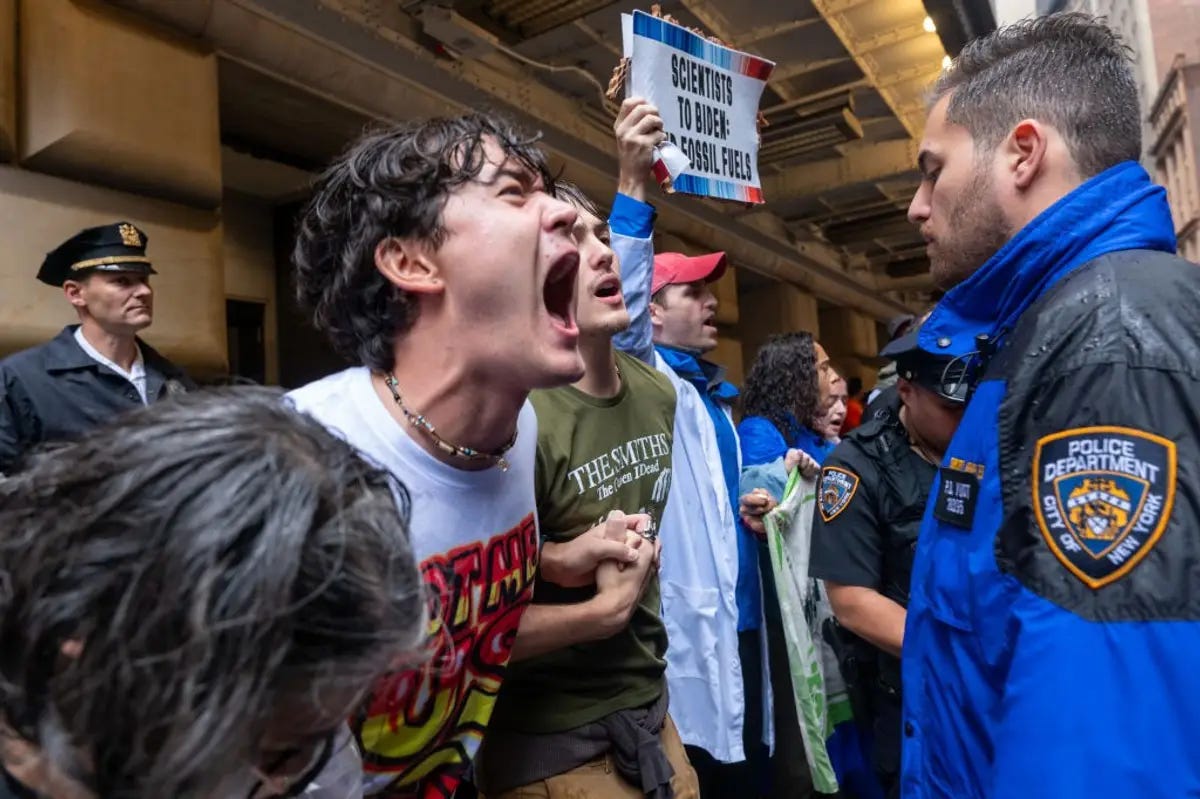
The challenge with every direct action campaign is the government's ability to crush dissent. This is why taking to the streets might send a signal to the government, but without it being at scale and sustained every day for weeks, as we saw in the Arab Spring, it’s sadly just a performative act of defiance that the government can and has ignored. It also has the added advantage of allowing political agitators to cause trouble and force a police or military intervention by the state, during which people might get hurt or even killed, as happened in the past. It might even result in a state of emergency and the suspension of elections.
The single most effective weapon the American people have for low-risk direct action is their purse. It can bring a government to its knees quickly. Even a credible collective threat of a spending strike can cause catastrophic economic consequences in an algorithm-driven stock market fine-tuned to react to risk.
Current consumer spending sits at around $22 trillion, and 50% of that comes from the top 10%. Given that this group has no intention of being the turkeys voting for Thanksgiving, this leaves the bottom 90% with, let’s say, $11 trillion.5 trillion. I think it's reasonable to conclude that many of these will be among those reluctant to inconvenience themselves by not buying the stuff they like, which takes us down to between $5.5 trillion and $6.6 trillion. To trigger a recession, the bottom 50% would need to reduce TOTAL spending by 8%.
Hold that thought for a moment, because we need to discuss ‘discretionary spending’ and non-discretionary spending. Put simply, ‘wants’ and ‘needs’. If we look at the economic demographics, those being hurt the most by this regime, aided and abetted by corporate America, are the bottom 50%. As a result, this group is more motivated to fight for change. The government mistakenly believes it is protected from this type of economic assault by what’s called ‘the high earner shield’. The flaw is that the assumption rests on the illusion of paper wealth. They can only spend freely now while their assets grow or hold value.
If the bottom 50% cut overall spending by just 8%, mass-market corporate revenues would collapse, and companies like Amazon and McDonald’s would suffer massive economic hits. This would instantly feed through to the markets as stocks are obliterated, causing the paper wealth of the top 10% to evaporate; then where does the required consumer spending come from? They will be forced to stop spending in order to protect their assets. Economic collapse then becomes a self-fulfilling prophecy.
The scenario I’m presenting assumes that self-preservation kicks in for the top 50%, and the bottom 50% say ‘fuck ‘em all’ and go it alone. If the bottom 50% do go all in, it’s literally game over; we see a total economic collapse as those higher up the food chain frantically try to mitigate losses. Of course, multiple options are available depending on who participates in the collective act of economic disengagement.
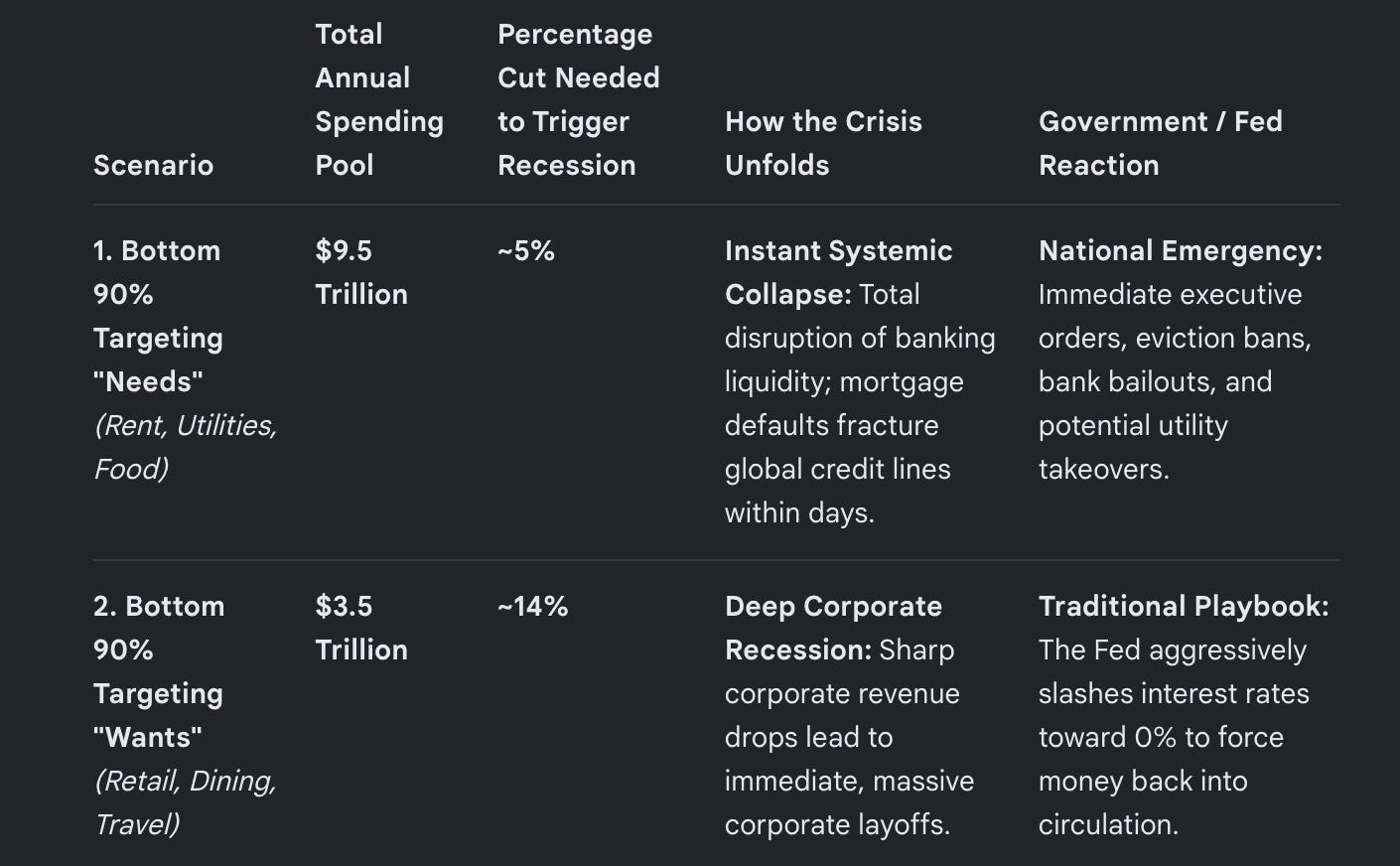
If the bottom 90% participate, then the spending cuts could be limited to ‘wants’ (disposable income spending) rather than ‘needs’ (essential spending). However, if participation is limited to the bottom 50%, then it’s down to cutting ‘wants’ and a small percentage of needs, like withholding part of the rent or loan and credit card payments.
For the sake of saving time, I plugged all the numbers into AI to examine the leverage produced depending on participation, which is split into two sections, one with the bottom 90% participation:
one with just the participation of the bottom 50%
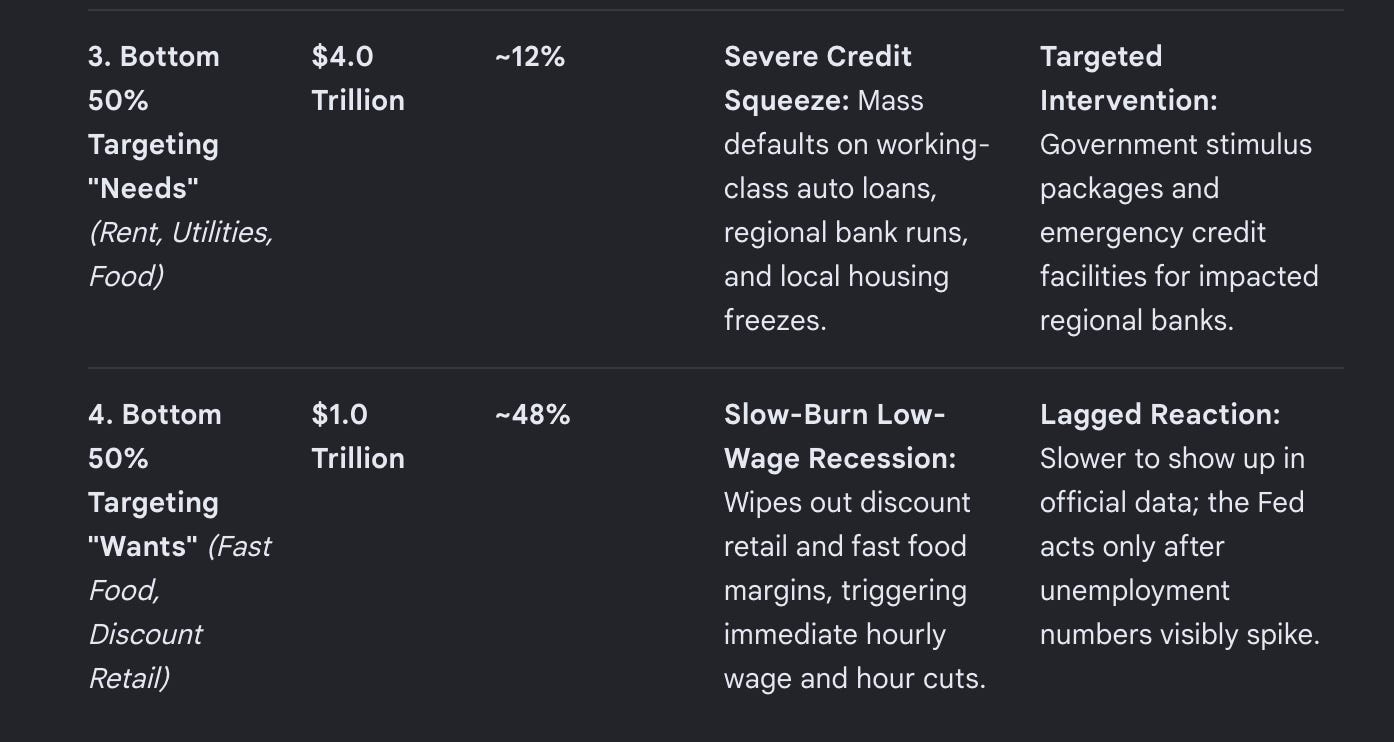
The critical point is that the rich might think they have a shield, but they don’t if those at the bottom have the collective will to go all in. Remember 2008: it wasn't the rich being forced to stop spending; it was the poor mugs who had been sold mortgages by the rich they couldn't afford; that demographic drove the crash. The problem you have with US society, much as we do too in the UK, is that those at the top have convinced those in the middle that if they challenge the system, they will lose everything. The problem for them, is that’s not how the real system is wired, and they should know because they created it. They just assume nobody can detect the huge holes they left vulnerable to attack.
All it would need is to punch a $485 billion hole in momentum to kill the current growth and push the US into a technical recession. That would be a message in itself; the bottom 50% could do that standing on their heads. Markets operate on forward thinking; it’s very difficult for them to factor in uncertainty and respond to events in real time fast enough to provide a firebreak, as we have seen in the oil crisis. The US Treasury has spent serious energy trying to mitigate this. All that’s happened is Bessent has robbed Peter to pay Paul, issuing short-term debt to buy long-term debt, hoping long-term bond yields drop. How’s that gone? Now he faces a potential short-term crisis, which is starting to raise its head.
The long and short of it is that a sudden drop in consumer spending would certainly have a bigger impact than it would have a year ago. As I was saying, forward-looking algorithms act as bouncers at the economic door; they react and protect. As soon as they pick up trends, they are programmed to react, and this is where we need to look carefully at ‘wants’ versus ‘needs’. If a spending strike is based purely on slashing wants, it induces a corporate recession, and those corporations instinctively cut costs to protect falling revenue. This, of course, means job losses and all the economic pain that follows.
As the above assessments show, if participants target even a small share of their needs spending (non-discretionary spending), we have a whole new ballgame. The algorithms would kick in, and we would see systemic collapse, disrupting banking liquidity. Mortgage defaults would have a global impact as in 2008; the first text image above lays it all out. Even the threat of this type of action would be enough to put both the government and those at the top on notice.
What I’ve tried to do here is to lay out the basics of this type of action purely to highlight to people that even those at the bottom who might think of themselves as helpless passengers in this economic car crash hold an economic weapon of mass destruction in their hands. For the purpose of brevity, I’ve just sketched it out from an extensive set of notes in which I have even gamed out a timeline of how the deck of cards would fall.
If people think it would help for me to share the details, I’d be happy to do an extra piece to map it out in more detail; just let me know in the comments. Take it from me: I have worked hard on this, and what I’m telling you holds water. The whole deck of cards could be brought down in 30 days; the only question is, whether enough collective will exists to prove to those who need to know that ‘We the people’ are willing to pull the trigger and make it happen. It’s more powerful than any nuclear weapon, and the poorest among us could make it happen all on their own if the need arises. Even self-preservation action from those above would have little impact, given the collapse would be systemic.
I’m aware, of course, that there will be those who will disagree, but I’m happy to do a roundup post at the very end to directly address any challenge to my assessment. I can, of course, only work on assumed market reaction based on history, and I certainly can’t account for human nature when it comes to how many people would be prepared to take the action, because it’s an all-or-nothing scenario if only the bottom 50% participate. A half-baked attempt would fail, and those participating would face ruin; that’s how high the stakes would be.
If you want to support my work but can’t commit to a paid subscription, you can now make a one-off donation by clicking the image below. Your donation helps cover the cost of research resources and keeps this independent reporting free for all.

I've been saying this forever and you know what? No one cares.
Convenience, that's the focus of American life, the holy Grail and for many, it's worth sacrificing all our personal freedoma and laws to order from Amazon. And before I go into, know that I live rurally and do not order anything regularly online - no Amazon for 2 years now. My closest grocery store is 45 minutes away and no, I do not use Amazon. Social justice and Human rights means more to me that most, I guess.
I started boycotting at the election. Every knew bending corporation I do not purchase from. We're now listening to library books in the evenings, because entertainment choices have become slim.
It's just not that hard to keep my money out of the pockets of those who torture, abuse and vilify democratic norms.
Please join the effort.
And maybe, just maybe we should have put higher aims than convienence on our altars on the first place.
Home Depot, McDonalds and Walmart are being open about massive lost revenue. Multiple chains are closing. I believe the pinch is starting. It may not be a result of intentional boycott but businesses are beginning to see the writing on the wall.