


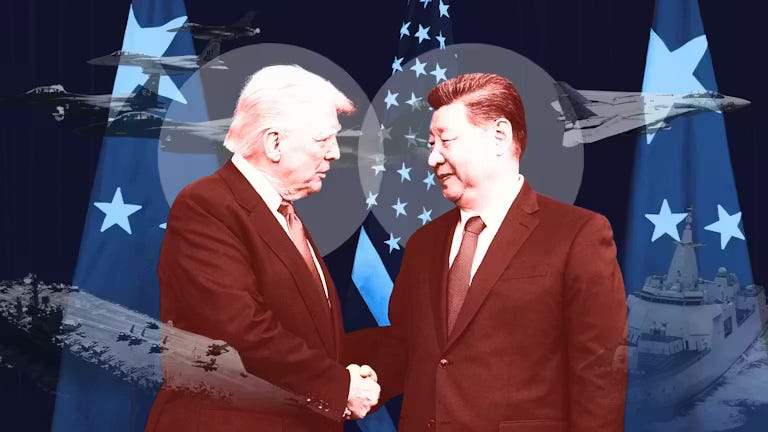
I’m tired and exhausted of singing the same old song when it comes to the bleeding out of American imperial ambition. Never have I been more certain of my assessment of the rise of China than I was following a summit in which an American president was forced to take an entourage of whom Trump sees as the Titans of the US capitalist system as a political security blanket. It was a lame attempt to sell the same fairy tale of American dominance that he’s attempted to sell to his domestic audience.
In so many ways, it has been embarrassing to watch. It’s like seeing an old rock star trying to recreate the days of adulation when the hits rolled off the conveyor belt. A star who once played to packed stadiums, now reduced to singing off-key in a downtown bar, still wearing spandex never designed to constrain a body ravaged by age and overindulgence. This is tragically what Trump is doing to America; he’s the failed manager who can’t see that he’s the cause of this fall from grace and shift from awe to pity.
He has returned to Washington, having been forced to create yet another false narrative that he’s tamed the Chinese dragon, when in truth, the dragon chewed him up and spat him out. He will tout Boeing Aircraft sales and soybean sales to China, but there is no signed agreement, and history shows that China has a poor track record of following through on agreed-upon verbal sales commitments. In terms of wins for China, the fact that they have Trump even thinking about holding up the release of an already agreed-upon arms package to Taiwan is significant and a real tell that Xi was the one negotiating from a position of strength.

Trump has proved to Xi that the mighty US military can’t even defeat a middle power whose economy is struggling due to global sanctions. Marco Rubio can claim that the US does not need help from China to solve the Iranian crisis, but that’s demonstrably untrue. The US, despite claims to the contrary, finds itself in a quagmire, having spent over $30 billion to date. It’s in denial that Trump will eventually be forced into an expensive negotiated settlement with a now emboldened Iran.
There is no military solution to this war of choice. The longer it continues, the more damage it inflicts on the global economy. It has already been assessed that Iran can outlast the economic decline of the nations impacted by the war. The US can claim it is less affected by the closure of the Strait of Hormuz, but it, too, relies on other key commodities that transit through this global shipping chokepoint, beyond oil and natural gas. It’s becoming pointless to repeat this because nothing will change until Trump decides to pay the price Iran will demand.
In my view, it can now be said without fear of contradiction that, unless Republicans are well and truly defeated in November, the decline will continue to the point where it will take decades to recover. I know some believe it’s a point that has already been reached. Trump, however, is totally unconcerned about the damage he will leave in his wake, just as he was in 2020; his sole focus is to stuff as much money as he can into suitcases before the hammer falls.
He knows the writing’s on the wall. That’s what makes him very dangerous in the run-up to the midterm elections. The thing Trump fears most is losing his grip on power. He fears that, marginally less than being held accountable for the economic destruction he’s caused as a result of his corruption while in office.
As the walls close in on his power, Trump is working around the clock to shape the narrative around election integrity and the nothing burger he is attempting to turn into an existential threat to American democracy. In a report by Samara Angel, Senior Research Analyst and Jonathan Katz, specialist in Governance Studies, Anti-Corruption, Democracy, and Security (ACDS), for the Brookings Institute, they note:
In our analysis, we found the total mail voting fraud percentage was minuscule, at only 0.000043% or approximately four cases per 10 million mail votes. We also determined that universal vote-by-mail systems had the lowest level of already negligible fraud. Mail voting was used by nearly one-third of voters in the 2024 general election, and substantial state and federal safeguards are in place that make voting by mail secure.
In a key takeaway, as expressed in the DC federal court, the report notes:
Judge Kollar-Kotelly also wrote: “Put simply, our Constitution does not allow the President to impose unilateral changes to federal election procedures.” The implementation of certain provisions of the executive order has been blocked in three federal courts as of mid-April 2026, though litigation is ongoing.
The whole piece is well worth reading to help you understand how executive action is being weaponised to put a finger on the scale, based on a completely false narrative that elections are inherently unsafe because of mail-in ballots. It’s simply another justification to indulge in targeted voter suppression, as is the current redistricting arms race.
One interesting takeaway from the piece is that :
For rural voters, decreased mail voting access could pose a significant challenge. One study published in the American Economic Journal showed that each additional mile from a polling location decreased the likelihood of voting in person by 1 to 3 percentage points, with mail voting operating as a substitute when accessible.
It seems to me that at the altar of a voting fraud percentage of 0.000043% (that’s approximately four cases per 10 million mail votes):
Voters with disabilities, who make up nearly one-sixth of the electorate in 2020, could likely be affected by this executive order. Disabled voters in the U.S. often face accessibility challenges at in-person polling places. Policies that advance easier mail voting can help address the disability turnout gap.
Older voters could also face significant barriers under this executive order. In the 2024 general election, voters over 65 were “most likely to vote by mail.”
In short, it has NOTHING to do with voter fraud and everything to do with an attempt to control the voter pool. The concerning thing, though, is that this is just one measure in a barrage of obstacles being erected to influence the outcome of the midterm elections. All these obstacles are part of a sustained attempt to create a shadow legislative program of voter suppression using executive action. This has been done in the knowledge that it takes the courts' time to play catch-up in order to nullify these premeditated attempts at targeted voter suppression. The same will be the case during the election, casting enough doubt and uncertainty over any unfavourable outcome.
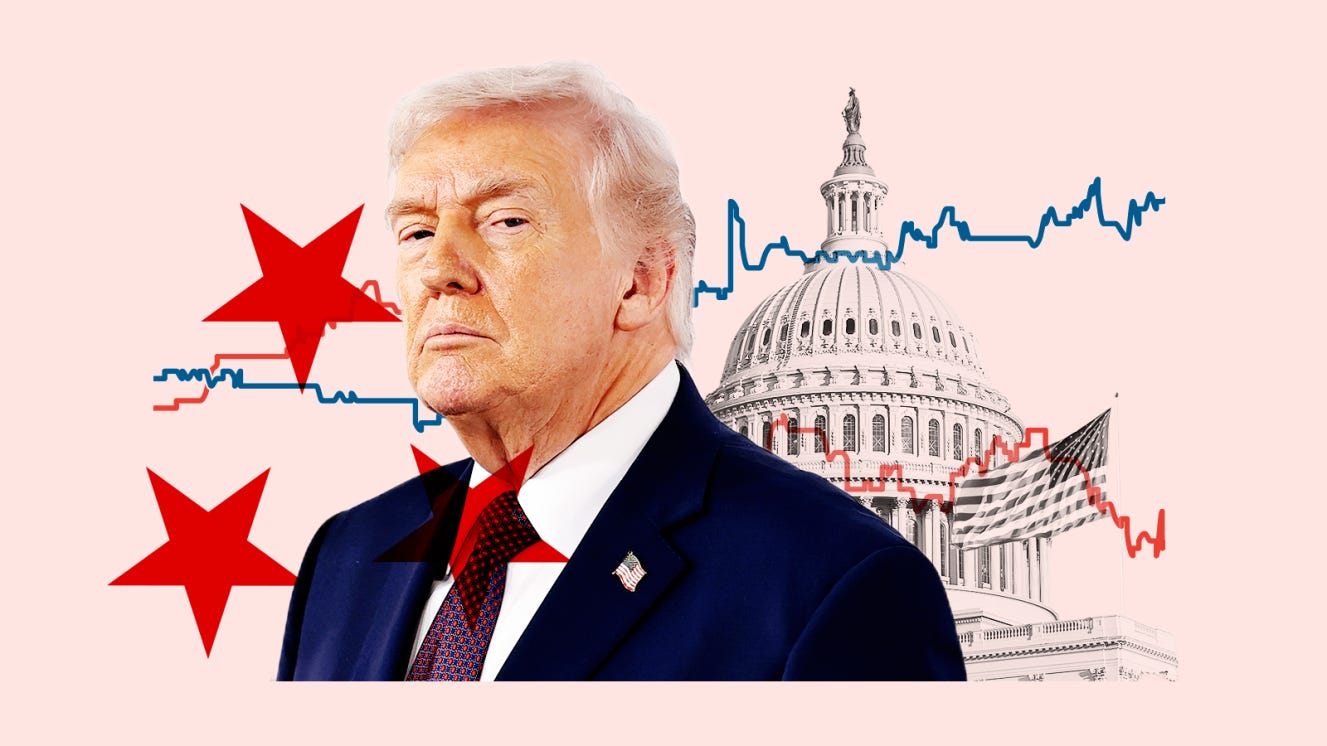
In an excellent piece by Politico, in their words, they:
Reached out to non-partisan voting experts with a simple but urgent question: What is one concrete, realistic step that should be taken now to protect the midterm elections?
The key recommendations are listed in the bullet points below. You can then review the details by reading the relevant section of the article.
Edward B. Foley is a professor of law at the Ohio State University:
Who: State election officials and legislators
How: Review and reinstate deadlines immediately
Alexandra Chandler is the director of Impact Programs, Free and Fair Elections at Protect Democracy:
Who: State election officials
How: Prepare a playbook for ballot seizures
Galen Sheely is the research director for the Voting Laws Roundup project at the Democracy Policy Lab at the University of California, Berkeley:
Who: State legislators
How: Draft legislation preventing federal election interference
Paul Gronke is director of the Elections & Voting Information Centre at Reed College. Lauren Prather is co-director of the Centre for Transparent and Trusted Elections at the University of California, San Diego.
Who: Candidates, members of Congress and election officials
What: Tours of election offices
Richard L. Hasen is professor of law and political science at the University of California, Los Angeles and director of the Safeguarding Democracy Project.
Who: Court administrators, candidates and election administrators
How: Prevent a seizure of ballots ahead of time
Wren Orey is director of the Bipartisan Policy Centre’s Elections Project:
Who: Congress
How: Secure funding with the Presidential Election Campaign Fund
As you can see, there is no shortage of suggestions from a variety of well-qualified experts, but the bottom line is that real reform can’t be implemented within the required timeframe. As pointed out by M.V. (Trey) Hood III, professor in the department of political science at the University of Georgia and director of the SPIA Survey Research Centre:
Attempting to implement major changes to a jurisdiction’s election system invites the possibility that issues, some unforeseen, may arise. If this were to happen, it would damage voter confidence and, unfairly or not, possibly raise questions about the legitimacy of the outcome of the election.
Rest assured that Trump will leave no stone unturned in his efforts to control the voter pool for November. This is all going to come down to a battle of will. Voters will have to take responsibility to stay alert to every step that might be taken to stop them from exercising their constitutional right to vote. There will be a continuing need to check your voter registration and to have readily available documentation proving you are a US citizen. I understand that for some, this requirement alone will be a barrier to participation, given that it amounts to a poll tax for those who can’t afford to obtain the required documentation. The closer we get to election day, the more aggressive the fight will become, and the more vigilant voters will need to be.
Be in no doubt, this will be an election like never before. Trump WILL attempt to deploy his private militia to intimidate voters under the guise of election security measures. Ballot drop-off points will be limited, and the focus will be much wider than just swing states, because the threat to Trump’s power will be coming from across the country. This is a moment when complacency will not cut it, I’m afraid.
It will take decades to recover for another reason - and that is the loss of trust. A loss that is emphasised by the destruction of the very checks and balances that might have provided some hope that the next president will not be able to convince most of the world that what he commits to will be respected by future incumbents. America has fallen behind in more than economic strength - it has undermined education, research and its allies, it has fallen behind so far in education that more than half of its population probably don't know the difference between England and the United Kingdom, let alone where it is - and think that Europe still works with a cart and horse
Such a good article. I think there will be intimidation, confrontation, and instances of overt conflict, at the ballot boxes in November. Whether ICE, paramilitias, GOP lawsuits/operatives, and/or vigilantes, I have no doubt there will be widespread intimidation. It is time for courage and determination to stare down those who would prevent this election. Who will law enforcement back? How about National Guard? To me, all of Trump's cards are on this. He wants allegiance above all. And the only way he will win is to prevent it from happening.