



Here we go with another mystery week in Trump world, where we try to guess what he has in store for us this week. I thought it might be a good idea to grab a coffee and pull up a chair, so I can share my broader thoughts on where we are in this moment.
A week ago, I wrote a four-part piece on Gaza.

I stated at the time that this piece would likely lose me more friends than it made me, and I wasn’t wrong. Almost 1000 subscribers walked away, which I have to admit was more than I had expected. As I have said many times, I am not here to tell people what they want to hear; I’m simply here to tell the truth, regardless of how uncomfortable that might be. Taking a hit for telling the truth has always been an occupational hazard for me. I had it on X if I dared to criticise Democrats and certainly for speaking out against Israel from the early days of what I could see coming.
It is said that you know you are touching a nerve when you evoke a reaction of that nature. I have always said that I will fight for the right of anyone to disagree with me; that’s how a democracy should work, and a healthy opposition of ideas is the bedrock of a functioning society. It’s about having conviction in your beliefs that builds strength. Over the last 48 hours, new subscribers have now surpassed those lost from our truth-seeking community a week ago. So, to all my new friends, welcome! It’s great to have you on board, and I look forward to sharing my ramblings with you moving forward. To those who stood firm and offered their support for the piece, thank you; it means the world to me.
Whether you’re new or have long endured the hard truths found all too often here, I thought we might relax a little today, take a step back and look at the big picture without that picture being Sydney Sweeney’s, because most of our jeans are blue and eugenics is a threat, not an Ad campaign. It was, however, a textbook example of how the far right messaging machine can weaponise an insinuation and get the liberal outrage machine to advance their talking points for free, all adding to the distraction from Epstein. We really are nothing if not predictable.
For me, the primary takeaway from last week was Trump firing the director of the Bureau of Labour Statistics for the downward revisions of the May and June job numbers. He was happy to accept the numbers at the time, but his narcissistic personality simply would not allow him to accept the real numbers, so he sacked the messenger. The alarming thing is that a bunch of Republican lawmakers piled in to agree with his decision, while in the same breath, supporting him in his threats to fire Jerome Powell. They know better; they know it’s a perilous move, yet self-preservation and career advancement are their concern and not the danger to the economy and the American people.
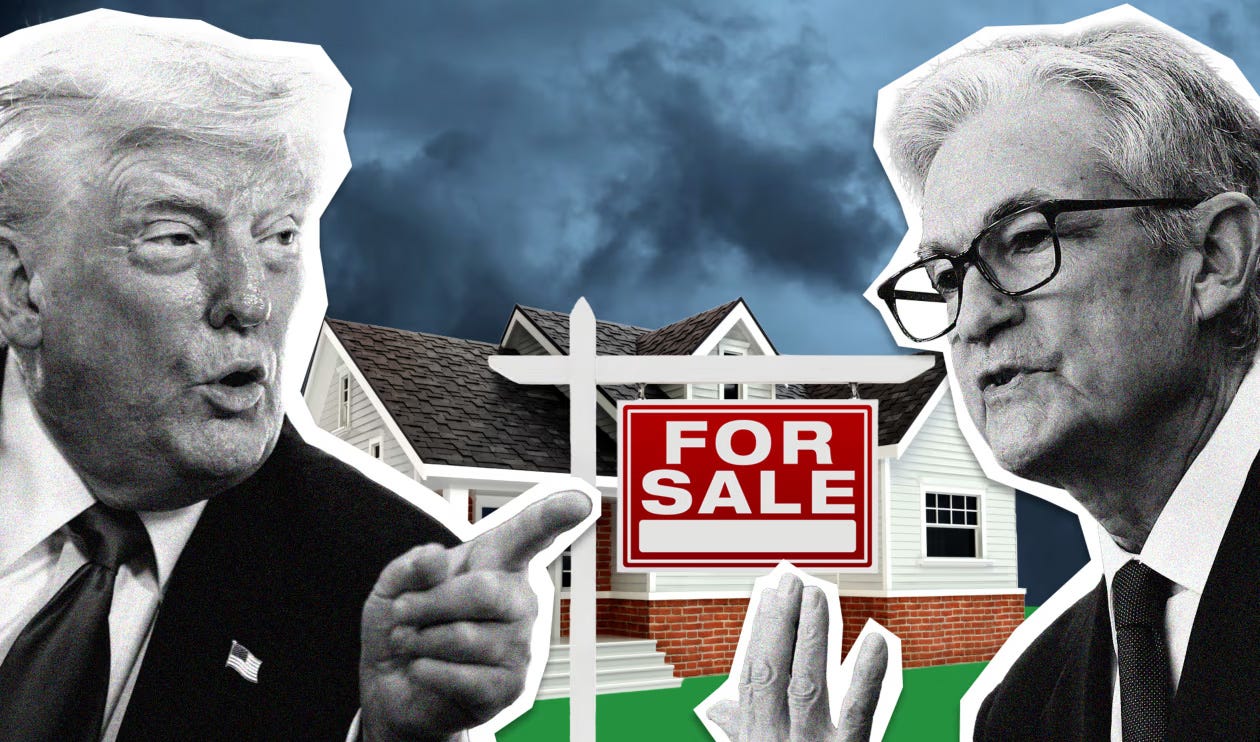
It represents a clear breach of their oath of office and is a total dereliction of duty, but sadly, they have no shame. As I have mentioned previously, the administration is examining new ways of measuring both GDP and inflation. If you link these to the control of interest rates, you are cooking up a perfect storm, which may take decades to recover from. The truth will disappear, leaving the American people to believe the head of the household, who is concealing the mail informing them that the country has been foreclosed on. This is a man so self-obsessed he can’t even play an honest round of golf.
I want to spend some time today to spell out in the simplest of terms the implications of tariffs for everyday Americans. I did do a piece last week attempting to explain it, but some commented that too many Americans aren’t literate enough to understand it. So I’m going to take another stab at it at the end of this piece, in the hope that a 7th grader will hopefully understand.
THE IMPACT OF US LITERACY RATES
As a preface to today’s piece, it is worth looking at literacy and numeracy in the US. I’m going to use data from the National Centre for Education Statistics (NCES), a government website. I’m using data from the Program for the International Assessment of Adult Competencies (PIAAC). This Data Point summarises the number of U.S. adults with low levels of English literacy and describes how they differ by nativity status1 and race/ethnicity.’ I have linked it above if you want to read the details.
The bottom line is:
Between 2017 and 2023, there were increases in the percentages of adults performing at the lowest proficiency level (Level 1 or below) in both literacy and numeracy: in literacy this percentage increased from 19 to 28 % and in numeracy from 29 to 34 %. The percentage of U.S. adults performing at the lowest level in adaptive problem solving in 2023 was 32 %.
The percentages performing at the highest level (i.e., Level 3 or above) in 2023 were 44 % in literacy, 38 % in numeracy, and 32 % in adaptive problem solving.
There is no better illustration of the haves and have-nots than the graphs below. The country is divided into two.
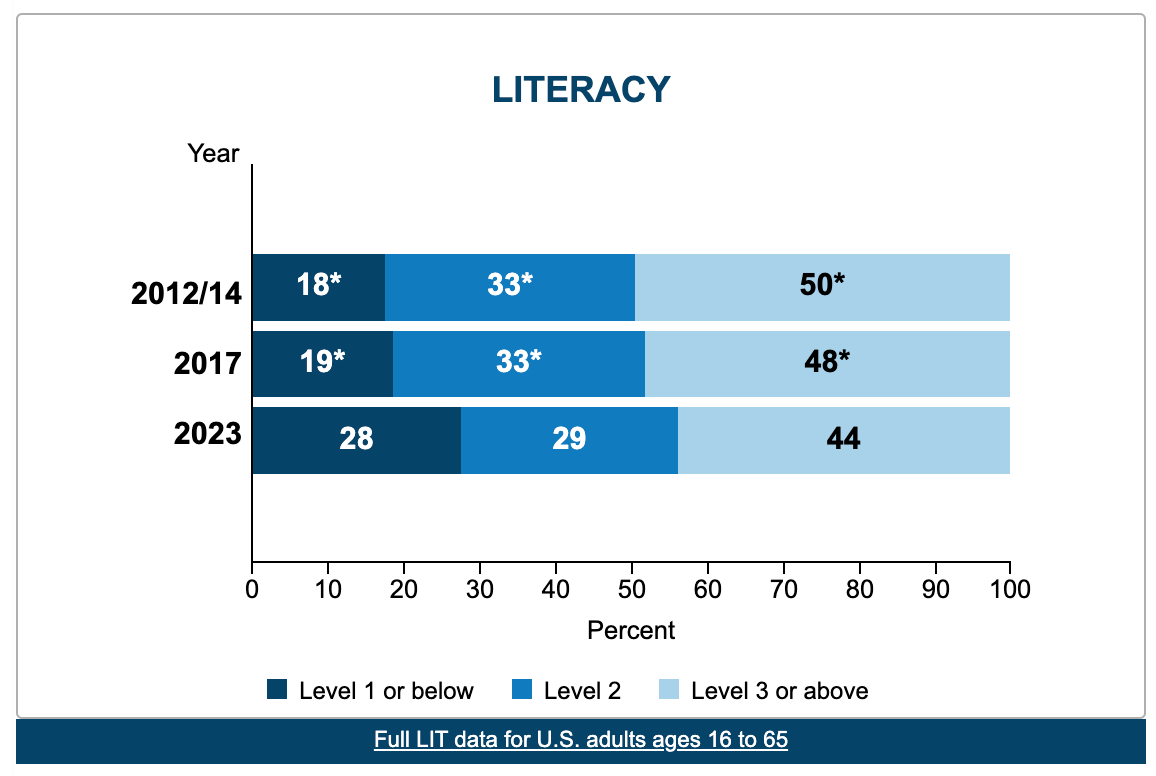
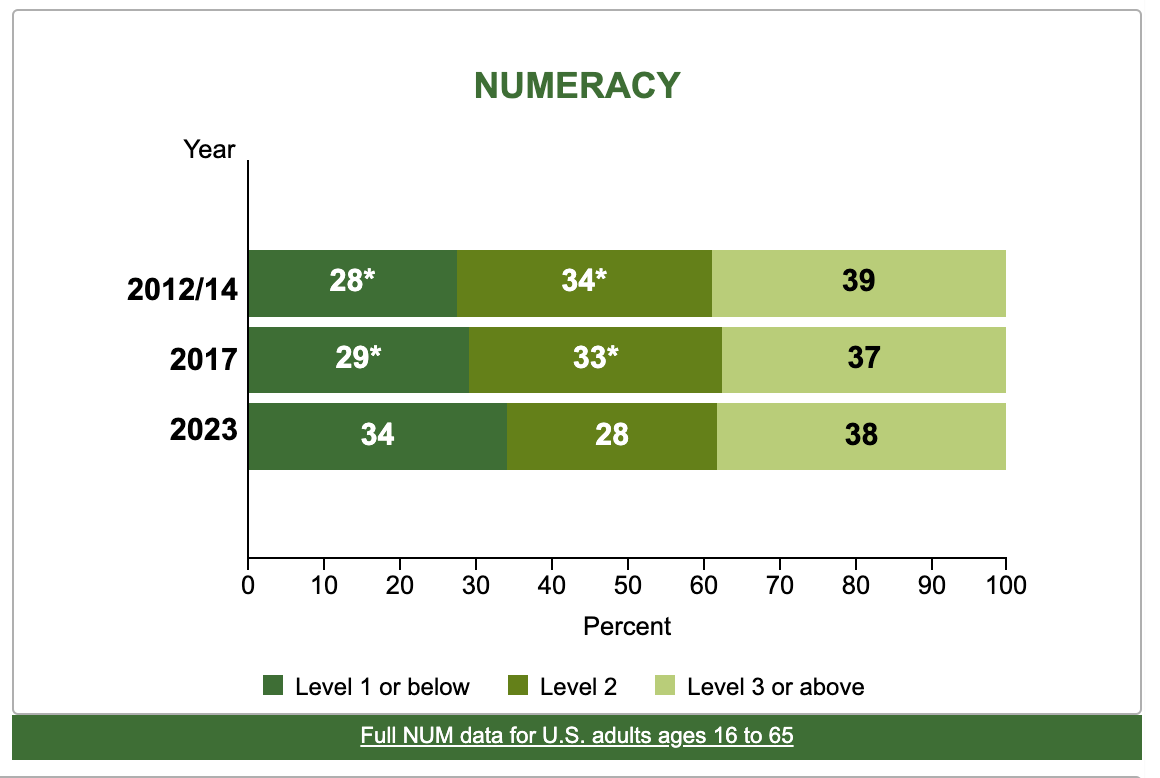
It is a sad and harsh reality that an estimated 21% of Americans are considered illiterate, with 54% having literacy skills below a 6th-grade level. If you look at the graphs above, you will see that literacy and numeracy are not improving. Between 2017 and 2023, level one literacy increased by 9%. Numeracy levels have historically not fared well, but even numeracy has deteriorated by 5% in the same period.
You can’t claim you are the wealthiest, most powerful nation on earth without hanging your head in shame that this is being achieved at the expense of the education of future generations. To have a 21% illiteracy rate is frankly an indictment of the lack of investment in America’s future. By comparison, China, the number one economic competitor of the US, has a literacy rate measured by the OECD at 97%, with some independent studies showing 99.83% in 2021. It is worth noting that literacy in rural areas of China lags at 87.13%. Those would be the ‘peasants’ that JD Vance refers to.
There is no question that, despite the US's demonetization efforts, China has eradicated poverty and boasts a literate and numerate population, along with a significantly larger pool of highly educated graduates, which supports its rapid advancements in technology and engineering. Unfortunately, the US's best response is not to educate its future generation, but to try to limit its access to technology and chips, which is having little impact on China’s ability to press forward. Trump believes he can bully his way to progress, which does nothing to shake off his title of ‘global village idiot’.
The US aims to reshore jobs from China, the country that has become the global leader in automated manufacturing. It has achieved its world-class export capacity through massive investment in top-tier infrastructure and a highly educated workforce. US companies chose China because it had invested in infrastructure for decades to prepare for future economic expansion. China is prosperous because it has reinvested in its people through what it would regard as gold-standard people-focused investment, education, affordable housing, childcare, and support for families. Unfortunately, this is somewhat tarnished by its human rights track record.
The US can call them communists all day long, claiming their people are slaves to the government, but you will see no homeless people on the streets or drug addicts on street corners. Access to housing, education, and healthcare is available to ALL Chinese people. Before you ask, no, the Chinese government is not paying me to tell you this; it is simply the truth.
There are now many US and other International influencers that document everyday life in China, and if you don’t want to believe them, you can go take a look for yourself. You can now transit through China visa-free for 10 days. You’re free to travel where you wish, provided you don’t go near military sites. You can travel around and get accommodation at a fraction of the cost of the US. The bottom line is, they are very proud of what they have achieved in a mere 30 years and are happy to share their progress with the world. There is no overt police presence, and the streets are considered safe and clean; women don’t have to fear being out alone at night, and the people are polite and friendly.
The critical takeaway here is that, in my opinion, China will eventually become the largest global economy, not through traditional military power projection and bullying, but simply by being the best at what they do. Let us not forget that they built their global economic powerhouse with Western money from companies looking to exploit cheap labour. Nobody forced the West to ship their jobs to China; they simply baited the trap, and the West dived in headfirst to gorge itself on higher margins through exploitation of Chinese cheap labour. The government positively encouraged it, because they played the long game and knew greed would blind these corporations, getting fat on what they thought was them taking advantage of China.
In truth, it was the other way around; China used the money to invest, at times up to 30% of its GDP, in infrastructure. They eradicated poverty and educated the population because they had a long-term vision, which is now coming to fruition. It goes much deeper than that, though. When you plan, you look at all the angles as part of creating a Western dependency on Chinese exports. They no longer imitate; they now innovate. You can present the argument about state control of capital and the unfair advantages given to Chinese companies through state subsidies. This has always been the case since the inception of shipping jobs to China. China does not have shareholders; it considers the people to be the shareholders.
Human nature dictates that there are uber-rich Chinese citizens, the difference is that the Chinese government do not allow the rich to become rich at the expense of ordinary Chinese people being forced to live on the street, not be able to afford healthcare or education for their children. Its competitors simply have to live with this simple fact of life. Does China have problems? Yes, it does. It has a massive property crisis, and there is no question that US sanctions have had a significant impact. The key difference is that they plan long-term, not short-term, and they were aware that Trump would take the actions he has, so they have taken steps to mitigate the impact. Trump thought he could just bully them and get his way. Never has an assessment been so wide of the mark.
We must never forget that China has a poor human rights record, and in no way do I want to diminish the importance of this when talking about China. You can read the Amnesty International China 2024 report, which makes for some hard reading for advocates of human rights, which should be all of us. The opening summary of that report reads:
The [Chinese] government continued to enforce repressive laws and policies that restricted the right to freedom of expression and other human rights. Human rights defenders were arrested, prosecuted and sentenced to long prison terms. Activists living overseas faced threats and intimidation. New restrictions on religious freedom were introduced in the Xinjiang Uyghur Autonomous Region and prosecutions of intellectuals, artists and other Uyghur cultural figures continued. Chinese authorities’ repression of Tibetan culture and language intensified. Renewable energy generation capacity was expanded but China remained heavily reliant on coal. A new national security law further restricted civic space in Hong Kong where dozens of pro-democracy activists were sentenced to long prison terms.
To be very clear, I defend NONE of it and condemn the repression of the right to freedom of expression. It is wrong and indefensible. The points I would make are:
Chinese human rights are not something new. They have long been part of a culture where the government exerts control over its population. The state has long exerted control over its people. It has never been a barrier to doing business with China; indeed, Western corporations have taken advantage of that control to make big profits. I can’t recall a human rights levy ever being applied to Chinese exported goods.
Given the current US human rights violations taking place across the country. The abduction of people from the streets by masked men from a state-controlled security apparatus, the control of the media and a willingness to deploy the military to crush dissent, I hardly feel the US is qualified to judge the human rights violations being committed by China. Feel free to read the latest Human Rights Watch report for an update.
TRUMP’S TARIFF STRATEGY
Trump’s tariffs were never about the use of tariffs in the traditional sense of protecting domestic manufacturing; they have simply been used as leverage to increase government revenue. Before he came to office for his second term, the US was generating revenue based on an average tariff rate of 2.3%. Since moving back into the White House, the primary objective has been to establish a global price for conducting business with the US. The average tariff rate is currently 18.3% which is the highest since 1934. This will rise after the implementation of new tariffs on August 7th; it’s going to be above 20%.
The important thing here is that the so-called ‘price of doing business’ with the US is NOT a cost to the person selling the goods—for example, selling sneakers into the US COSTS CHINA NOTHING. They just ship the sneakers as usual at no additional cost to them. The Trump magic act begins once the sneakers arrive at a U.S. port of entry. TO BE VERY CLEAR, the company that has imported the sneakers then pays(in the case of China), a 30% TAX(tariff) to the US government before the sneakers can be sold in stores. The critical thing to be aware of is that the importer will simply pass his/her cost on, and ultimately, you, the US consumer, will pay the tax with a higher shop price for the sneakers. That’s it, tariffs in a nutshell, children.
This, of course, applies to all imports coming into the US, and the amount of TAX(tariff) paid will vary depending on the country which exported the goods. This means that any consumer items coming into the country will be taxed at the port of entry. That tax WILL ultimately be passed on to US shoppers. No foreign country will bear the cost of the US's higher-priced items in the shops, from groceries to shoes. The impact would have been even greater had Trump not excluded smartphones, computers, and other electrical goods imported from China.
To better understand the breakdown of how tariffs work, here are a couple of basic examples from an article by Croner-i. Of course, there might be a longer chain to the shop selling the goods to the retail customer, but this gives you a basic idea of the cost breakdown.
Example 1
Exporter sells goods for $90. Shipping and insurance costs $10. Duty charge of 0%.
Total cost to the importer: $90 + $10 = $100.
Importer is also the retailer to the public and charges a margin of 50%.
Selling price to final consumer: $100 + ($100 x 50%) = $150.
Example 2
Position after tariff of 25% is charged and full cost passed to customer.
Exporter sells goods for $90. Shipping and insurance costs $10. Duty charge of 25% — this is applied to the cost of the goods, plus any shipping and insurance costs to get the goods to the point of entry. Duty due: ($90 + $10) x 25% = $25.
Total cost to the importer: $90 + $10 + $25 = $125.
Importer is also the retailer to the public and charges a margin of 50%.
Selling price to final consumer: $125 + ($125 x 50%) = $187.50.
As can be seen, the price to the consumer increases significantly (by $37.50), with the seller’s margin being applied to the tariff plus the cost of the tariff being borne by the consumer.
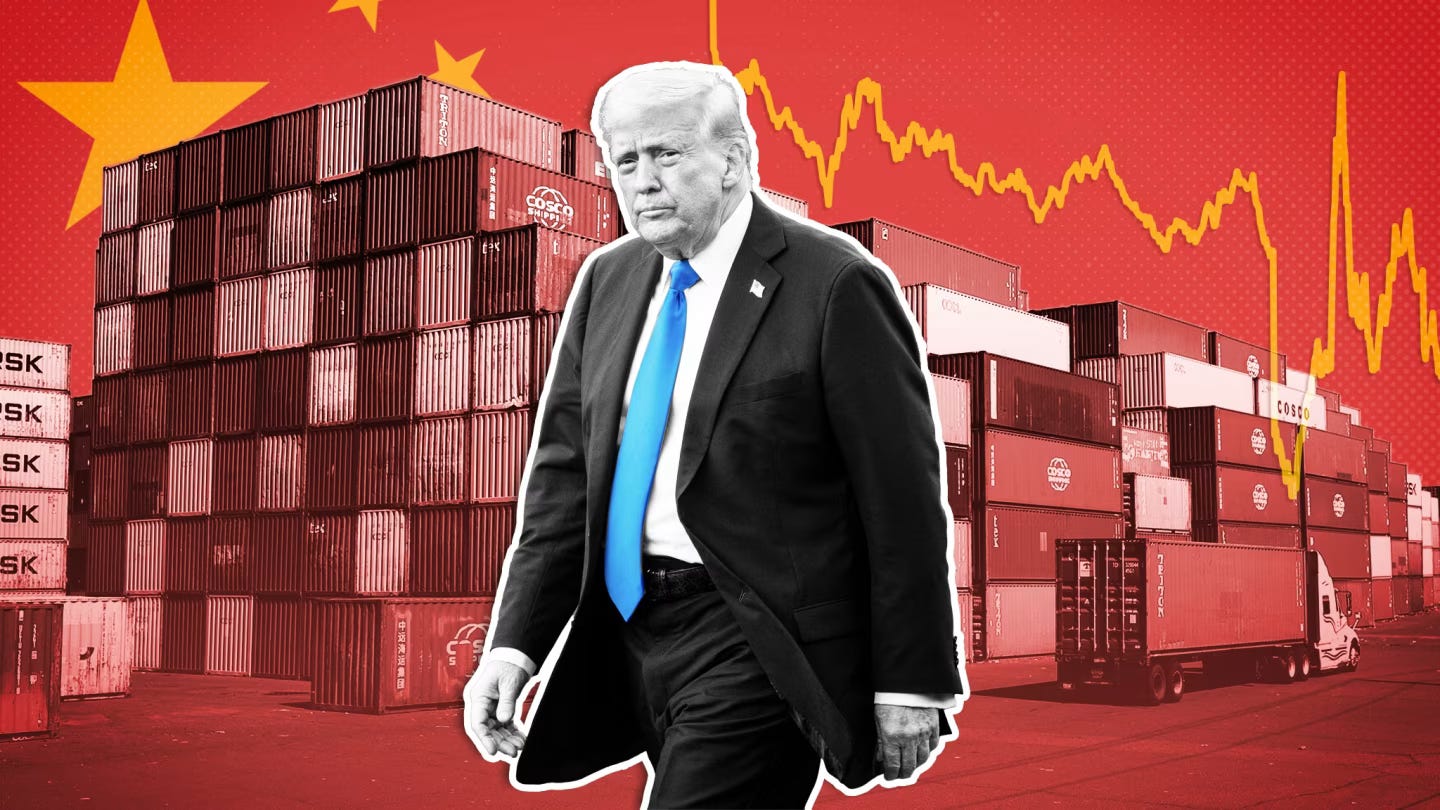
It’s all been designed deliberately to confuse people with differing rates and carve-outs for specific products. The key is that YOU, THE CONSUMER, will ultimately bear the cost of the tariffs, so all the money Trump is bragging about forcing countries to pay is a bare-faced lie; YOU are ultimately paying the tax. So when he claims ‘We have more money coming in than we know what to do with’, that’s YOUR money, not China’s or Europe’s. It is effectively a federal sales tax, and as with any sales tax, it hits the poorest in society the hardest, which is why this revenue stream has been structured in this way.
It goes much deeper than that, though; it goes to the very heart of the American economic engine. As prices go up, so does inflation, but that is only half of the story. Tariffs impact US companies that employ American workers. Tariffs increase the cost of assembling products in US factories due to the now-tariff-elevated price of imported components, such as steel or aluminium. As the cost of these products increases, they become harder to sell and export, making US manufacturing less competitive. Ultimately, this leads to layoffs and failed export targets. This then leads to higher unemployment and the revised job numbers that Trump was so angry about.
We are already witnessing lower company profits and, in the case of the auto industry, billion-dollar losses. This is not rocket science; Trump is creating an economic illusion with the taxes he’s imposing on American businesses and shoppers. That is not going to get better after August 7th; it’s going to get worse, and let me reassure you, it has absolutely nothing to do with lowering interest rates.
The American people will soon be flying blind in an illusory economy where Trump acolytes will cook the books and deliver fantasy economic numbers that will serve to do nothing other than defer the collapse of the US economy. I am not exaggerating when I say we are about to enter the economic twilight zone. It won’t matter to Trump and his rich buddies when the deck of cards collapse; they will already have shifted their wealth overseas and out of danger. It will be you left holding the fiscal IED when the music stops, because believe me, it will, and it has the potential to make the 2008 crash look like a walk in the park.
We stand with you! I will be sharing your substack and asking people to follow you. Sensible human beings, that care for life existence, need to look themselves in the mirror.
Jesus is watching… that’s my typical response when topics come up among friends, family, or colleagues. I don’t consider myself exempt.
It’s hard to even wrap my brain around the magnitude of corruption (not only in politics, but globally) and I always wonder how do they sleep well at night?
I could go on and on….
Thank you, for your words of wisdom and facts.
Thank you. So the tariffs collected are paid directly to the feds? That's why you referred to them as a federal tax? We, the consumers, are then sort of repaying the /manufacturer/wholesaler/retailer via the higher prices on the goods? So Trump's motivation for raising tariffs is to make up for the tax deficit due to a federal tax structure that favors billionaires. Ok, I think I got it. :)