


This is PART THREE in a five-part series of posts on the state of the US economy. You can read PART ONE and PART TWO if you'd like to catch up.
Every piece of evidence indicates that the Republicans are not and never have been the party of fiscal responsibility. 10 of the last 11 recessions have been presided over by a Republican president. Since 1977, both parties have held the presidency for roughly the same amount of time, around 24 years. During that time, Republicans have created approximately 17 million jobs, while Democrats have delivered almost three times that amount, 50 million.
In a report from the Economic Policy Institute (a non-profit, non-partisan think tank founded in 1986), dated April 10 2024, they note that since 1949, data shows:
Annual real GDP growth is 1.2 percentage points faster during Democratic administrations than Republican ones (3.79% versus 2.60%).
Total job growth has averaged 2.5% annually during Democratic administrations, while it is barely over 1% annually during Republican administrations. Applied to today’s total workforce, this would imply nearly 2.4 million more jobs created every year under Democratic administrations.
The Democratic advantage is even larger in private job growth than it is for total job growth. Notably, business investment is higher during Democratic administrations, with investment growth running at more than double the pace than it does during Republican ones.
Average rates of inflation—both overall and “core” measures that exclude volatile food and energy prices—are slightly lower during Democratic administrations.
Families in the bottom 20% of the income distribution experience 188% faster income growth during Democratic administrations.
To better understand where we are today, we need some benchmarks that are NOT alternative facts. A good place to start is the wealth gap. In a Pew Research report from January 9th 2020, they note:
From 1981 to 1990, the change in mean family income ranged from a loss of 0.1% annually for families in the lowest quintile (the bottom 20% of earners) to a gain of 2.1% annually for families in the highest quintile (the top 20%). The top 5% of families, who are part of the highest quintile, fared even better – their income increased at the rate of 3.2% annually from 1981 to 1990. Thus, the 1980s marked the beginning of a long and steady rise in income inequality.
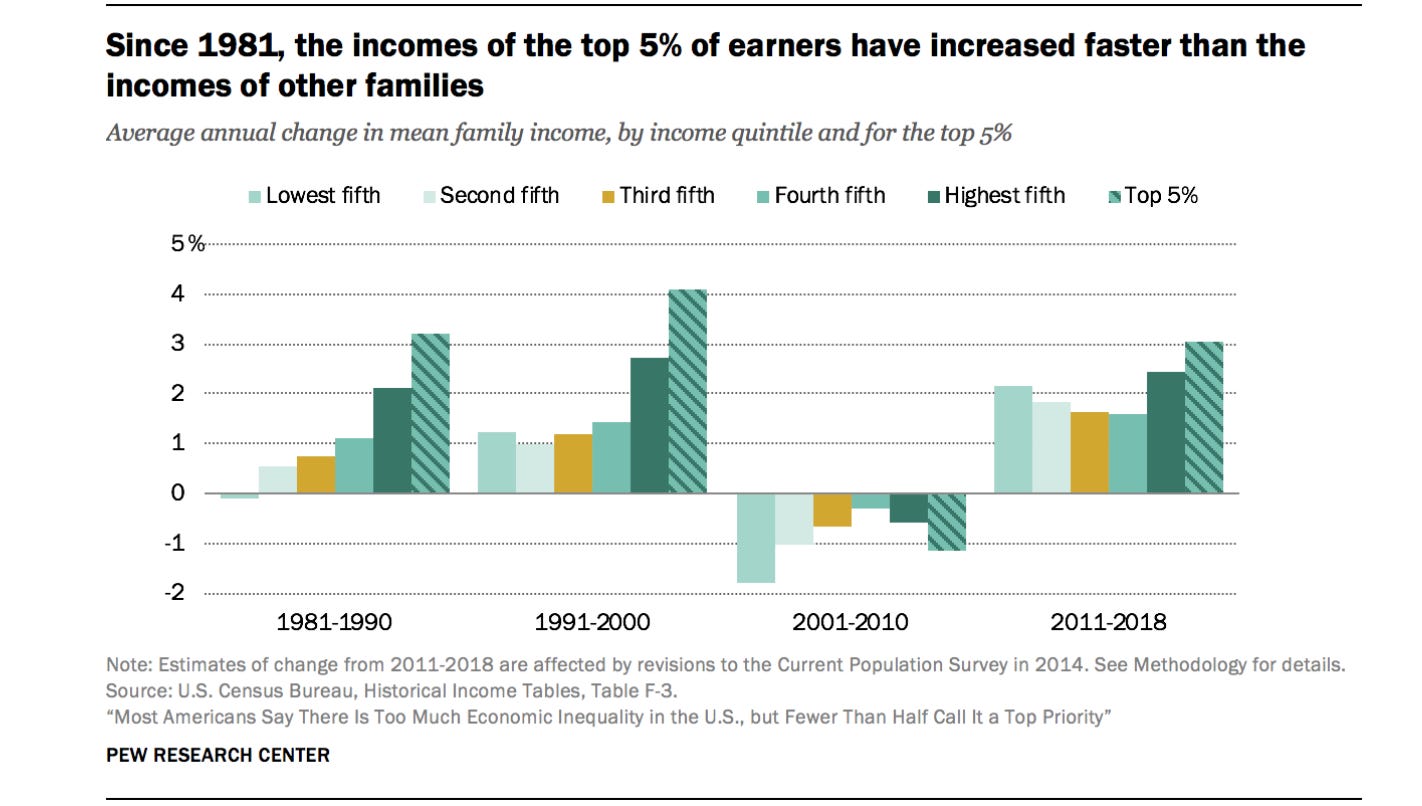
This is a critical context in examining how we arrived at the moment we now find ourselves in. It’s clear proof that, regardless of the economic climate, the top 20% of earners have consistently seen their wealth grow, except during the 2008 financial crisis. You will note that the top 1%, who hold 29% of total household wealth as of the second quarter of 2025, are not isolated in the above statistics. Neither are the top 10%, which is important in the context of this conversation, as they hold 67% of total household wealth, leaving the bottom 90% having just 33%.
There is a critical message in the above graph, and that is that NO Democratic administration since 1981 has taken any strident steps to reduce this wealth gap more than Republicans. This, my friends, tells you that both parties appear to have been representing the interests of the wealthy rather than those who elected them to serve. The only gold star that Democrats can claim is that they screwed their constituents a little less than the Republicans.
To be in the top 1% in the US, you are estimated to have a net worth of between $11 billion and $13.7 million. Based on mid-2025 data, this number totalled approximately 3.4 million people; their collective wealth grew by $4 trillion in the last year alone to $52 trillion as of October 2025. Since the pandemic, the wealth of the top 0.1% has almost doubled, reaching over $23 trillion.
As reported by CBS News:
The surging wealth at the top has created an increasingly bifurcated consumer economy, with the wealthy accounting for a growing share of overall spending. Consumers in the top 10% of the income distribution accounted for 49.2% of consumer spending in the second quarter, marking the highest level since data started being compiled in 1989, according to Mark Zandi at Moody’s Analytics.
As I have discussed previously, the extraordinary wealth at the top has now become the key driver of consumer spending, so once again, this is distorting the state of the US economy because Trump is creating a narrative where the claim is that consumption remains strong, when this is only the case for the top 10% of earners who currently account for 49.2% of consumer spending. Let’s not forget that the same top 10% hold over 87% of corporate equities and mutual fund shares. The stock market is essentially their playground. To summarise, 34 million Americans hold 67% of the wealth in America, leaving 306 million to fight over the remaining 33%.

This level of inequality is the stuff of the French Revolution, and that has not gone unnoticed by those at the top. I have heard more than one discussion of their fear that the current inequality may lead to what they term ‘a socialist revolution’. While those at the top are spending like drunken sailors, those at the bottom are now being forced into the hands of ‘Buy now, pay later’ platforms for everyday essentials. Their fall into economic slavery benefits the rich still further, as they capitalise on economic despair, which is now a market expected to grow this year to $122.6 billion. It is essentially a wild west extortion racket perpetrated on the vulnerable that operates largely outside traditional banking systems.
Thirty per cent of US consumers take advantage of the facility, but the most worrying statistic is that 25% of BNPL users are now funding grocery purchases with these loans, which is an 11% increase from 2024. This will clearly grow yet further as Trump’s tariffs and higher energy prices rise in his endeavour to give tax breaks to the very people who run these extortion rackets, and just as the icing on the cake, he has gutted the agencies set up to police these loans.
I can’t think of a more sickening example of how this administration is complicit in imposing misery on those who are finding it increasingly difficult to survive in America today. To add insult to injury, BlackRock are buying up trailer parks in preparation for Americans being forced off the conventional property ladder and into trailer park accommodation. This is before we discuss how 401(k)s are being opened up to the private equity sector. Trump is creating a perfect storm to create a 21st-century economic slave population, with the White House becoming the ‘big house’ on the new American plantation.
Before you tell me that the top 10% have worked their socks off to breathe the rarified air of obscene wealth, be mindful that nearly 38% of the top 10% inherited their wealth, and when it comes to the billionaire class, that number rises to 60%, so it can’t be said that this is solely the result of hard work chasing the American dream. To a much larger extent than they would have you believe, many of them are merely the beneficiaries of inherited wealth.
Before we continue, let me be clear: I have no problem in principle with hard-earned wealth and the rewards it brings; what I do have a problem with is stolen prosperity and wealth gained through the extortion of those denied the dignity of a fair wage for a fair day’s work. This brings me to a simple question: why did this administration CHOOSE to deny healthcare and food assistance to the working poor and the vulnerable to give a taxpayer handout to those that already hold 90% of the country’s wealth? It’s not an unreasonable question.
As the headline read from the Economic Policy Institute report on July 2nd 2025:
The radical Republican budget bill steals from the poor to give tax cuts to the rich.
The bill is designed to cause a shocking upward redistribution of income. It includes draconian spending cuts—mostly to health care and food assistance for children and families—in order to give massive tax cuts to the wealthiest households.
The report goes on:
Because the cuts to health care and food assistance are so broad and deep, and because the tax cuts for anybody who is not already rich are so paltry, the bill will cause the bottom 40% of households to actually lose income on average.
These are NOT liberal talking points; they are hard FACTS. The fact that Republicans seek to defend the indefensible is totally irrelevant. No credible source disputes that the extension of the Trump tax cuts from 2017 will cost taxpayers $4 trillion between 2026 and 2035. The argument goes that they will stimulate growth, but there is no evidence throughout recent history that tax cuts of this magnitude have ever delivered a return on investment. Take a look at the graph below from The Centre on Budget and Policy Priorities, and you will see that no measurable growth was recorded as a result of Trump’s corporate giveaway.
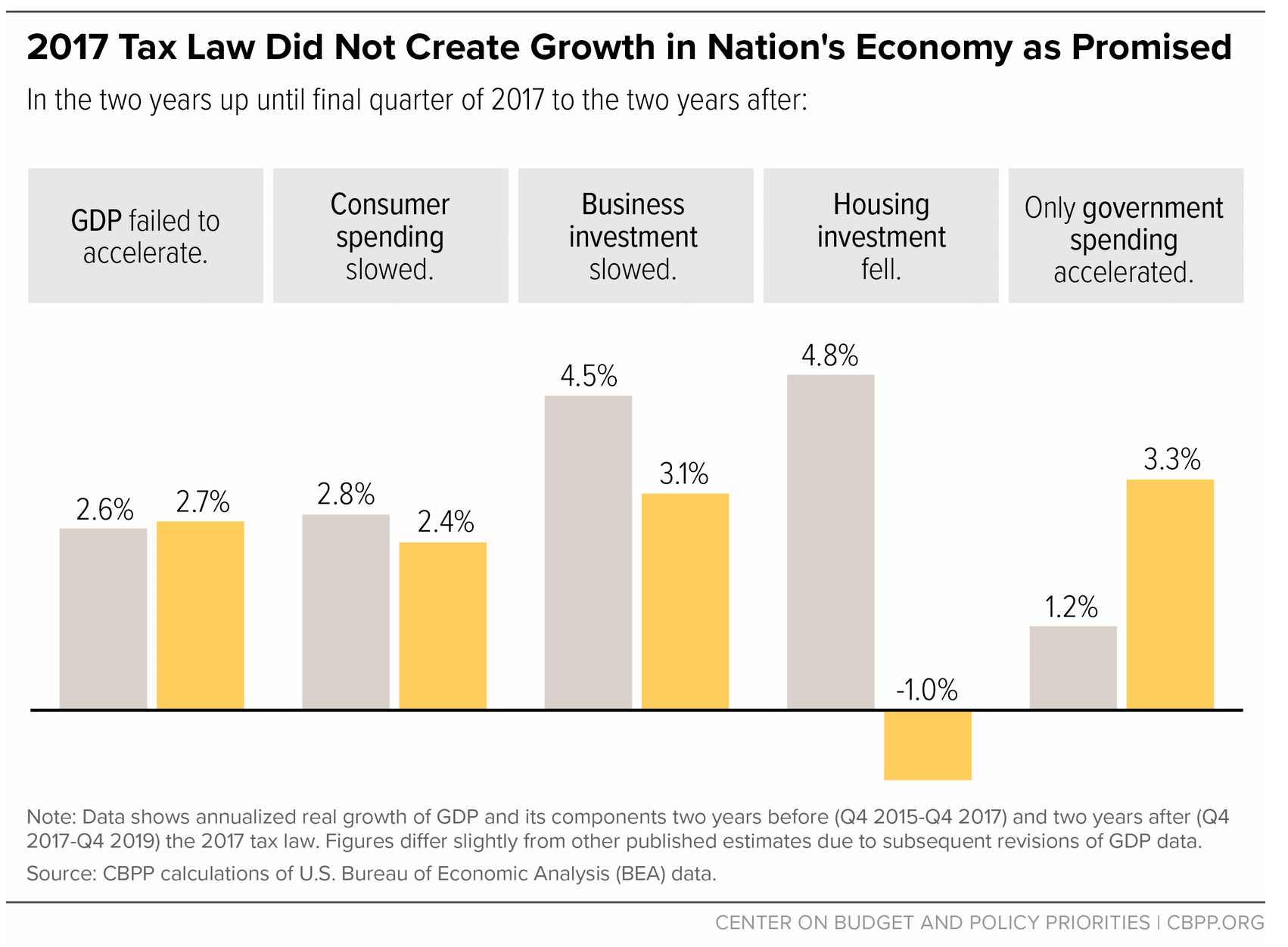
The only thing that grew was government spending, and Trump’s contribution to the national debt reached $7.8 trillion, which amounted to almost 25% of the total debt at that time, in a single term. The primary beneficiaries of these tax cuts were US corporations, which gratefully accepted them and subsequently went on stock buyback sprees to boost their own stock values. It was a con then, as it is now, and the American people are supposed to act like the obedient abused spouse and sit there in silence.
The claim is always that there’s no money because lazy Americans and those pesky disabled people want to game the welfare system; it’s a deflection tactic as old as the hills. In 2017, before the tax cuts, the top corporate tax rate was 35 per cent. The tax cuts reduced the rate to 21%, effectively stripping 14 percentage points from corporate tax revenue. As ever, Republicans falsely claimed that after the tax cuts, investment, economic activity and wages would grow; that was their justification for robbing bottom and middle income earners. The truth, however, is that as noted by Neil Weinberg in a report by the Chicago Booth Review on December 18th 2024:
An analysis of the tax cuts by Harvard’s Gabriel Chodorow-Reich, Princeton’s Owen Zidar, and Chicago Booth’s Eric Zwick finds that the TCJA has boosted investment, as well as wages and economic activity—but not nearly enough to make up for substantial losses in corporate tax revenues that have increased the deficit.
What they did was another magic act where they lowered the projected costs of the tax cuts by setting many of its provisions to expire in 2025. Then, when Trump got re-elected, they made the case for why the cost to businesses would be catastrophic if these tax cuts were not permanently extended. The lack of public awareness of this deliberate act of economic deception is breathtaking to me and an abject failure of Democratic messaging.
The researchers found:
The Council of Economic Advisers had predicted the TCJA would benefit full-time employees by up to $9,000 on average (in 2017 dollars), the researchers indicate it actually produced a wage boost that averaged $750. Long-term GDP grew by less than 1 percent annually.
The truth is that ‘trickle-down economics’ has long since been discredited as economic quackery.
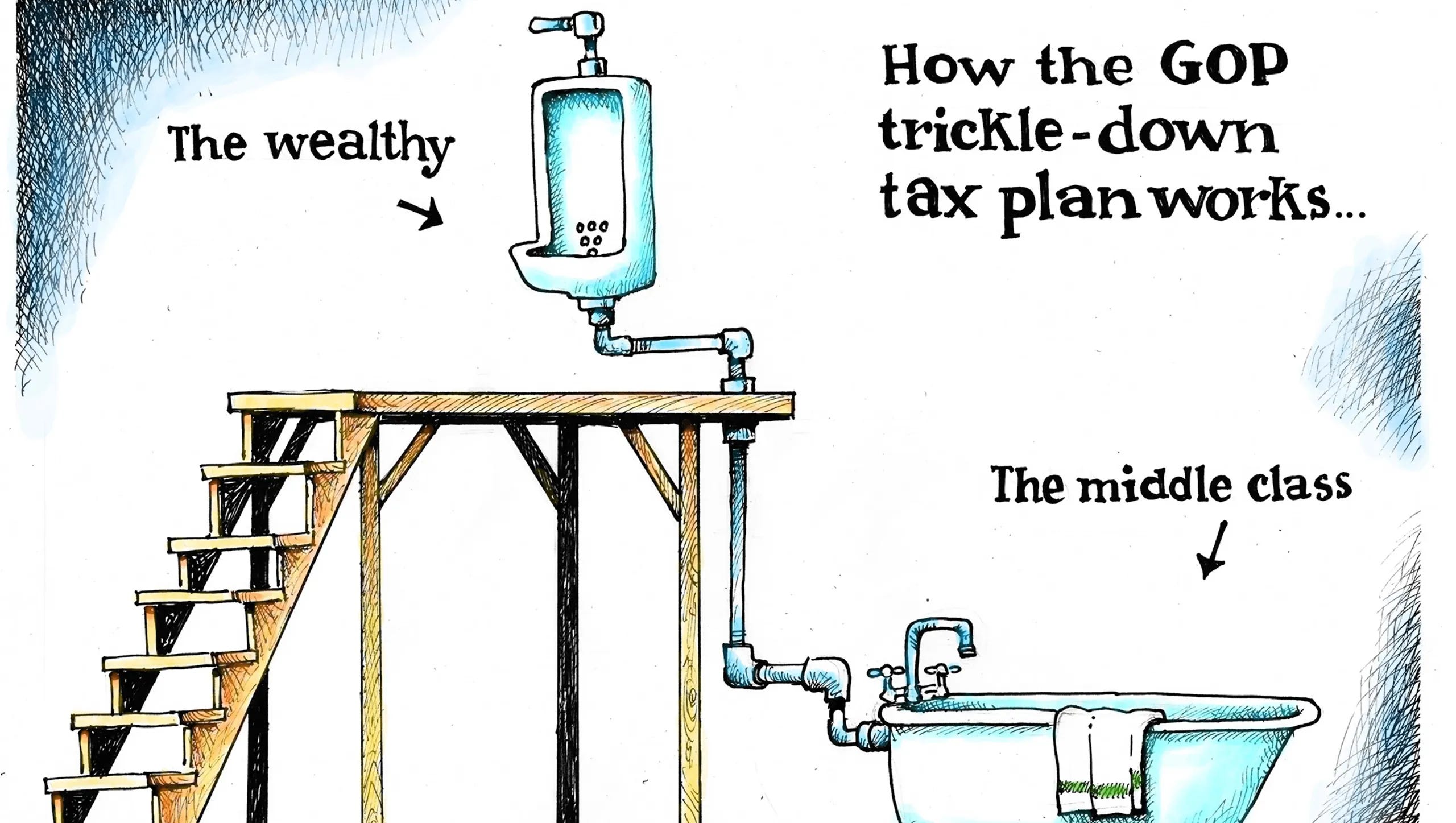
It’s an economic interference strategy designed to conceal the transfer of wealth from the bottom and middle to the top. Nobody can dispute that growth from tax cuts NEVER replaces the tax revenue lost to the treasury; it’s a fallacy, and anyone who tells you different is lying to you.
The American people are like the abused spouse of a gambling addict. Republican administrations, time and time again, speculate with YOUR hard-earned taxes to gamble on unattainable growth, and EVERY TIME it’s the poorest who pay for their acts of state-sponsored theft with critical services cut to the vulnerable and in the case of the Big Beautiful Bill, the removal of healthcare and food assistance to millions. This is not governance, it’s a criminal abdication of responsibility.
Next time, I want to delve deeper into the real impact on everyday Americans as the economic stress on the government intensifies, all while the stress on family budgets is poised to challenge them like never before.
Read PART FOUR