


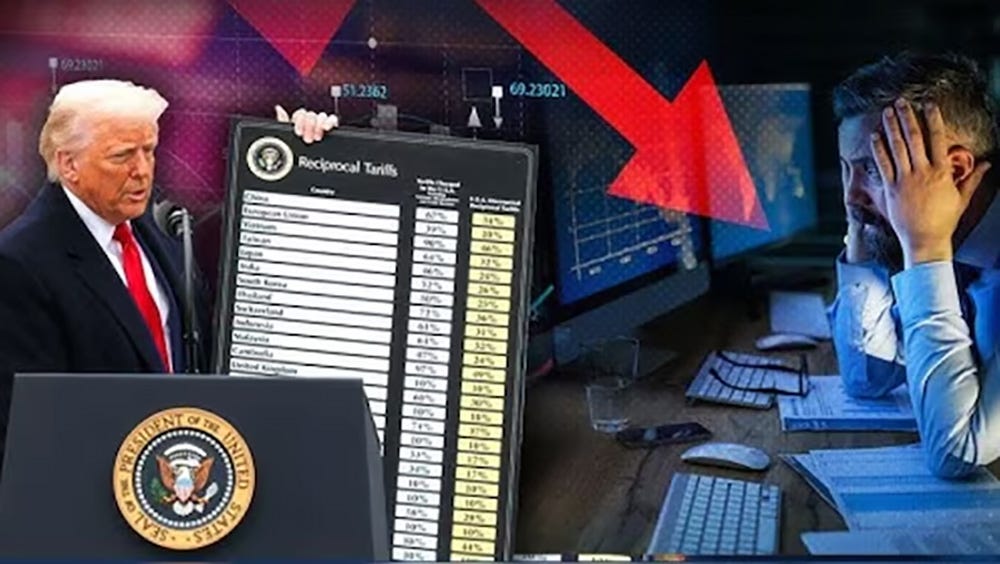
If you were in any doubt that Trump has declared economic war on the American people, it’s time to splash some ice-cold water on your face and WAKE UP. As of today, the cost of living for many Americans will rise significantly for everyday items that were previously shipped to the US duty-free, under an exemption known as the ‘de minimis rule’. It has been baked into the e-commerce experience of shoppers since online shopping became a popular trend.
De minimis is not a US term; it is a term that dates back to the 15th century, when global trade was first prevalent. It is derived from the Latin principle "de minimis non curat lex" (the law does not concern itself with trifles). Even in the 1600s, traders understood the value of frictionless trade on low-value items.
As noted by CustomsCity:
Section 321 is a statute under the Trade Enforcement and Trade Facilitation Act, sometimes called de minimis entry, that allows cargo valued at $800 or less to be imported into the United States duty-free.
The implementation of the de minimis rule dates back to the Tariff Act of 1930. Initial exemptions were—the duty-free prices on ‘personal goods’, which were increased from $1 to $5. On ‘gifts’ mailed to the US, the exemption was raised from $10 to $25. As trade accelerated, the exemption settled at $200 by 1994, until the technology revolution led the Obama administration to raise it to $800 in 2015.
Obama recognised there was a real need to meet the demands of e-commerce. As noted by CustomsCity, he had three key objectives in raising the level.
Increase the incentives for global e-commerce in the United States
Generate more economic productivity by redeploying revenue collection resources toward more efficient revenue sources.
Make the customs process more efficient to facilitate international trade and make it easier for low-value consignments to be imported into the United States, where it is shipped or physically transported.
Let’s be crystal clear. IT WORKED and has spawned millions of small businesses that have, over the years, formed the backbone of the US economy. The object of de minimis is to reduce administrative effort, labour, and time. I had thought that this was a central tenet of the Trump agenda, to reduce bureaucracy and deliver a more agile economy. This move is antithetical to that objective and eradicates a system that has served the American economy well since the 1930s.
The reality is that Trump sees just one thing: MONEY. Now that he’s fleeced American import companies, he wants to fleece everyday Americans because that’s what the removal of the de minimis rule does. It gives him access to your pocketbook. The exemption was removed from Chinese imports as of May 2, 2025. Therefore, when Scott Bessent discusses tariff revenue, he is also referring to the tax levied on small businesses importing low-value goods to America in the micro-enterprise space, as well as Chinese goods bought directly by US consumers. To clarify, this is not revenue generated from foreign countries; rather, it is tax revenue collected from Americans.
The estimated cost to the US. Consumers are not easy to measure, but it is estimated to be around $10.9 billion, according to a paper by Pablo Fajgelbaum and Amit Khandelwal for the National Bureau of Economic Research. To be clear, that’s a $10.9 federal sales tax on US consumers.
To understand the impact of removing this exemption on your everyday shopping, please take a look at the chart below, created by The Wall Street Journal.
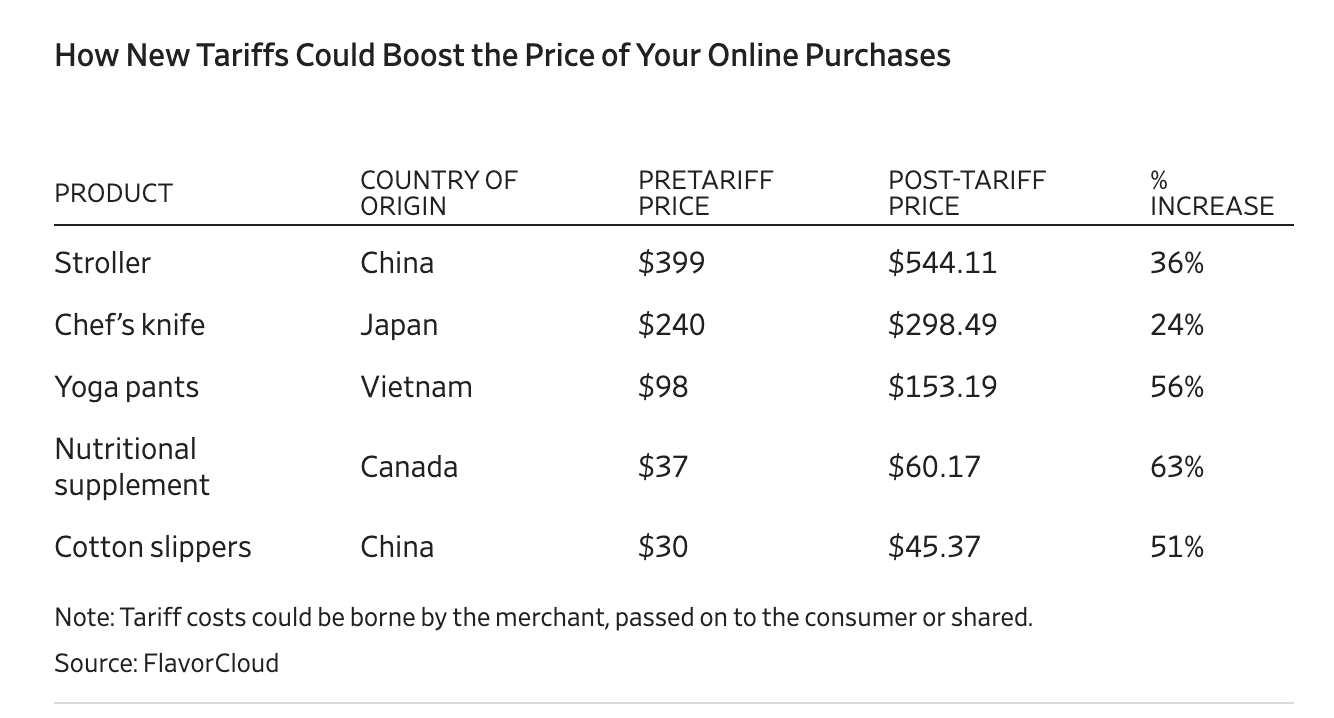
Esther Fung in the Journal reports:
The cost of ordering packages from abroad will jump. A host of merchants are halting U.S. sales. And many postal services across Europe and Asia have stopped shipping e-commerce packages to the U.S. altogether.
Parcel carriers such as FedEx and United Parcel Service are bracing for the added workload of collecting newly imposed duties, and potential confusion among consumers who are slapped with unexpected bills.
To be very clear, this is a reality as of today. I have gifted the article here because it contains essential information you need to know. When you order online, although you are ordering in the US, these orders are often placed directly with overseas manufacturers who then ship the goods to you under the de minimis exemption. This means that the price on your order was the price you paid.
As of today, this is not the case, and you should review the price to see if it includes the tariff cost (TAX). If not, you will be asked to pay the tariff before the goods are delivered to you, or you may get a separate bill for the tariff charge (TAX). It’s worth noting, as pointed out by a White House spokesperson, that in some instances, you can pay a flat fee of $80 to $200, but only for the next six months.
In some cases, the tariff charge (TAX) may now exceed the value of the item being purchased. Currently, some countries are halting shipments of what would previously have been de minimis exempt packages altogether while they develop mechanisms for handling them. In short, this upends the entire global e-commerce model, allowing Trump to tax American consumers in his effort to redistribute wealth from the bottom and middle to the top 5%.
Please think about this VERY CAREFULLY. When you buy higher-priced groceries, as are now appearing in the supermarket, and consumer goods, YOU are effectively being subjected to a federal sales tax. When you now try to buy cheap goods online to help make ends meet, you are going to face the same federal sales tax of between 15% and 50% depending on the origin of the goods you are ordering.
That’s fine, you might say, I’ll buy American goods. Firstly, be cautious of what you consider American goods. To avoid tariffs (TAX), the goods must be manufactured in the US, not assembled there, because assembled goods are subject to tariffs on any imported components. This is why American automakers are incurring billion-dollar losses due to tariff costs, as market conditions now prevent them from passing on all their costs to their customers. In short, there is no hiding from the American Sheriff of Nottingham, and there is no Robin Hood to help you out. In short, there is no escape from Trump's higher taxes on everything you buy.

The argument from the White House is that this will boost US manufacturers. No question, it removes competition from cheap imports, but what happens in a market-driven economy when you remove competition? You got it, prices go up, so the only winners are the US government, which taxes the imports, and the US manufacturer who hikes their prices. As it was ever so, the only loser is the consumer. This is really simple: The sheriff of the White House abuses you, takes your money as he pulls up his trousers over his swollen ankles and heads for the door.
Let me try to put this in the very simplest of terms: this government is economically hanging on by its fingertips because it’s generating tariff revenue by taxing YOU. This is why he’s removing an almost century-old import duty exemption. DOGE has actually cost money, not saved money. The US is drowning in $37 trillion of debt while running a nearly 130% debt-to-GDP ratio. The cost of servicing debt interest alone in 2025 is likely to exceed $1 trillion, and this is expected to rise to almost $2 trillion in the current budget cycle. You do not have to be an economist to understand that this is unsustainable. Debt costs are around 17% of total federal spending.
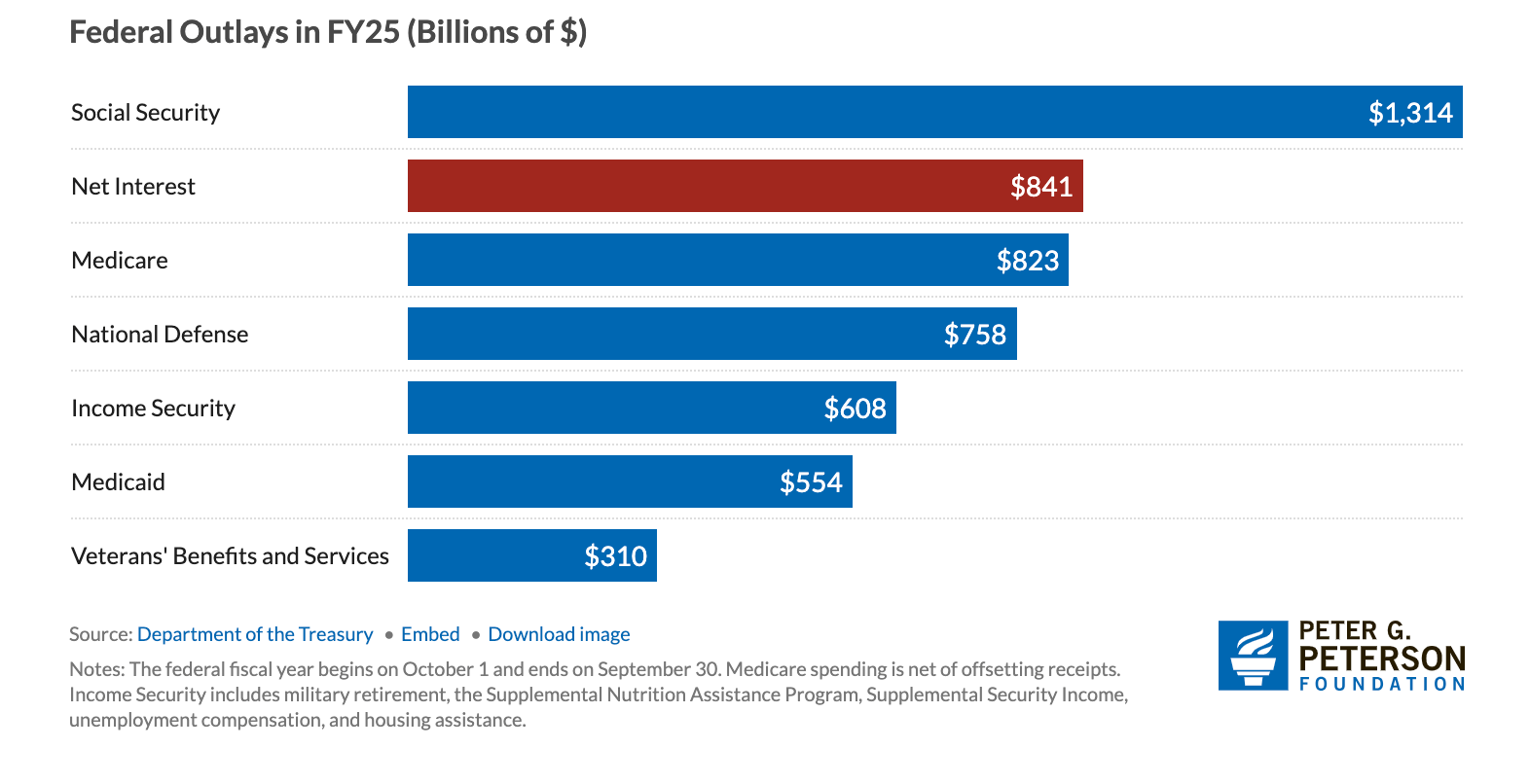
As you can see, the debt interest cost for 2025 is the second-largest federal outlay. The Congressional Budget Office estimates that Trump’s budget bill will add at least $3 trillion to the debt over the budget cycle. Most of the current debt was financed at an interest rate of between 1% and 2%. This is why Trump is beyond desperate to see the Fed reduce interest rates to 1%. The truth is that nobody trusts the stability of the US economy, so the appetite to invest in US treasuries is diminishing. As a result, Trump faces an impending crisis, as the government will have to refinance around $9 trillion before the end of the year.
Economically, this is a government wearing a fur coat, but no knickers. Trump can feel the draft, but he’s intent on you not seeing beyond the expensive fur coat. Everything is far from rosy in the economic garden, which is probably why he’s attempting to pave over it. This is an economic illusion being propped up by stealing money from Americans in the form of tariffs. The normal purpose of tariffs is to reduce imports and protect domestic production, but if he succeeds in that goal, then the tariff revenues on which he is building the economy diminish. What does he replace them with?
To make matters worse, he has bet the house on the US AI stack dominating the world, and there are warning signs that China has something to say about that. He granted export licenses to Nvidia and AMD to sell degraded AI chips to China after extorting a 15% revenue share from both companies’ sales in China. However, there is one problem: China has decided to support its domestic chip production and reject the chips on offer from the US. This was reflected in the Nvidia earnings report this week.
The reality is that China has decided to rise to the challenge and is pumping out open-source AI solutions to destabilise the market. What Trump failed to recognise is that China always plays the long game; from the digital yuan to AI, they have long-term planning in place and a strategy to win. Whether they will is another matter, but gone are the days of imitating; they are now innovating, and that represents a massive threat to the US.
As America returns to the Pony Express and stagecoach when it comes to energy production required to drive AI, China has embraced a balance between fossil fuels and renewable energy. This, along with its advances in thorium nuclear reactor technology, leaves the US significantly behind when it comes to generating the energy required to power energy-hungry AI data centres. As reported in Newclear Energy International in April 2025:
Chinese scientists have refuelled an experimental thorium-fueled molten salt reactor continuously without shutting it down. The Chinese prototype reached full operational power in June 2024, and in October, researchers reloaded fuel while the reactor remained online, a world-first. This achievement was announced recently by Xu Hongjie, head of the scientific team responsible for the thorium reactor project, during a closed meeting of the Chinese Academy of Sciences (CAS). “We are now at the frontier of global nuclear innovation,” he said
The irony here is that this technology was developed using abandoned US research—just another example of China capitalising on every opportunity.
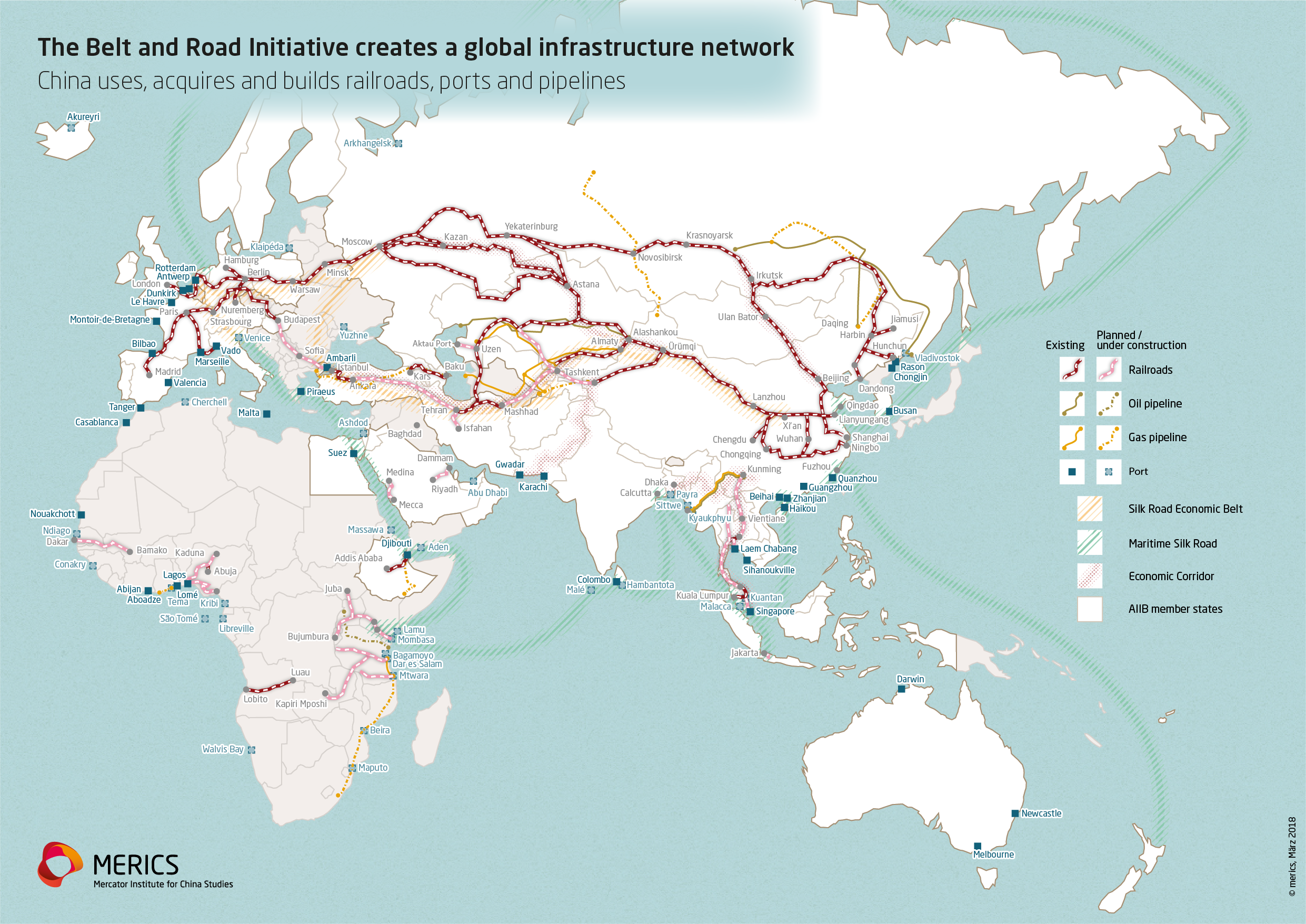
The key point is that the US is no longer in the driving seat in geopolitical terms; it has failed to invest in critical infrastructure, education and science at anywhere near the level of China. Not only that, it is now scrambling to acquire rare earth metals by attempting to extort them from countries like Ukraine and Greenland, while China refines 90% of all these minerals. It will take the US years, maybe decades, to catch up. Additionally, China’s Belt and Road Initiative has already established infrastructure-driven trading routes across all major global trading nations. All this without hardly any military projection.
What I’m trying to get you to focus on here is that in desperation, Trump is having to steal money from you, remove healthcare for 17 million Americans, and remove SNAP from food-insecure children, to fund this fantasy world of global economic domination. As he becomes more and more desperate, he needs access to more and more levers to keep feeding his addiction to control the narrative as he gambles your future on his fantasy. That’s why he is obsessed with controlling interest rates, because if he can’t, I believe there is a real chance that the US will default on its debt obligations. At that point, the 2008-style crash will start looking like an attractive option, as the alternative is beyond your wildest imagination.
My friends, the removal of the de minimis exemption today is just one piece of a puzzle that is propping up a failed president in a failing economy staring down the barrel of infamy.
Its even much worse than you know. Our small company fme lighting is really getting murdered. China has dozens of warehouses of lighting fixtures in the USA. They get free slave labor and their cost of goods is 1/5th of ours. So they ship containers of fixtures and cost them at 1/5 for the tariff. If the fixture cost me $100 with Trump tariff $160, the Chineese cost their item 1/5th of $100 = $20. Plus tariff =$50. Then they sell them for $70. My cost remember is $160., so I sell for $350.00 . I have to pay 25% taxes on the profit afer expenses. I would bet these China companies are not LLCs nor do they pay taxes. YOU ARE 100% CORRECT TRUMP IS KILLING SMALL BUSINESS WHILE CHINA IS EATING OUR LUNCH, TAKING ORDERS DIRECT AND SHIPPING FROM USA WAREHOUSES AND PAY NO TAXES ON PROFITS.
Once again, spot-on reporting--and research, I might add! I've been wondering when the national call to Wake The Fuck Up will happen.