



This is part two of a two-part series. You can read part one here
Those who have been longtime followers of my work will be more than aware of my advocacy for economic disengagement to end this tyranny. The one thing that stands out to me, from the outside looking in, is that money has become the curse of progress in the activism space.
Sadly, the monetisation of content all too often gets in the way of common objectives. I was writing about economic disengagement when few others seemed interested. The concept only really gained traction when social media-based organisations began running economic strike campaigns. Predictably, it then became a competition to see which group could gain the most engagement. The result was a lack of a centralised campaign to bring people together for a common goal. That’s when I stepped back because many of these attempts were not thought through. Advocates suggested that people skip work during ‘sick day’ campaigns. Of course, there were also calls for a general strike.
While I am sure these were well-intentioned attempts at economic activism, they had the potential to create more problems than they solved. In comfortable Western democracies, we breathe the rarified air of freedom for all its faults and failings. We have created an instant-gratification society in which inconvenience has become a barrier to participation. This is why I believe no economic action to date has had any meaningful impact. For many, if there’s no instant fix to the problem after having been inconvenienced, they lose interest. That’s EXACTLY how the system is designed to work.
Smart Campaigning
This has to be about smart campaigning, not shotgun activism that demands an instant result. There is an assumption that if millions take to the streets in protest, things will change. Well, I think it’s pretty evident that unless it’s happening every day and disrupting the economy, it’s simply performative activism that makes people feel good and makes for great social media. There’s nothing wrong with that, as long as people understand the limitations of one-off protests.
Sustained Street Protests
If 8 million people were on the streets every day for a month, then I dare say the regime might sit up and take notice, but I suspect that before the month was up, the army would be on the streets, Trump having declared martial law. The bottom line is that the risks to public safety are too great for sustained protests like those we saw in the 2011 Arab Spring. Do I believe the No Kings protests should stop? Absolutely not. They play an important role in raising awareness and providing motivation; they are just incapable of moving the political dial.
General Strike
There is no question that, throughout history, general strikes have proved highly effective in delivering change. Even strikes in specific sectors have resulted in better working conditions, higher pay and benefits. Strikes were driven largely by the Trade Union Movement, and this did not escape employers' attention. In 1954, trade union membership stood at 35% of the workforce. By the mid-2020s, it stood at around 9%. Below is a chart showing the decline in union membership from 1983 to 2023.
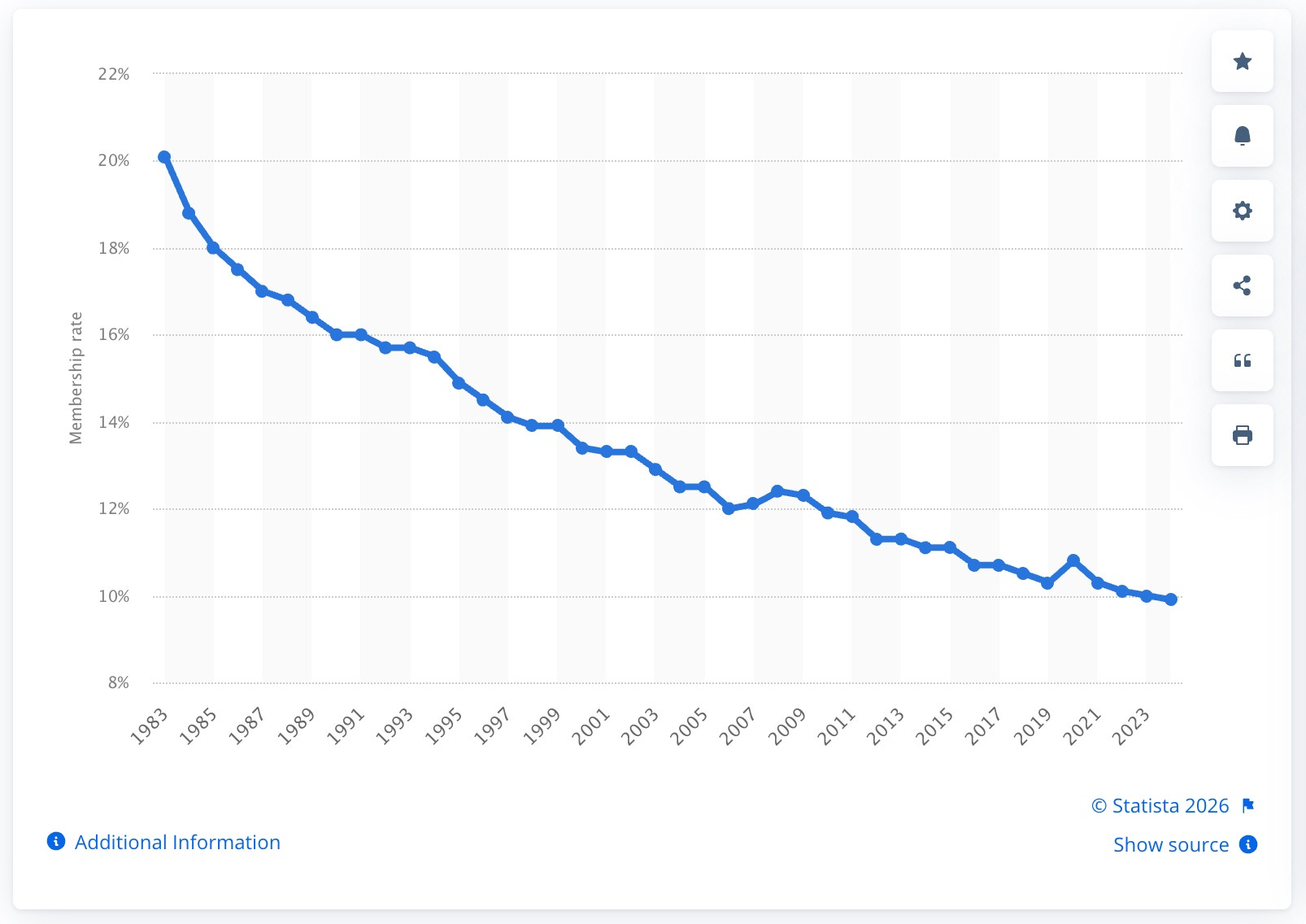
Organising a general strike without unions is all but impossible, and that’s why the oligarchs have worked extremely hard to eradicate them from the workplace. It’s the same reason healthcare in the US is linked to employment. It’s all about control and limiting the options to challenge the system. Previous calls to action, I believe, failed because of some breathtaking naivety on display from activists who really should know better. This is not a political vanity project; it’s about impact on ‘real lives’. I become angry when I see what we in the UK call ‘champagne socialists’ who sit in their comfortable homes with their well-paid jobs, sending the poor and the low paid over the top of the trenches to sacrifice their jobs at the altar of left-wing political ideology.
At a moment when employers are seeking to trim payroll, it is the height of irresponsibility to ask people to risk their jobs for the cause. AI is screaming down the track with the sole intent of decimating workforces across most sectors, and frankly, political idiots asking people to become pointless sacrificial lambs is wrong and unacceptable.
The power of your purse
As stated in my previous post, the bottom 90% account for $2.75 trillion in consumer spending in a 70% consumer-driven economy. It doesn’t take a rocket scientist to understand that this represents awesome economic power in the hands of an organising team prepared to weaponise it. The secret to deploying this weapon is so simple it’s scary. The objective must be to isolate any action from government intervention to prevent its diffusion.
What we are talking about here is a no-risk action, safe from attack by the usual forces present at a public protest, i.e., the National Guard, ICE, or law enforcement. This is the power to defeat a government silently, by starving those funding this tyranny of the fuel they need to continue this war against the American people. It’s about attacking the economic supply lines through economic nonparticipation.
To be effective, it has to be a centralised campaign that is simple to participate in, with a unified goal, not just to choke the economy, but to do it in a very specific way that commands public attention and encourages mass participation.
Let’s explore how we structure the campaign. I believe that the very first step is to target just one high-profile streaming service. We learned in 2025 that mass cancellations of subscriptions forced Disney to capitulate to consumer demands. I need you to bear with me because the plan is MUCH bigger than this initial shot across the bow. The purpose here is simply to conduct a messaging and awareness exercise to bring the campaign to public attention. I would NOT target Netflix, because I have plans for them downstream.
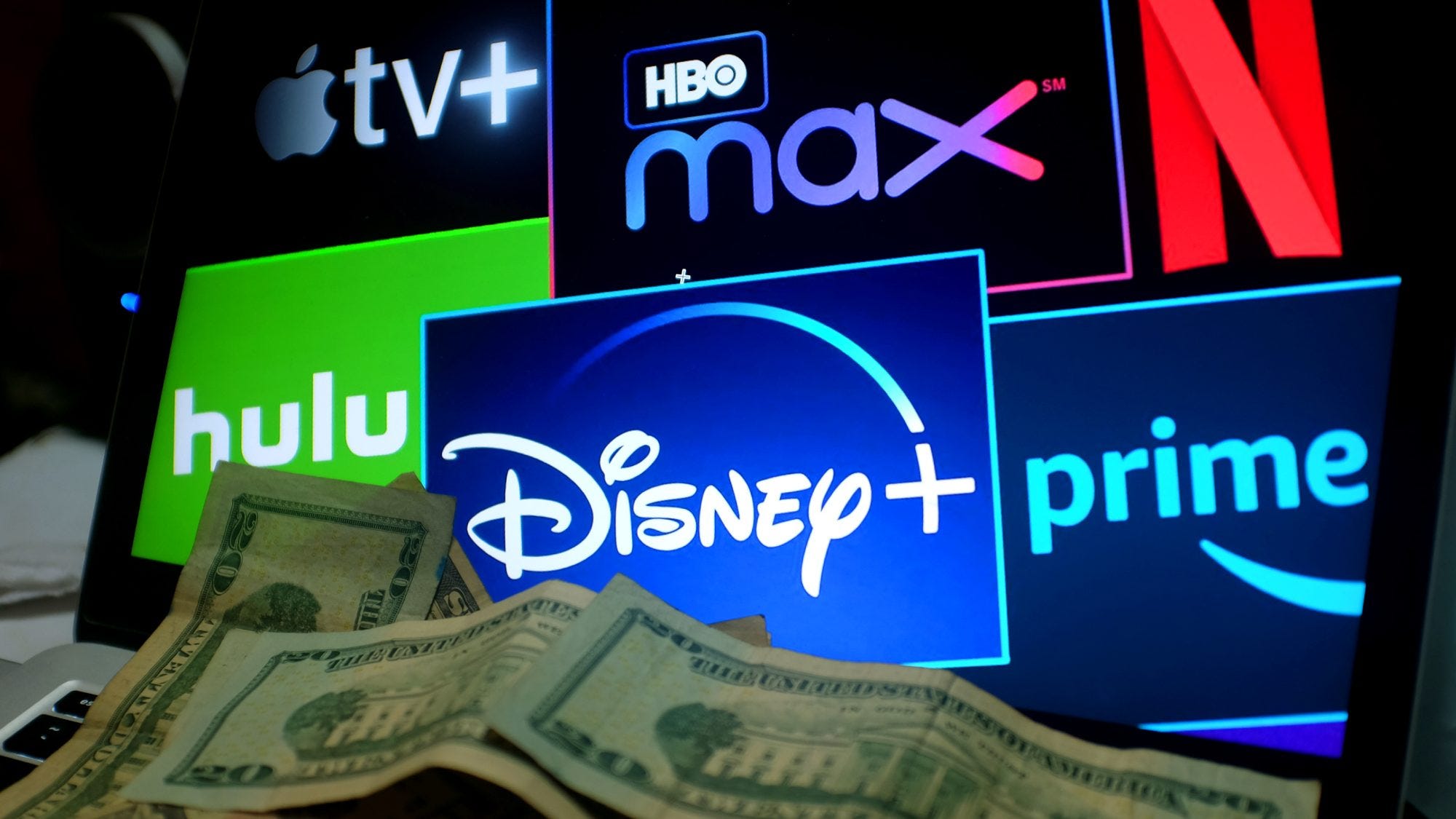
I can guarantee that as soon as a major streaming service is targeted, mainstream media will not be able to resist covering it, raising the profile of the campaign. It’s a quick win that allows preparation for the next step in the background. It also allows participants to focus on a single initial objective, so divide-and-conquer can play no part. One target, one aim, and a loud message that says, ‘How far would you like us to go, because we’re just getting started.’
A Targeting Operation
Meanwhile, in the background, it’s about convening a targeting team. I know Scott Galloway is a controversial character in the eyes of some, but he is already heading up an important initiative called ‘Resist and Unsubscribe.’ For context, when I originally started writing about economic disengagement, Scott had not yet lent his weight to the argument. Given that he has a much higher profile and has built a project targeting the tech giants, I believe he’s the perfect ally to build on what he’s already established. If you listen to the clip below, he is absolutely right in his assertion that, in the case of Disney, while cancelled subscriptions did have an impact, the biggest impact came from publicity and damage to brand reputation. Hence, my suggestion is to pick a streaming service as a primary target.
I’ll be reaching out to Scott with this piece directly to see what he thinks. In my view, there’s no point reinventing the wheel if a mechanism already exists. He and people like Robert Reich can help identify targets that will have maximum impact, and once critical mass is achieved, it’s about having a negotiating team to do what the Democratic Party has been unable to do because it’s funded by the same corporations that need to be targeted.
If we assume this is something Scott and others with the skill set to target the regime's soft belly can do, then all that remains is to drive critical mass participation. My goal would be to go beyond what Scott is doing to also focus on the broader economy, which is why a conversation might be useful.
The Magic Sauce
The magic sauce here is a centralised attack operation in which social media is just used as a vehicle to generate site traffic. It’s all about driving the critical mass participation required to achieve the goal. The mission-critical objective is to create a messaging campaign that key social media influencers use to drive traffic to the site, from where centralised instructions can be provided. I’m pretty confident I could bring together a coalition of influencers to work toward this common goal.
The challenge is not if this can work; it absolutely can. It’s about the inconvenience caused to those participating, and I fear this is the larger obstacle. The technical ability to deliver the economic blow is already in place, but mass participation is the key to unlocking success. While Scott’s model is very specific in its targeting of the ‘magnificent 7’, my plan is broader in scope, focusing on wider economic disengagement. It’s this, in my view, that would accelerate the process. The great thing about not pressing the ‘buy now’ button is that you can’t be assaulted, arrested or targeted for not pressing it. It’s bloodless activism at its best.

My suggestion would be a halt to spending on high-ticket, high-margin purchases. To be clear, this is not about stopping spending; it’s about deferring spending until the goals of the campaign have been met. White goods, vacations, new car purchases, mobile phones, home renovations, non-essential flights, etc. It’s all about spending the bare minimum. Not only is this effective, but it also keeps money in your account when savings are essential for survival right now.
Examine a proposed purchase and ask if it can wait for a month or so, shift spending from online to support local businesses and services. There’s no reason to stop ordering in, but limit it to local businesses and avoid big delivery services. Go out to dinner, but focus on mom-and-pop restaurants. At a time when budgets are already being squeezed, I know that many are already being forced to spend less, so please don’t assume I think everyone can contribute equally to the fight. People are in this together.
While Scott’s project focuses on market cap, my proposal focuses on reducing consumer spending by 3-4%; together, they make for a perfect two-pronged attack. It was this concept of economic disengagement that led to my initial concept for the Political Truth Portal in 2025. A single point of reference for fact-checked public information and resources, which incorporates an activist hub for ‘people first’ activism. This project is a perfect fit. If you want to read more about it, I’ve linked a piece below.

Solutions require strategy, and I’ve spent considerable time exploring how various ideas can be brought together to add value to this fight. Above all, it’s about establishing trust, which is hard-earned and easily lost. My work here has transformed from a place to record my thoughts on the day's events into a passion for helping move the dial.
I was grateful to Keith Sander, who commented on part one of this post. He wrote:
“Martin, you are unfailingly modest and hesitant to ask for more than that folks subscribe to your commentary, but once we’ve done that, we absolutely need a prominently visible DONATE button to support you more strongly. Thank you for all your efforts.”
My response was in part:
“…I am very mindful that many are finding it difficult to survive let alone support what I do. It’s imperative to me that nobody feels any pressure from me to contribute, because I’m not here to make money I’m here to deliver FREE fact based commentary and reporting that helps people make informed political decisions.”
While this has always been, and will continue to be, my position, paid subscribers and donations do help cover important research and development costs. There will never be any pressure from me, but for anyone who would like to and can afford to donate, I’ve included a button below. I’ll put it at the foot of my pieces moving forward, if that’s OK with everyone?
I see it as a personal responsibility to refuse to participate in a consumer driven society. The nonstop bombardment of advertising has reached new levels of absurdity. Corporations are predators. Most Americans live beyond their means. I see young men buying $80k pickup trucks for no reason. I see women ordering online almost daily. Its easy, its convenient, but its not cheap. The end result is massive debt and indentured slavery. All anyone needs are the basics. Everyone deserves the basics. Life is about relationships. Not material stuff. I feel our entire country has been brainwashed to buy, buy, buy.
Decades ago in san francisco a lovely human gifted us craigslist. That was the perfect site until people ruined it. Nextdoor was beyond a poor substitute. We need craigs again like it was in the beginning, we can repurpose and collectively organize far better if we have better platforms available.